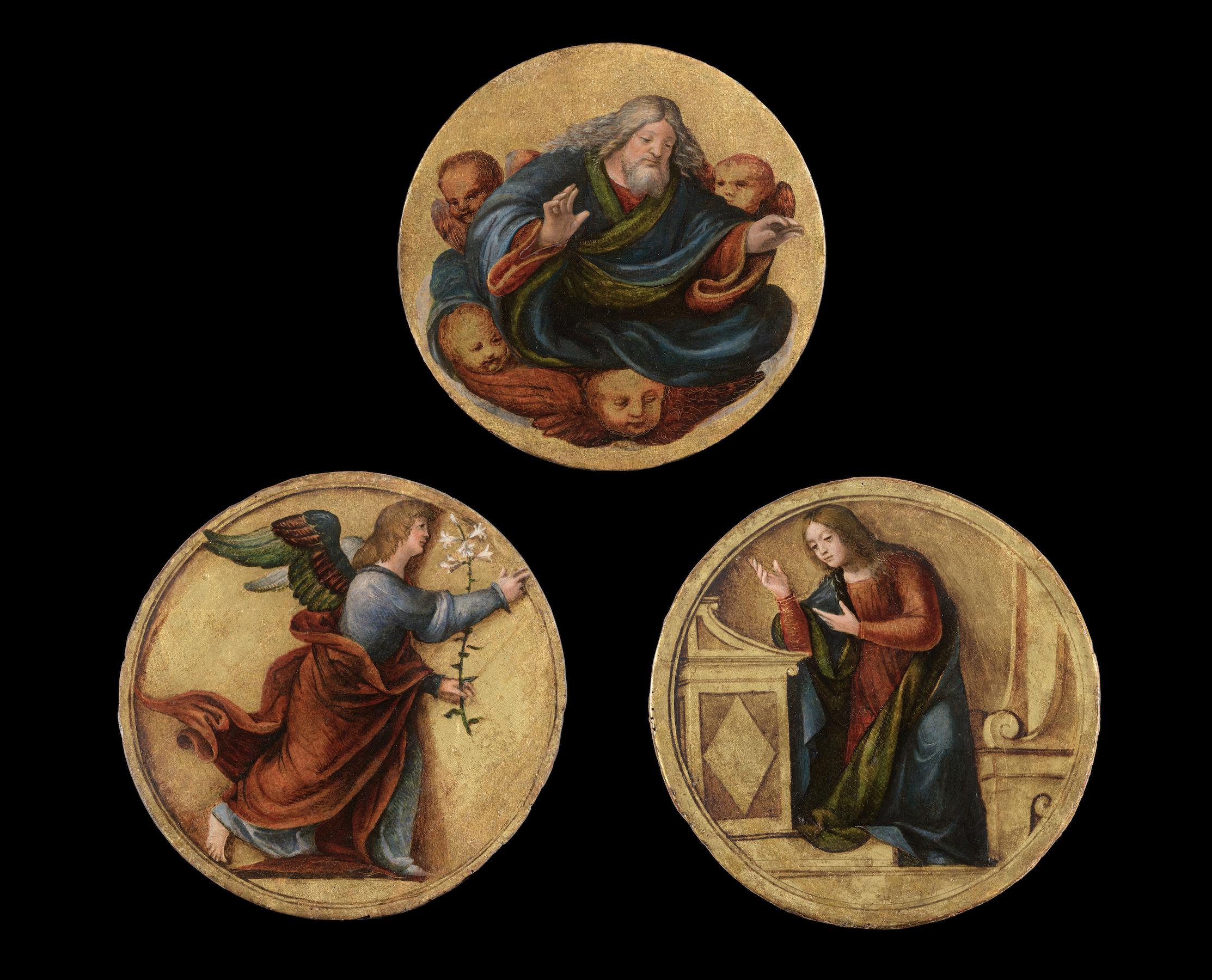


Bernardo Zenale
b. 1460, Treviglio, Italy
d. 1526, Milan, Italy
Three Panels Depicting the Annunciation with the Blessing of God the Father
c. 1515–18
Tempera on panel
D: 23 cm (9 1/8 in.)
D: 23 cm (9 1/8 in.)
D: 22 cm (8 5/8 in.)
Provenance
Literature
M. L. Ferrari, ‘Lo Pseudo Civerchio e Bernardo Zenale’, in Paragone, Florence, 1960, pp. 34-69.
M. L. Ferrari, ‘Zenale, Cesariano e Luini: un arco di classicismo lombardo’, in Paragone, Florence, 1967, pp. 18-38.
P. Astrua Loiacono, ed. P. M- Cionini Visani ‘Uno Zenale a Padova’, in Scritti di amici, Turin, 1977, pp. 44-47.
M. L. Ferrari, Studi di Storia dell’Arte, ed. A. Boschetto, Florence, 1979, pp. 47-80, 153-170.
G. Carlevaro, ‘Materiale per lo studio di Bernardo Zenale’, in Arte lombarda 1982, pp. 88-89.
P. L. De Vecchi, ed. P. L. De Vecchi, J. Shell, ‘Opere attribuite, Bernardo Zenale’, in I pittori bergamaschi. Il Quattrocento, II, Bergamo 1994, pp. 445.
Description
Together these three roundels represent the Annunciation, and were likely originally conceived to adorn the upper tier of an altarpiece. When the tondi appeared at action in Milan in 1963, it was suggested that they came from the chapel of Cascina Pozzobonelli in Milan, whence they passed into the collection of the architect Luca Beltrami and, from the heirs of the latter, reached the art market. It has not, however, been possible to confirm this hypothetical link, though Beltrami did indeed work on a project at Pozzobonelli, the remains of which constitute one of the most interesting examples of Bramante's architectural influence in Milan. The villa at Pozzobonelli was built at the end of the fifteenth century by Gian Giacomo Pozzobonelli, who belonged to an ancient Milanese family (owners also of the beautiful palace in Via dei Piatti in Milan, also by Bramante) then attempting to assert their status and further their prestige at the court of Ludovico il Moro. The subsequent history of the family merits further investigation, and might indeed shed light on the patron who commissioned the three paintings, which can be dated in the second decade of the sixteenth century.
When the works were presented in the Finarte auction catalogue in 1963, three important scholars weighed in on the attribution. Enos Malagutti, Giovanni Testori and Carlo Volpe advanced the opinion that the works could be attributed to the late career of Bernardo Zenale, the subject of a recent study by Maria Luisa Ferrari in 1960, who restored to Zenale's maturity a corpus of paintings until then attributed to the so-called Pseudo Civerchio. Ferrari herself, in another article dedicated to Zenale in 1967, published the three panels and placed them near Zenale’s Deposition in San Giovanni Evangelista in Brescia. In 1977, Paola Astrua questioned their place in Zenale’s corpus, though Giovanna Carlevaro in 1982 gave them back to the master, admitting, however, that she was unable to date them. The most recent mention of the paintings dates to 1994, when Pier Luigi De Vecchi gave a further negative opinion, though on the basis of the images only.
A further step forward made by Zenale studies was the discovery in 2002 of a deed that records the payment given to the artist for having painted the Busti altarpiece, a large panel once in Santa Maria di Brera and today in the picture gallery bearing the same name, a work whose attribution had long oscillated between Bernardo Zenale and Bernardino Luini. The altarpiece is dated 1515 on the step of the throne, while the deed is dated 1518, a fact that allows us to delay the conclusion of the work by a few years. Thus, the document establishes that, contrary to earlier thinking by various scholars, Zenale did not stop painting at the beginning of the second decade of the sixteenth century to devote himself exclusively to architecture, but rather continued to work as a painter. A reassessment of this later period was undertaken by Stefania Buganza in 2006, who placed the present three panels into this phase of Zenale’s career, drawing comparisons, in particular, with the Busti altarpiece and thus suggesting a date for the works around 1515–18. For example, the face of the Annunciate Virgin in the present set compares well with that of the Madonna in the Busti altarpiece, while that of God the Father correlates nicely with Saints James and Philip. The drapery throughout the present panels, similarly conceived to those in the Busti altarpiece, and the chromatic range, absolutely identical, are also indicative of contemporaneity.
Consequently, Buganza has hypothesized that the present panels might have come from a cornice once crowning the Busti altarpiece. The history of the Busti altarpiece between the sixteenth and early nineteenth centuries follows that of the church for which it was created, Santa Maria di Brera. The mother house of the Humiliati passed, with the suppression of the order in 1571, to the Jesuits, who were in turn suppressed in 1773. At the beginning of the nineteenth century the church was sacrificed to the needs of the Napoleonic government, which wanted to use both it and the adjoining convent to house the now-famous art gallery. It was then that the altarpieces in the church were moved, many destined, like the Busti altarpiece, for the art gallery, others for different ecclesiastical institutions throughout Milan and Lombardy. Thus, a list numbered B27 in the Brera’s archives, dated between 1812 and 1822, is of the utmost interest. Among the items included are three paintings by "Incerto" with "L'Angelo Annunciante", "L'Annunciata" and "Il Padre Eterno", listed at nos. 288–90 as canvases (though not panels, but this could be an oversight) entrusted on 9 October 1819 to the Liceo di Sant’Alessandro in Milan, the current Liceo-Ginnasio Cesare Beccaria. The recently inventoried archives of the Liceo Beccaria certainly merit further investigation in this regard.