
Nicolas Henry Jeaurat De Bertry
b. 1728, Paris, France
d. 1796, Vermenten, France
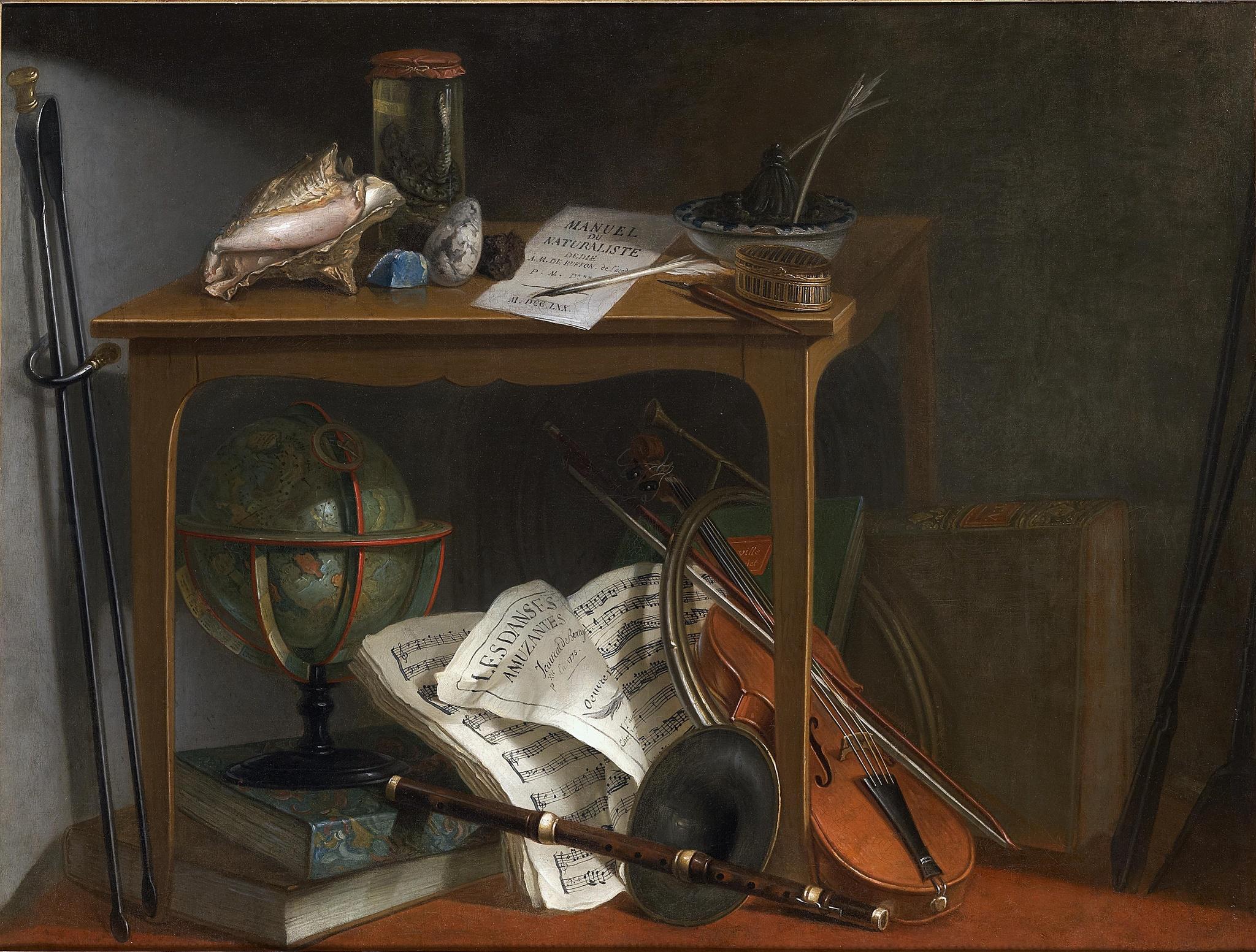
Still Life with a Naturalist Manual and Objects Resting on a Table above a Globe and Musical Instruments
1775
Oil on canvas
89.5 x 117.5 cm (35 1/4 x 46 1/4 in.) each
With frame: 112 x 141 x 6 cm (44 1/8 x 55 1/2 x 2 3/8 in.)
Literature
Michel and Fabrice Fare, La Vie Silencieuse en France, La Nature Morte en France au XVIIIe siècle, Fribourg, 1976, p. 200, fig. 304 and 305, described as ‘Le Desordre d'un Cabinet sert de thème a Jeaurat de Bertry dans deux compositions traitées librement en devants-de cheminée. L'une signée et datée de 7775 assemble maints objets sur une table: coquilles, silex, serpent dans un bocal, Manuel du naturaliste dédie a M. de Buffon nous avertissent sur les goûts de I’ amateur. Sous le meublée sont entasses un globe et des volumes dont un livre de musique avec pages froissees : Les danses amusantes, un violon, un cor, une flute. L'autre devant de cheminée, signe et date 7777 est compose, en trompe I'oeil, d'un fauteuil et d'un bureau de marqueterie ; sur le bureau sont posés un bougeoir, un encrier et différents objets : oraison funèbre, dictionnaire de I’ industrie, lettre adressée a Monsieur Duchesne, contrôleur des rentes, rue Saint André des Arts.’
Description
his uncle, the painter Etienne Jeaurat. Above all, the young artist excelled at still-life painting,
where he managed to capture the objects of daily life, (if a privileged one,) with a detail and
vitality reminiscent of the genre’s master, Chardin. It was with his still-lifes that Jeaurat the
younger established his reputation. Remarkably, Jeaurat dit de Bertry was both nominated and
accepted, by verbal agreement of the assembly, for membership in the Académie Royale de
Peinture et de Sculpture on the same day, 31 January 1756. His submissions for acceptance were
two still lifes: one depicting kitchen implements (Paris, École des Beaux-Arts, formerly Louvre)
and the other military trophies (Château de Fontainebleau.)
The following year, the artist presented three works at the Salon of 1757. All still-lifes, they
depicted a group of musical instruments, an allegory of war, and one of science. A critic from
October’s Mercure observed ‘On a vu avec plaisir trois tableaux de M. Jeaurat de Bertry; ils sont
d’une belle imitation et bien groupés.’ Though the locations of the latter works are for the present
unknown, a painting today in the Musée Carnavalet, signed and dated 1756, of musical
instruments, would appear to be the first of these three Salon paintings. At one time mislabeled
Chardin or de la Porte, a few still-lives in the Réunion Musées Nationaux (Cambrai for example)
have been recently reattributed to Jeaurat de Bertry, one even containing his J.B. monogram.
Whether in Trophée de Chasse (Paris, Pardo Collection) or Trophée des Arts, the artist
dramatically arranged near-architectural compositions, while the individual objects there-in
together communicated a subject that, at its most elaborate, functioned on the same level as
contemporaneous 18th Century figurative allegories. A kitchen interior replete with eggs, fish,
vegetables and wine becomes an allegory of Abundance; an assembly of a sword which draws a
horizontal harmony line across the canvas, a drum, sashes and pistols becomes an allegory of War
in the artist capable hands; an allegory of the hunt shows not a pile of dead birds, but a hare,
partridge, and rifle resting as if laid against a tree by their hunter, and an animated parrot, symbol
of the soul and of sound, holding two cherries.
With recognition and a flourishing career, in 1761 the artist was named painter to Marie
Leczinska and moved his residence from Paris to Versailles. Henceforth Jeaurat de Bertry was
able to sign letters with the title peintre de la Reine, his job described as ‘pour l’amusement de
cette princesse dans l’art de la peinture.’ Upon the queen's death in 1768, he returned to Paris
and remained there for all but a second four-year sojourn at court.
During the French Revolution, Jeaurat concentrated on portraiture, some of a veiled satirical
nature, as well as allegorical constructions that featured portraits, the tricolour, pyramids and the
Masonic eye.
In the pendant paintings here Jeaurat de Bertry has captured the feeling of the day. In the first of
the pair of devants-de cheminée an inkwell and quill sit next to a naturalist manuel clearly related
to the snake in formaldehyde, large conch shell and rocks and turquoise. Below them, an astral
globe sits on large books, behind a flute, French horn, violin and sheet music entitled ‘The
Entertaining Dances.’
In the second of the pair a classical style bust of a woman sit on the brick floor of a fireplace next
to a wicker basket of sheet music (on one sheet of which the artist has again signed his name.) A
marquetry desk above, with a an unlocked drawer enticingly open, supports a four-pot inkwell, a
half-burnt candle, and various papers; these include an oraison funèbre (?), a dictionary of
industry, and a letter to a Paris landlord.
Together they capture a zeitgeist conflict of the artist’s time – as educated individuals grappled
with Rousseau’s naturalism and political theory, rapid advancements in both technology and
industry, and questioned where in this modern world traditional values, such as accorded the arts,
(and later the monarchy.) His answer, like the still-lifes’ compositions, appeared to be balance.
The artwork described above is subject to changes in availability and price without prior notice.
Where applicable ARR will be added.