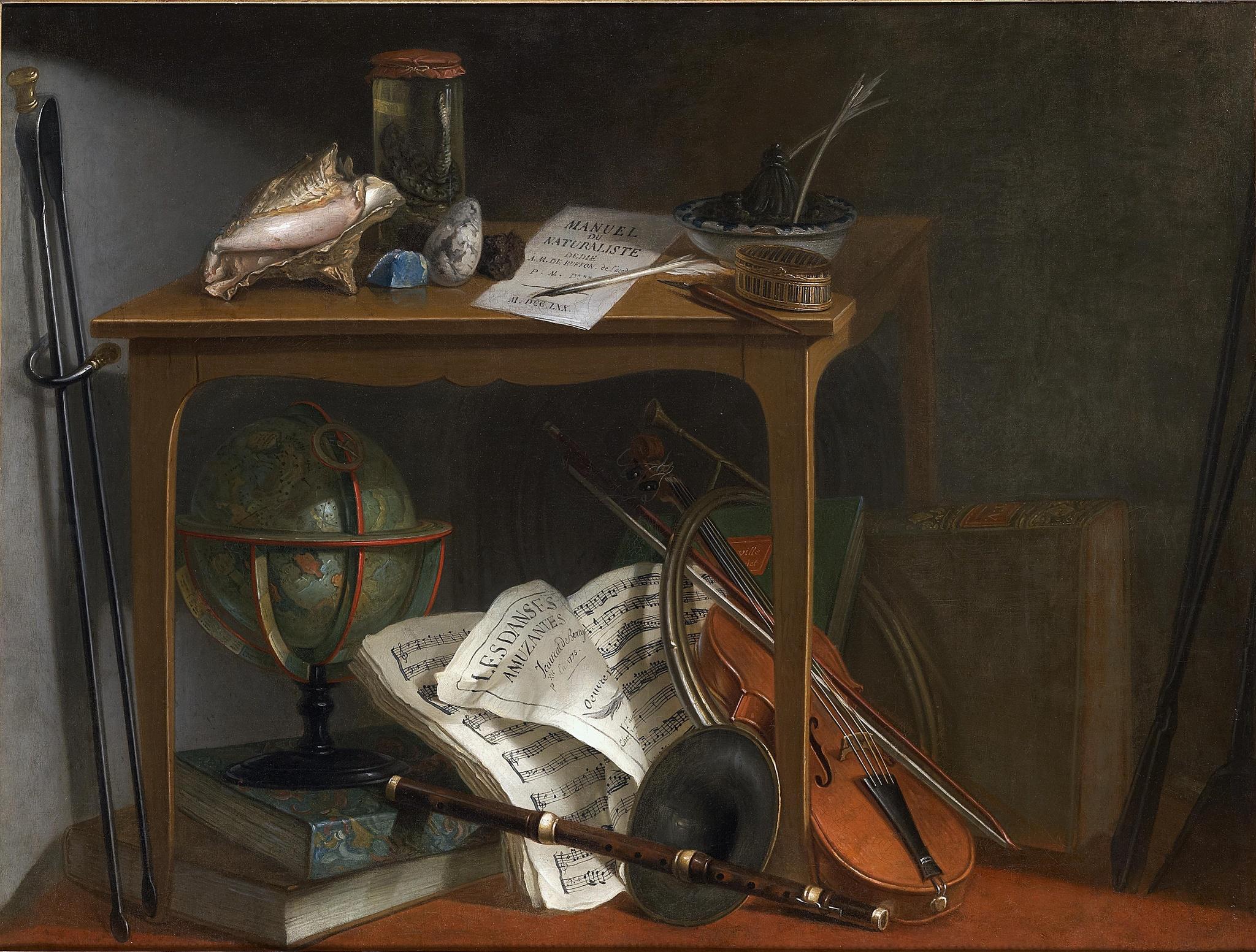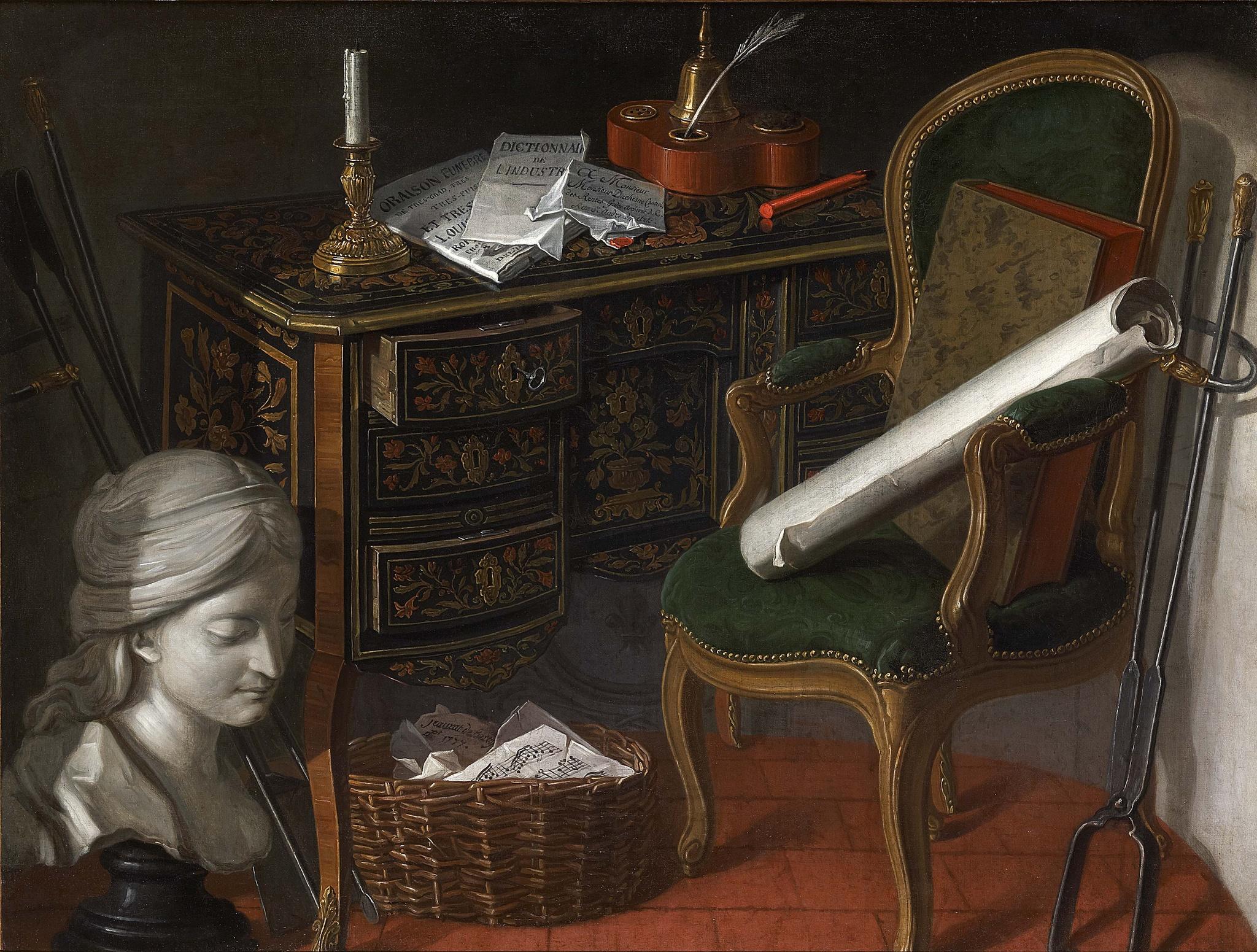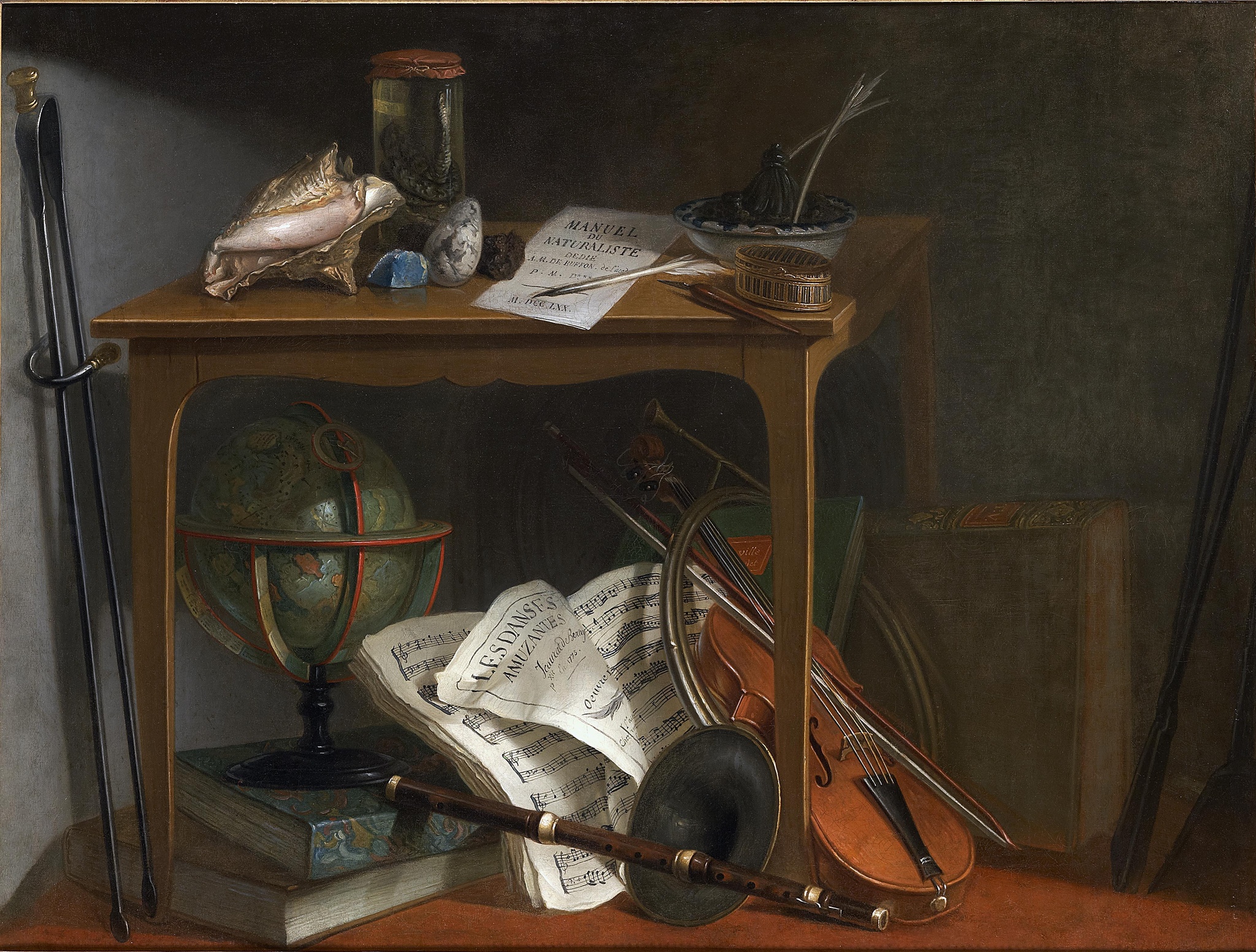
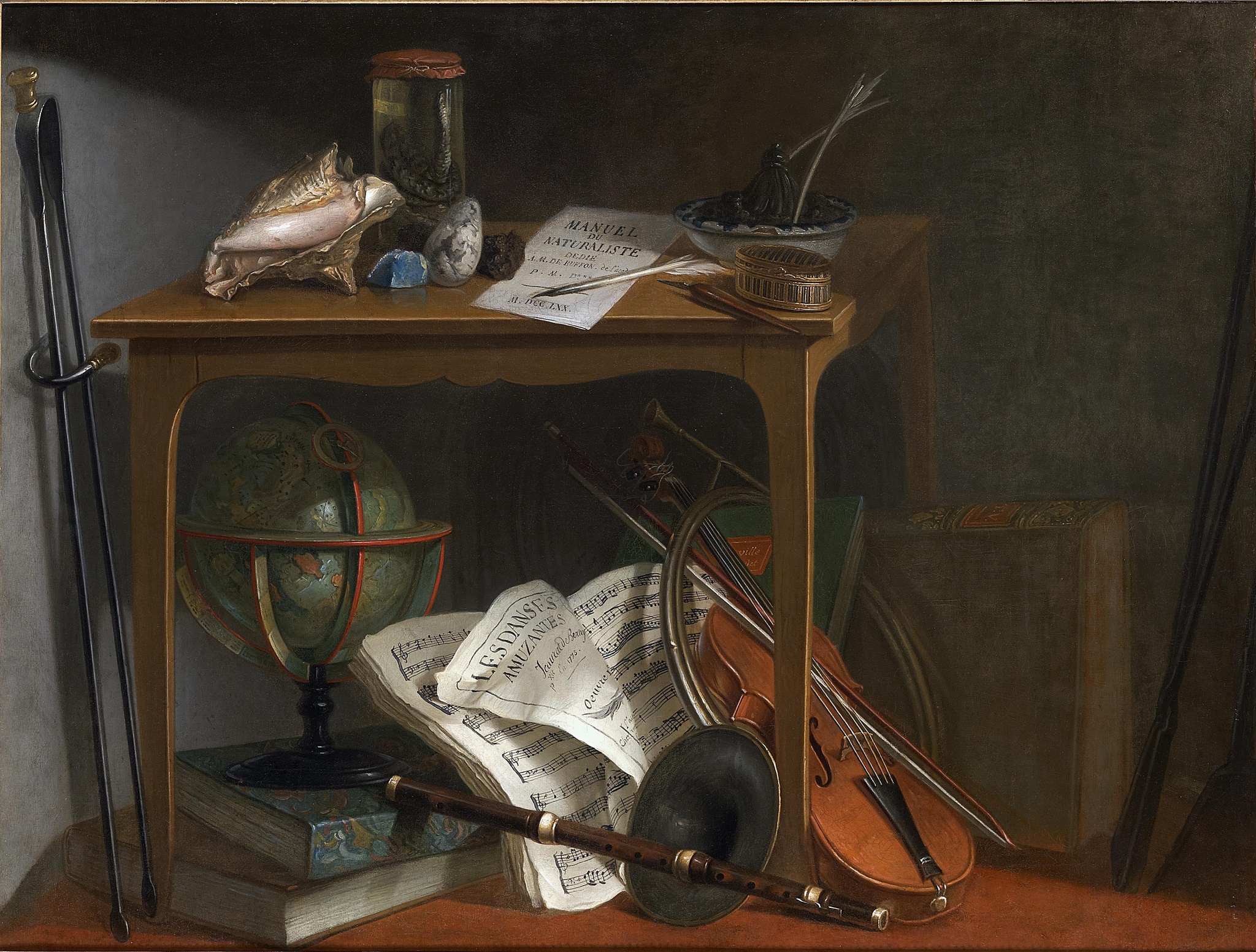
Born in Paris to d’Edme Jeaurat, graveur du Roy, Nicolas Henri Jeaurat de Bertry studied under his uncle, the painter Etienne Jeaurat. Above all, the young artist excelled at still-life painting, where he managed to capture the objects of daily life (if a privileged one) with a detail and vitality reminiscent of the genre’s master, Chardin. It was with his stil llifes that Jeaurat the younger established his reputation. Remarkably, Jeaurat de Bertry was both nominated and accepted, by verbal agreement of the assembly, for membership in the Académie Royale de Peinture et de Sculpture on the same day, 31 January 1756. His submissions for acceptance were two still lifes: one depicting kitchen implements (Paris, École des Beaux-Arts, formerly Louvre) and the other military trophies (Château de Fontainebleau).
The following year, the artist presented three works at the Salon of 1757. All still lifes, they depicted a group of musical instruments, an allegory of war, and one of science. A critic from October’s Mercure observed, ‘On a vu avec plaisir trois tableaux de M. Jeaurat de Bertry; ils sont d’une belle imitation et bien groupés.’ Though the locations of the latter works are for the present unknown, a painting in the Musée Carnavalet, signed and dated 1756, of musical instruments, would appear to be the first of these three Salon paintings. At one time mislabeled Chardin or de la Porte, a few still lifes in the Réunion Musées Nationaux (Cambrai for example) have been recently reattributed to Jeaurat de Bertry, one even containing his J.B. monogram.
Whether in Trophée de Chasse (Paris, Pardo Collection) or Trophée des Arts, the artist dramatically arranged near-architectural compositions, while the individual objects communicated a subject that, at its most elaborate, was on the same level as contemporaneous 18th century figurative allegories. A kitchen interior replete with eggs, fish, vegetables and wine becomes an allegory of Abundance; an assembly of a sword which draws a horizontal harmony line across the canvas, a drum, sashes and pistols becomes an allegory of War in the artist capable hands; an allegory of the hunt shows not a pile of dead birds, but a hare, partridge, and rifle resting as if laid against a tree by their hunter, and an animated parrot, symbol of the soul and of sound, holding two cherries.
With recognition and a flourishing career, in 1761 the artist was named painter to Marie Leczinska and moved his residence from Paris to Versailles. Henceforth Jeaurat de Bertry was able to sign letters with the title peintre de la Reine, his job described as ‘pour l’amusement de cette princesse dans l’art de la peinture.’ Upon the queen's death in 1768, he returned to Paris and remained there for all but a second four-year sojourn at court. During the French Revolution, Jeaurat concentrated on portraiture, some of a veiled satirical nature, as well as allegorical constructions that featured portraits, the tricolour, pyramids and the Masonic eye.