

Henri Matisse
b. 1869, Le Cateau-Cambrésis, France
d. 1954, Nice, France
Portrait of a Woman, Lorette
1916
Oil on panel
34.5 x 26.6 cm (13 5/8 x 10 1/2 in.)
With frame: 55.5 x 42 cm (21 7/8 x 16 1/2 in.)
Provenance
Literature
Description
For a period of six or seven months beginning in November of 1916, Matisse painted a sole subject with single-minded obsession, a young Italian woman named Lorette (or Laurette, or perhaps Loreta). As Hilary Spurling has noted, “No other model ever absorbed him so exclusively and at this degree of intensity either before or afterward” (Matisse: In Search of True Painting, exh. cat. Metropolitan Museum of Art, New York, 2012, p. 101). Matisse’s first painting of Lorette, the Italienne now in the Guggenheim Museum in New York, offers a sombrely abstracted vision of his model often thought to reflect the devastation of the war in progress, the portraits of Lorette that followed, some fifty in total, betoken the sensuality and freedom of approach the artist would embrace over the course of the next decade.
The present painting shows the woman who utterly transformed Matisse’s painting, as he embarked on his radical turn from abstraction to joyous figuration. Indeed, as Matisse himself explained: “When you have achieved what you want in a certain area, when you have exploited the possibilities that lie in one direction, you must, when the time comes, change course, search for something new” (quoted in Matisse: Radical Invention 1913–1917, exh. cat. Art Institute of Chicago, 2010, p. 318).
Few facts have been established regarding the raven-haired woman whose free-spirited, Mediterranean persona so profoundly stirred Matisse’s vision and invigorated his artistic practice. As noted in Matisse’s journal, it is likely that the painter Georgette Sembat introduced the artist to the model, a welcome gesture during wartime when models were in short supply. It is possible that Lorette was the sister of Rosa Arpino, who had posed for Matisse in 1906. Whatever the case, her talent for transformation offered Matisse an endless source of stimulation. The artist painted her in a range of costumes and in a striking array of modes and moods, from hieratic gravity to playful flirtatiousness, from otherworldly purity to sybaritic abandon.
Jack Flam deliberated the motivations underlying this extraordinary variety: “Was Matisse’s main purpose to explore the intriguing young woman before him, aiming to plumb the depths of her being, or to use her as a kind of actress who plays different parts in different plays, allowing him to work out some of the technical challenges presented by portraiture?” (Matisse in Transition Around Laurette, exh. cat. Norton Museum of Art, West Palm Beach, and Solomon R. Guggenheim Museum, New York, 2006, p. 14).
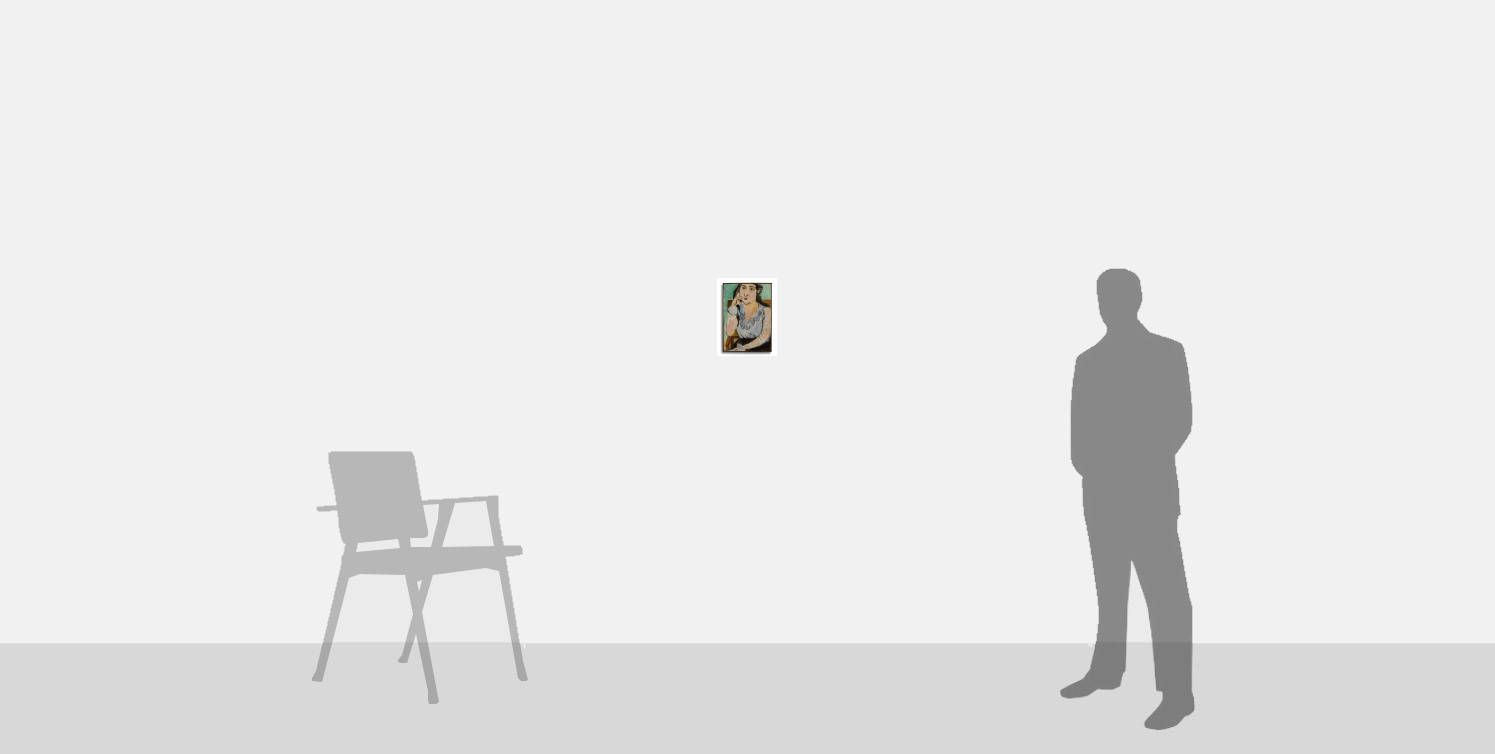
Matisse painted the present portrait of Lorette in 1916, early on in his period of intense exploration. The painting shows Lorette seated in a wooden chair against a jewel-toned aqua ground. She rests her cheek upon her hand in traditionally melancholic gesture, yet looks away from the viewer in a sort of pensive dreaminess. She is dressed in a white blouse with long, transparent sleeves, a plunging neckline and a ruffled collar and cuffs, which she also wears in Matisse’s first painting of her and in some half-dozen other portraits as well as two multi-figure studies from the spring of 1917. As Spurling wrote: “Laurette released in Matisse an observant gaiety and speedy, casual attack suppressed in years of strenuous sacrificial effort. He painted her energetically from odd angles and in exotic outfits, but mostly he returned to her simplest pose, seating her facing him in a plain, long-sleeved top and improvising endlessly inventive rhythmic variations on the central theme of her strong features, heart-shaped face and the black ropes of her hair” (Matisse the Master: A Life of Henri Matisse, New York, 2005, pp. 200–1).
In the present work, the ruffles of the blouse find echoes in Lorette’s feathered hair, in contrast with the upright solidity of the chair back and the flatness of the background. As Matisse commented: “A will to rhythmic abstraction was battling with my natural, innate desire for rich, warm, generous colours and forms. From this duality issued works that, overcoming my inner constraints, were realized in the union of contrasts” (quoted in J. Flam, Matisse on Art, Berkeley, 1995, pp. 271–72).
Lorette no longer posed for Matisse after the summer of 1917, and he made a brief turn to the genres of landscape and still life. In December of the same year he relocated from Paris to Nice, and found a promising successor to Lorette in nineteen-year-old Antoinette Arnoud. Subsequently he met Henriette Darricarrère, who became the muse of his odalisques into the late 1920s. Matisse’s paintings of Lorette served as a bridge between his abstract style of the war years, and the more sensuous, theatrical paintings that he created at Nice. At the same time, they set the certain pattern for his later relationships with models he employed, which assumed the compulsive, exhaustive intimacy of a love affair played out across a series of canvases. “I depend entirely on my model, whom I observe at liberty,” Matisse declared in 1939, more than two decades after Lorette had transformed his working practice. “After a certain moment it is a kind of revelation, it is no longer me. I don’t know what I am doing, I am identified with my model” (quoted in Matisse and the Model, exh. cat. Eykyn Maclean, New York, 2011, pp. 45 and 53).
A painting of Lorette in similar attire from 1917 was sold at Christie's in 2016 for USD 2,527,500. Please see:
https://www.christies.com/en/lot/lot-6037836.Georges Matisse has confirmed the authenticity of this work.
The artwork described above is subject to changes in availability and price without prior notice.