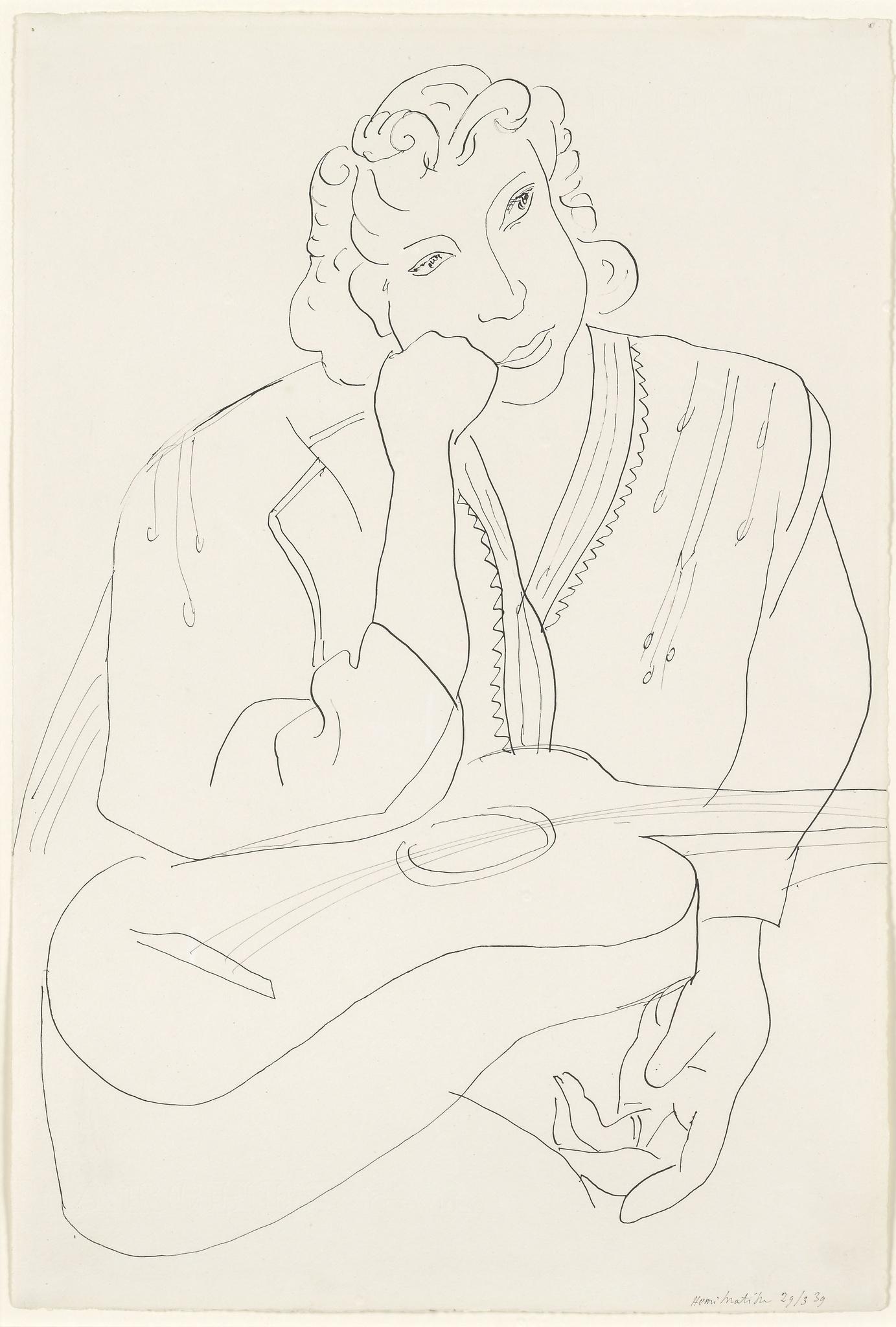
A leading figure in early twentieth-century art, Henri Matisse was born in Le Cateau-Cambrésis in 1869 and died in Nice, at the age of 85, in 1954.
After initially pursuing a career in law, Matisse was inspired by morning drawing classes to commit his life to art. In 1891 he moved to Paris where he studied at the Académie Julian and the École des Beaux-Arts. During this time, his work was noticed by the painter Gustave Moreau, who became a mentor to the young Matisse. Through Moreau, Matisse became acquainted with Impressionist art and especially the trio of giants of post-impressionist French art—Gaguin, Cezanne, and Van Gogh—from whom Matisse received a fundamental iconographic, stylistic, and conceptual grounding.
After a visit to the south of France in 1904, Matisse was inspired by the Mediterranean light and landscape to create canvases with bold, bright colours, which he exhibited at the Salon d'Automne in Paris in 1905. The works marked a decisive shift in Matisse's style, with a contemporary review describing the works as 'fauves', or 'wild beasts'. Matisse became a key proponent of Fauvism, depicting scenes with clear-cut, vibrant shapes that evoked a feeling rather giving an accurate representation of the subject. He also produced drawings and sculptures in this style, always distilling the essence of the visible world into simple, naïve forms. Other members of this avant-garde artistic movement included Matisse's long-time friend Raoul Dufy, Andre Derain, Maurice de Vlamink, and Georges Braque.
Matisse's unique style brought him widespread success and recognition. He travelled widely in search of inspiration and established a large studio in central Paris. He also earned commissions from notable individuals such as Gertrude Stein and Russian businessman Sergei Schukin, for whom Matisse produced the important pair of paintings Dance I and Music (1910).
In 1921, Matisse relocated to the southern city of Nice on the Mediterranean coast. Despite his radical stylistic approach to painting, his subjects were often traditional, including landscapes, views of his studio, and the female nude. During this time, he also engaged extensively with printmaking.
From around the year 1940, ill health and immobility caused Matisse to look for new ways to express his creativity, as painting was beyond his physical capabilities. He developed an artform that involved assemblages of shapes cut from painted sheets of paper. This ground-breaking innovation was widely celebrated and today there paper cut-outs are among his most famous works. This art form also allowed Matisse, with failing health, to continue his practice until his death in 1954.
Matisse was an artist who shaped the course of twentieth-century art history, an innovator and experimenter whose main artistic preoccupation was, consistently throughout his life, that of colour.