
Alexander Calder
b. 1898, Lawnton, PA
d. 1976, New York, NY
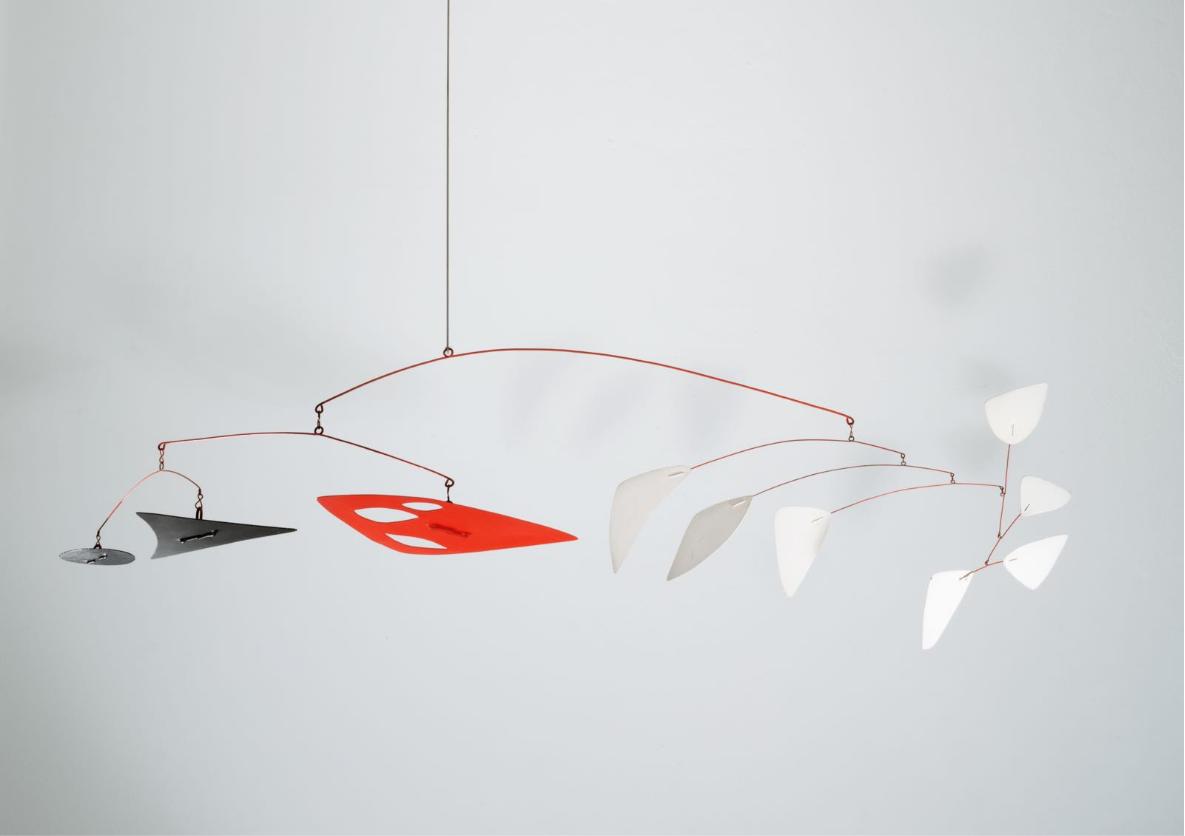
Black Circle, Black Triangle
1961
Metal, wire
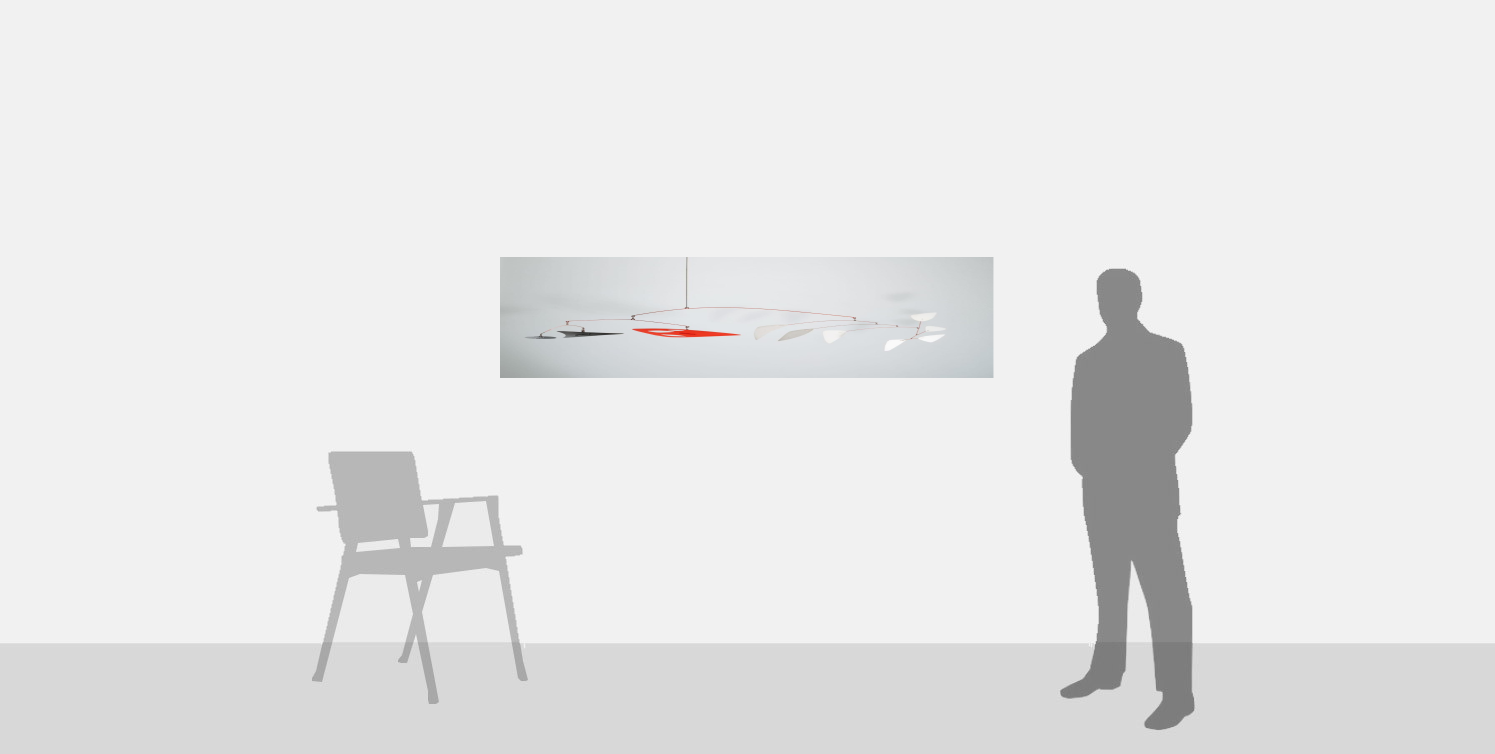
54 x 220 cm (21 1/4 x 86 5/8 in.)
Provenance
Perls Galleries, New York.
Private Collection, United States, acquired from the above in 1967
Private Collection, United States, acquired from the above in 1967
Description
Executed in 1961, Black Circle, Black Triangle displays Calder’s renowned mastery of the kinetic sculpture. Calder’s discovery of the mobile originated on a visit to Piet Mondrian’s studio in 1930, where the sight of rectangles of coloured cardboard, arranged on the wall in the manner of one of Mondrian’s paintings, inspired Calder to think of the kinetic possibilities of art. In 1932, the same year that he created his first suspended mobile sculpture, Small Sphere and Heavy Sphere, Calder revealed his excitement at the extraordinary new creative world he was in the process of discovering: ‘Why must art be static?... You look at an abstraction, sculptured or painted, an intensely exciting arrangement of planes, spheres, nuclei, entirely without meaning. It would be perfect but it is always still. The next step in sculpture is motion.’ (H. Greenfield, The Essential Alexander Calder, New York, 2003, p. 67).
Black Circle, Black Triangle Calder incorporates three distinct metal elements, painted in black, red and white and arranged along a horizontal axis. Positioned beside the black circle and triangle of the title is a single red form displaying Calder’s preference for accents of bold colour. A separate branch bears a dynamic arrangement of white forms, resembling the leaves Calder depicts, often in monochrome, which cascade dynamically in the composition. By piercing the red form Calder allows air to drift through the apertures, rotating smoothly and inspiring movement in the other elements. As Calder stated in 1959: "When I cut out my plates I have two things in mind. I want them to be more alive, and I think about balance. Which explains the holes in the plates. The most important thing is that the mobile be able to catch the air. It has to be able to move" (quoted in XXE siècle: Homage à Calder, Paris, 1972, p. 98). Together these forms float with a beautiful delicacy, pursuing their own paths while maintaining an undeniable sense of cohesion and total resolution.
As the French Existentialist Jean-Paul Sartre wrote of the mobiles in 1946: "The forces at work are too numerous and complicated for any human mind, even that of their creator, to be able to foresee all their complications. For each of them Calder establishes a general fated course of movement, then abandons them to it: time, sun, heat and wind will determine each particular dance. Thus the object is always midway between the servility of the statue and the independence of natural events. Each of its twists and turns is an inspiration of the moment. In it you can discern the theme composed by its maker, but the mobile weaves a thousand variations on it. It is a little hot-jazz tune, unique and ephemeral, like the sky, like the morning. If you missed it, it is lost forever" ("Existentialist on Mobilist", Art News, vol. 46, Dec. 1947, pp. 22-23). Displaying this dynamism, Black Circle, Black Triangle interacts autonomously with the physical environment, the precise quality of its movements dependent on the slightest atmospheric shift. As Calder wrote: "When everything goes right a mobile is a piece of poetry that dances with the joy of life" (H. Greenfield, op. cit., p. 47).
This work is registered in the archives of the Calder Foundation, New York, under application number A07393.
The artwork described above is subject to changes in availability and price without prior notice.
Black Circle, Black Triangle Calder incorporates three distinct metal elements, painted in black, red and white and arranged along a horizontal axis. Positioned beside the black circle and triangle of the title is a single red form displaying Calder’s preference for accents of bold colour. A separate branch bears a dynamic arrangement of white forms, resembling the leaves Calder depicts, often in monochrome, which cascade dynamically in the composition. By piercing the red form Calder allows air to drift through the apertures, rotating smoothly and inspiring movement in the other elements. As Calder stated in 1959: "When I cut out my plates I have two things in mind. I want them to be more alive, and I think about balance. Which explains the holes in the plates. The most important thing is that the mobile be able to catch the air. It has to be able to move" (quoted in XXE siècle: Homage à Calder, Paris, 1972, p. 98). Together these forms float with a beautiful delicacy, pursuing their own paths while maintaining an undeniable sense of cohesion and total resolution.
As the French Existentialist Jean-Paul Sartre wrote of the mobiles in 1946: "The forces at work are too numerous and complicated for any human mind, even that of their creator, to be able to foresee all their complications. For each of them Calder establishes a general fated course of movement, then abandons them to it: time, sun, heat and wind will determine each particular dance. Thus the object is always midway between the servility of the statue and the independence of natural events. Each of its twists and turns is an inspiration of the moment. In it you can discern the theme composed by its maker, but the mobile weaves a thousand variations on it. It is a little hot-jazz tune, unique and ephemeral, like the sky, like the morning. If you missed it, it is lost forever" ("Existentialist on Mobilist", Art News, vol. 46, Dec. 1947, pp. 22-23). Displaying this dynamism, Black Circle, Black Triangle interacts autonomously with the physical environment, the precise quality of its movements dependent on the slightest atmospheric shift. As Calder wrote: "When everything goes right a mobile is a piece of poetry that dances with the joy of life" (H. Greenfield, op. cit., p. 47).
This work is registered in the archives of the Calder Foundation, New York, under application number A07393.
The artwork described above is subject to changes in availability and price without prior notice.