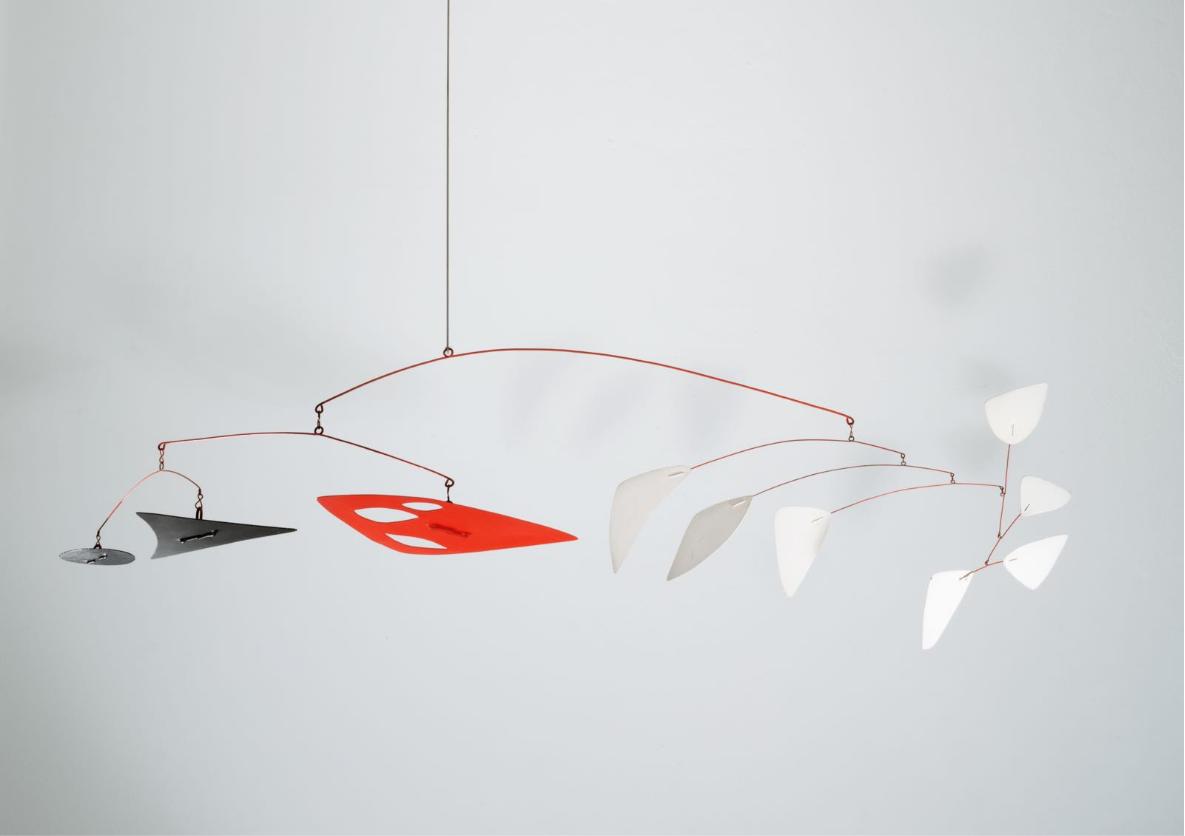
Alexander Calder was born in Pennsylvania in 1898. He grew up in an artistic family: his mother was a portrait painter and his father a sculptor. However, his parents did not want their son to pursue an artistic career, so Calder instead chose to study engineering at university. This training gave him the knowledge and grounding which he would use to investigate movement and its implications in sculpture, developing his own unique practice and so-called 'kinetic' sculpture.
After graduating from university in 1919, Calder had a series of engineering jobs including as a mechanic on a passenger ship. This allowed him to travel and visit his sister who lived in Washington state on the west coast of America. The dramatic mountainous landscape he experienced there inspired Calder to paint, and he decided to pursue a career as an artist and moved to New York in 1923.
While in New York, Calder enrolled at the Art Students League, where he proved himself a talented draughtsman. His first book, a drawing manual called Animal Sketching was published in 1926. In this same year, Calder moved to Paris where he established a studio and took further art training. At this time, Paris was an epicentre of artistic experimentation and dynamism, and Calder was able to meet and befriend artists such as Joan Miró and Piet Mondrian. It was during his time in Paris (1926-33) that Calder began to develop his sculptural practice and unique investigations using wire. Calder called these wire sculptures his 'drawings in space'
Simultaneously, Calder was working on a seminal early piece, his Cirque Calder (1926-31), a fully-articulated miniature circus fashioned from wire, rubber, cloth, string and found materials. The work was exhibited in Europe and the United States and caused a sensation, particularly among the Parisian avant-garde.
A pivotal moment in Calder's career came in 1930, when he visited Piet Mondrian's studio. Mondrian was known for his geometric abstraction; seeing his works, Calder was inspired to commit wholly to abstract art. Following the visit, he produced his first fully kinetic sculptures powered by motors, which were dubbed 'mobiles' by the artist Marcel Duchamp. Calder soon abandoned the motorisation of his sculptures, relying instead on natural forces such as air currents or touch.
While Calder was in Paris, he also exhibited internationally and became widely admired for his unique artistic creations. Having married in 1931, Calder returned to New York in 1933 where he set up a studio in the city and on a farm in Connecticut, which became his main residence for the rest of his life. World War II resulted in a shortage of sheet metal for Calder to use in his creations, causing the artist to turn to other materials such as wood, glass, ceramics and other discarded items that he found on his Connecticut farm.
Alongside his kinetic sculptures, Calder also produced large, static works in metal, which came to be known as 'stabiles' - a term coined by artist Jean Arp - most of which exist today as monumental public art. In the 1950s and 1960s, he focussed mainly on these large-scale stationary metal sculptures. Notable examples include 125 (1957) for JFK Airport in New York, Spirale (1958) for UNESCO headquarters in Paris, and El Sol Rojo (1968) for the Mexico City Olympics.
Calder died suddenly in New York in 1976, shortly after the opening of a major retrospective at the Whitney, New York. Other retrospectives during his lifetime include shows at the Guggenheim in New York (1964) and at the Fondation Maeght in Saint-Paul-de-Vence, France (1969). His works feature in the collections of numerous organisations internationally, with the Whitney Museum of American Art possessing the largest body of his work.