
Maestro del Lume di Candela
b. 1759, Arles, France
d. 1650, Avignon, France
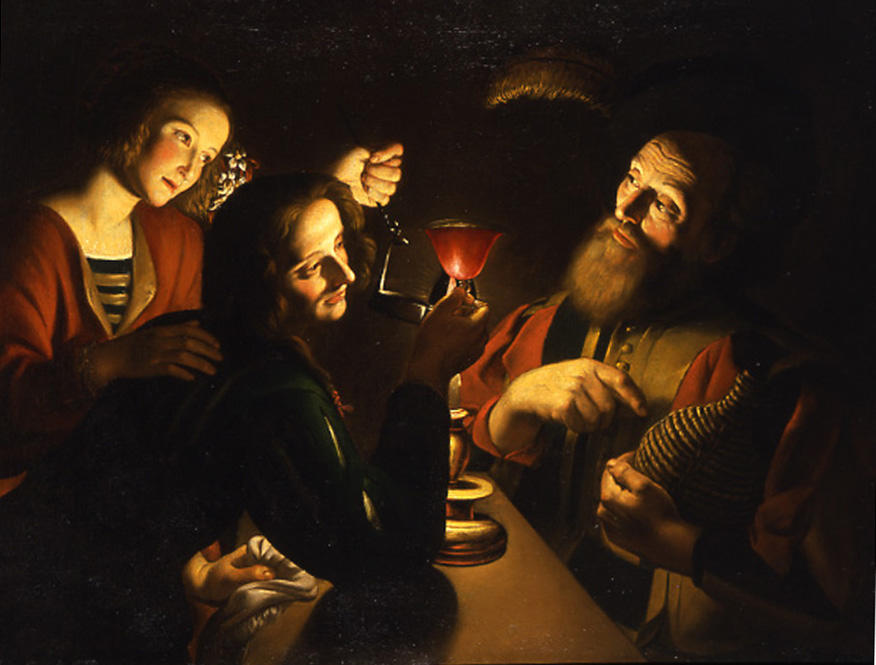
A Tavern Scene by Candlelight
Oil on canvas
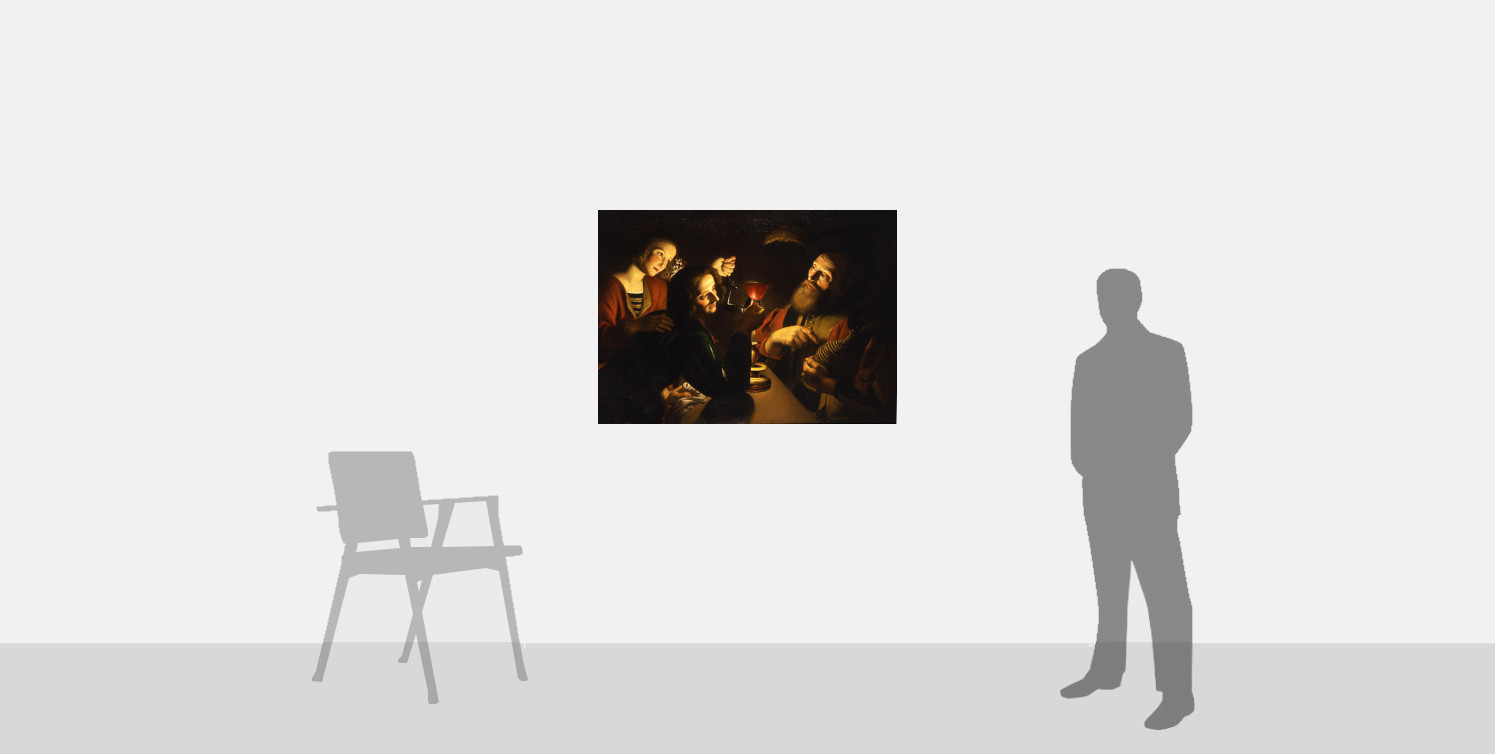
95 x 133 cm (37 3/8 x 52 3/8 in.)
Provenance
Verona, Fraccaroli collection;
Milan – London, Koelliker collection.Literature
B. Nicolson, Un caravaggiste aaixois, le mâitre à la chandelle, in “”Art de France” 1964, pp. 116 – 139; B. Nicolson, The International Caravaggesque Movement, Oxford 1979, p. 22; B. Nicolson, Caravaggism in Europe, 2° ed, Torino 1990, p. p. 62, fig. 861; G. Papi Trophime Bigot, il Maestro del lume di candela e Maestro Giacomo, in “Paragone” 1998, pp. 3- 18; G. Papi in La Schola del Caravaggio, catalogue of the exhibition ed. by G. Papi, Milan 2006, pp. 220 – 223; K. Miyashita in Caravaggio and his Time: Friends, Rivals and Enemies, catalogue of the exhibition, Tokyo 2016, pp. 60 – 61
Description
In two different essays released at the beginning of the 1960s, Benedict Nicolson analysed a group of paintings, mostly scenes of interiors, which at first were attributed to the anonymous "Master of Candlelight" and then to the Provençal painter Trophime Bigot (Arles 1579 - Avignon 1650). The catalogue compiled in 1964 included also this Tavern Scene, which at the time belonged to a private collection in Verona.
However in more recent years Gianni Papi has proposed to split this catalogue of works between two different artists: the aforementioned Trophime Bigot and the anonymous Master of Candlelight.
According to the reattribution of Gianni Papi the Master of Candlelight differs from Bigot in the search for more complex compositions and for greater pictorial softness which in some ways seems to bring him closer to Honthorst’s models.
Finally it should be noted that the discovery of the payment for the three paintings held in the Passion chapel in Santa Maria in Aquiro in Rome, has highlighted the hypothesis of the Master of Candlelight to be identified with Giacomo Massa. This hypothesis was also accepted and reported in the recent catalogue of the exhibition at The National Museum of Western Art in Tokyo. These paintings are in fact characterised by a nocturnal setting and represent the moments of the Passion lit by torchlight (cfr. A. Amendola, La cappella della Passione in Santa Maria in Aquiro: il vero nome di Maestro Jacomo, in “Bollettino d’Arte” 2012, pp. 77 -86)
The artwork described above is subject to changes in availability and price without prior notice.
Where applicable ARR will be added.
However in more recent years Gianni Papi has proposed to split this catalogue of works between two different artists: the aforementioned Trophime Bigot and the anonymous Master of Candlelight.
According to the reattribution of Gianni Papi the Master of Candlelight differs from Bigot in the search for more complex compositions and for greater pictorial softness which in some ways seems to bring him closer to Honthorst’s models.
Finally it should be noted that the discovery of the payment for the three paintings held in the Passion chapel in Santa Maria in Aquiro in Rome, has highlighted the hypothesis of the Master of Candlelight to be identified with Giacomo Massa. This hypothesis was also accepted and reported in the recent catalogue of the exhibition at The National Museum of Western Art in Tokyo. These paintings are in fact characterised by a nocturnal setting and represent the moments of the Passion lit by torchlight (cfr. A. Amendola, La cappella della Passione in Santa Maria in Aquiro: il vero nome di Maestro Jacomo, in “Bollettino d’Arte” 2012, pp. 77 -86)
The artwork described above is subject to changes in availability and price without prior notice.
Where applicable ARR will be added.