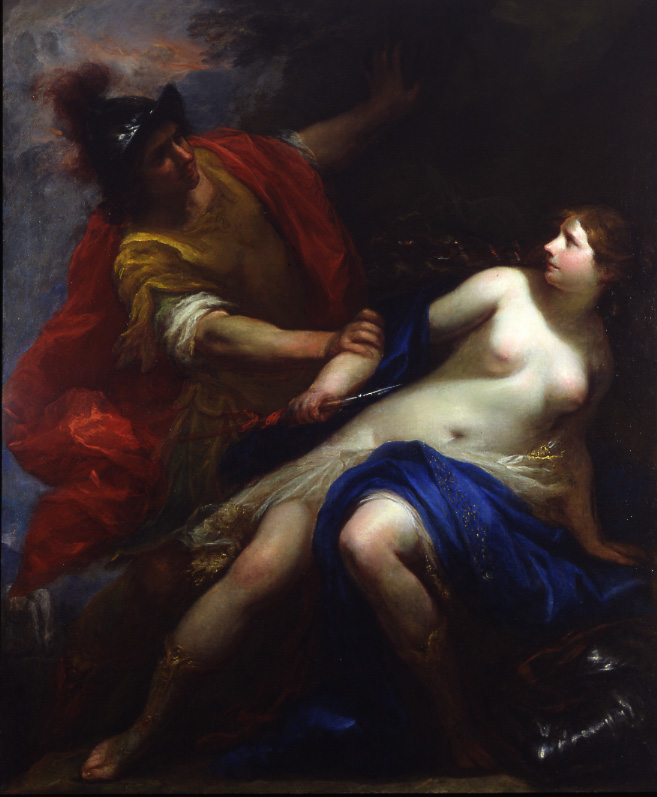
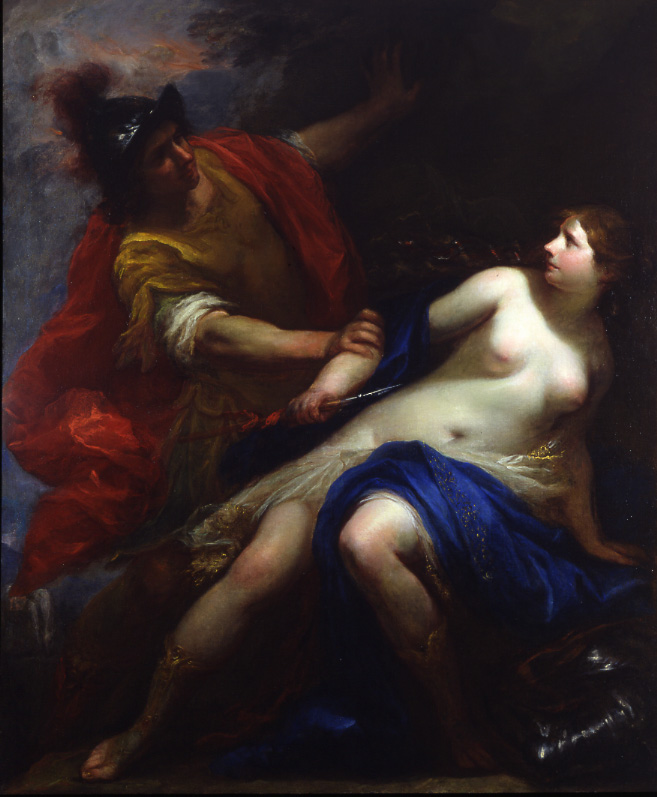
A Florentine painter and sculptor, Simone Pignoni was born in Florence in 1611 and died in his native city in 1698.
Described as an excellent teacher and a point of reference for some of the most famous painters of the 18th century in Florence, Pignoni began his artistic education first with Fabrizio Boschi and later with the famous painter Francesco Furini, who was to be a constant stylistic and artistic reference point throughout his career.
In Pignogni's first painting phase, represented by the canvas depicting 'St. Thomas' painted for the confraternity of St. Sebastian, we see Furini's influence, an accentuated tendency towards naturalism and a colouristic use of Venetian origin, making his reinterpretation of the colouristic baggage unique.
Pignoni's production, the dating of which appears particularly difficult due to the numerous private commissions he received during his career, ranges from religious themes to his famous and sensual Magdalene, Junoesque female depictions in which Pignoni departs from the Furini model.
These are representations where strong plastic and colouristic connotations prevail.
As far as church production is concerned, Pignoni produced about 30 altarpieces, and among the religious works we must mention the famous canvas 'Abigail and David': painted for Piero Bigongiari, it is a canvas characterised by a remarkable level of complexity both in terms of colour, with an unprecedented use of highlights, and structure.
In 1665, Pignoni produced the altarpiece depicting 'S. Tommaso da Villanova', with a more severe and moderate expressive style than previous works.
The 1680s were the last years of Pignoni's work and saw the realisation of the 'Annunziata Altarpiece', in which we see the overcoming of the key that had distinguished the previous works for the confirmation of a new spatial scansion, with a pyramidal structure, and particular attention to the emotional and gestural dimension of the figures represented, a follower of late Baroque language.
Pignoni's last dated work dates back to 1682, the 'St. Louis of France Offering a Banquet to the Poor' in the church of S. Felicita and was commissioned by Count Luigi Guicciardini: the canvas features a complex compositional orchestration in which the imposing architectural backdrop dominates.