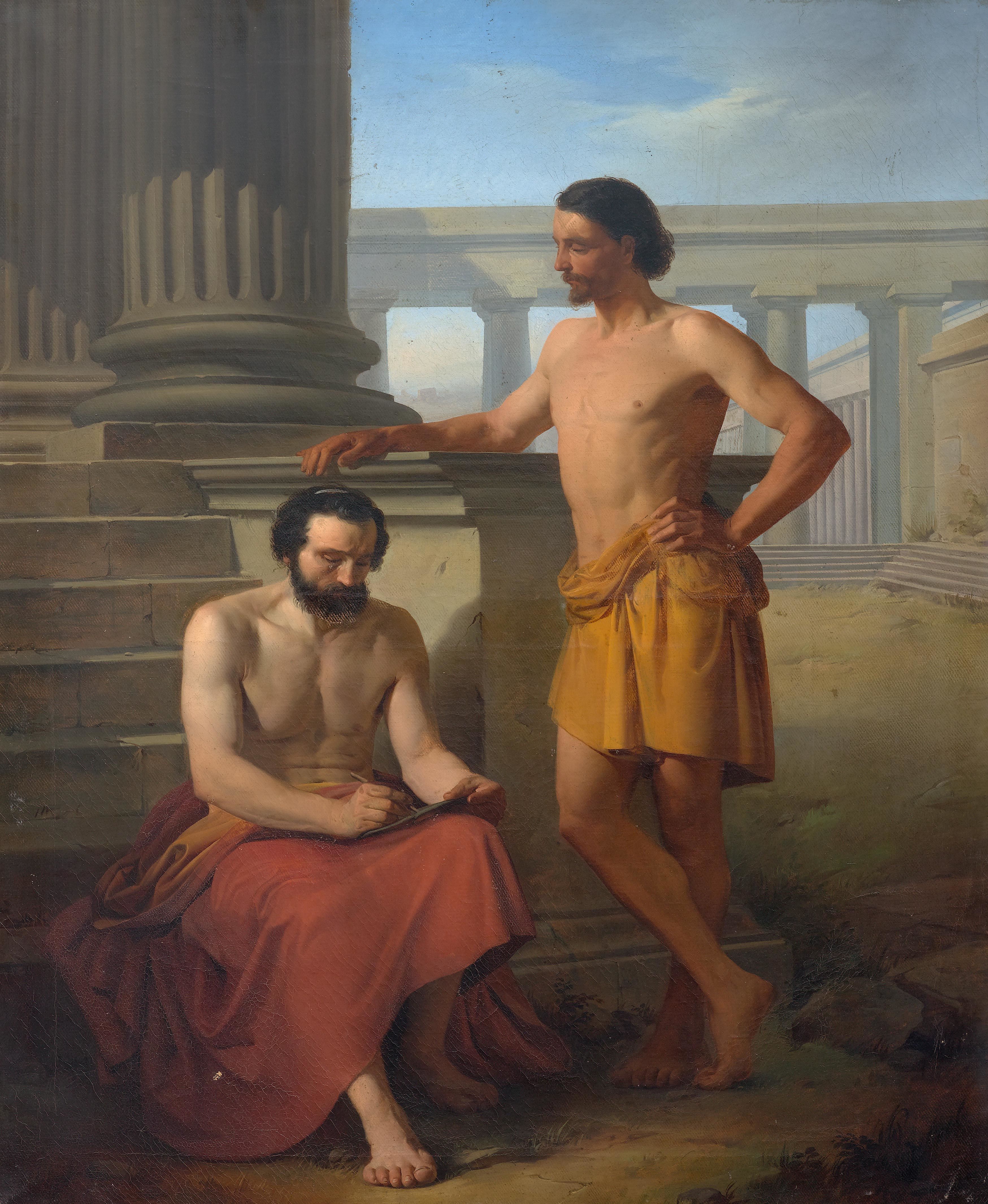
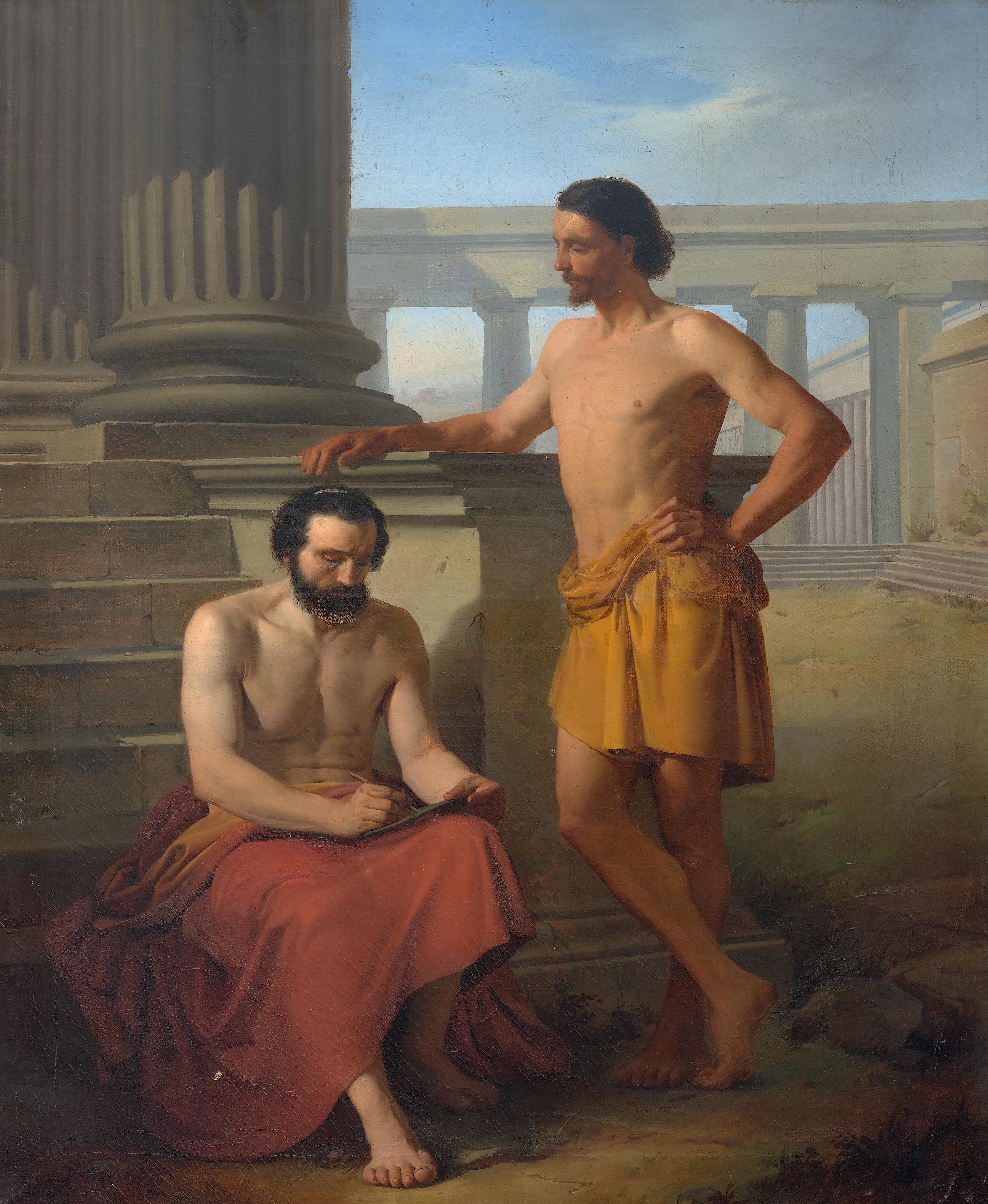
Born in Berlin to the chapel-master at the Prussian court, Natale Mussini, Luigi Mussini was sent as a child to Florence, where he was schooled in art, music and literature. He undertook his earliest artistic training from his older brother Cesare Mussini and later studied at the Accademia delle Belle Arti in Florence.
Early on, Mussini turned away from the academic practice of copying from classical casts that had defined the Neoclassical tradition, preferring direct study of the great Tuscan masters of the fourteenth and fifteenth centuries, whose works he admired for their expressive dignity and purity.
In 1840 Mussini won a scholarship to Rome, where he painted his first significant work, Holy Music (1842, Galleria Palatina, Palazzo Pitti, Florence), clearly inspired by Raphael’s iconic Saint Cecilia. After fighting in the Revolutions of 1848, Mussini traveled to Paris, where he became close friends with Ingres and many of his school. Holy Music and another painting, the Triumph of Truth (1848, Accademia del Brera, Milan) were exhibited at the Salon in 1849 and proved so successful that Mussini was commissioned by the Ministry of Fine Arts to make copies of them as well as to create another painting on a subject of his choice.
For this he chose a theme particularly close to the hearts of the artists of the Purismo movement: the Commemorative Celebration of the Birth of Plato Held at Lorenzo the Magnificent’s Villa di Careggi (1851, Musée de Brou, Bourg-en-Bresse). Rendered in an austere manner of drawing derived from Ingres coupled with a rich and luxurious palette inspired by the masters of the sixteenth century, Mussini’s painting emphasises the importance of Neo-Platonic thought to the formation of Florentine humanism.
In 1851 Mussini became director of the Istituto d’Arte in Siena and remained there for the rest of his life, playing a prominent role in the artistic and cultural life of the Tuscan city. He was celebrated by a grand monographic exhibition staged in 2007–8 at Santa Maria della Scala in Siena, Nel segno di Ingres: Luigi Mussini e l’Accademia in Europa nell’Ottocento.