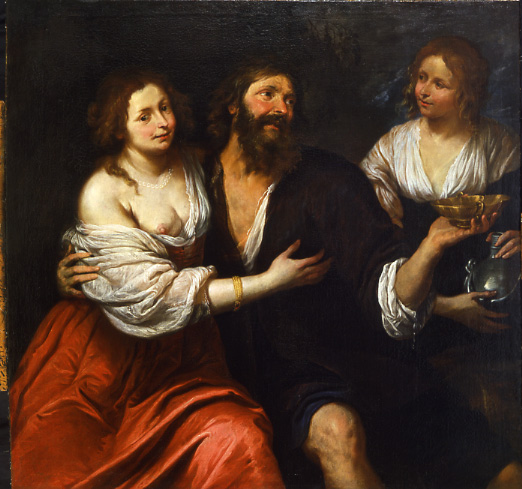
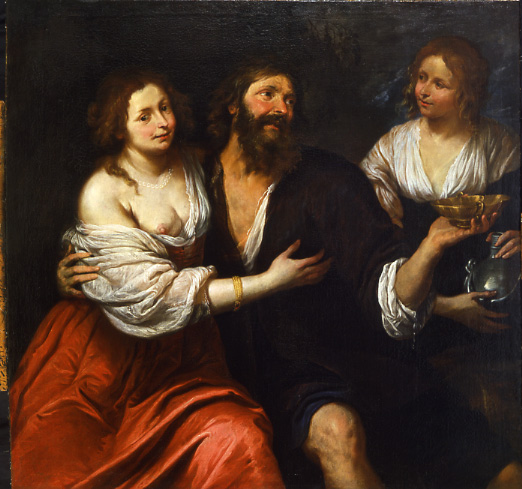
Active primarily in Genoa, Giovanni Andrea de Ferrari was a Baroque painter who worked primarily with religious subjects in the Mannerist style. At a young age, he decided to pursue a career in painting, training in the workshop of the painter Bernardo Castello, thanks to whom he made his first contact with Mannerist culture. Showing particular artistic talent, the young Ferrari completed his training with the famous master Bernardo Strozzi. Through Strozzi’s influence, his typically Tuscan Mannerist background became enriched by a series of models that changed the young man's brushstrokes, making them decidedly richer and more full-bodied.
What is striking about the early works of his youth, painted after leaving his master Strozzi, is the interest Ferrari showed in naturalism in still life and, above all, the psychological investigations of the characters depicted. In this way, he incorporated the influences of Caravaggio and the Spanish schools into his own practice. Canvases depicting the allegory of Justice, painted for the Palace of Justice, and the Nativity of the Virgin for the Church of Our Lord of Remedy belong to this period. Starting in the second decade of the 17th century, a particularly fruitful period began for de Ferrari, with many commissions, including The Preaching of St. Thomas before the King of the Indies, The Martyrdom of St. Andrew and several altarpieces, types of works that the painter was to produce until 1635.
In the 1630s, by which time he had developed an entirely personal style that shared some characteristics with the popular Spanish style, and at the head of a flourishing workshop, de Ferrari began to dedicate more time to undertaking small private commissions, rather than large altarpieces. In this small format, de Ferrari was able to rediscover and realise the naturalism characteristic of his style. This period includes The Miracle of St. Brigid and Saint Resuscitating a Fallen Mason: these two works have similar compositions, as well as a strong sense of pathos at the narrative level.
Precisely the strong pathos, the spiritualisation of the scenes, and mellow contrasts between light and shadow are the elements that would distinguish de Ferrari's more mature works. This distancing from the prevailing academic taste of the time can be seen in the work Samaritan Woman at the Well. One of de Ferrari’s last dated works, a Deposition, contains an unprecedented reinterpretation of styles that the artist had accrued during his long career, namely the combination of Van Dyck's art and Lombard naturalism.