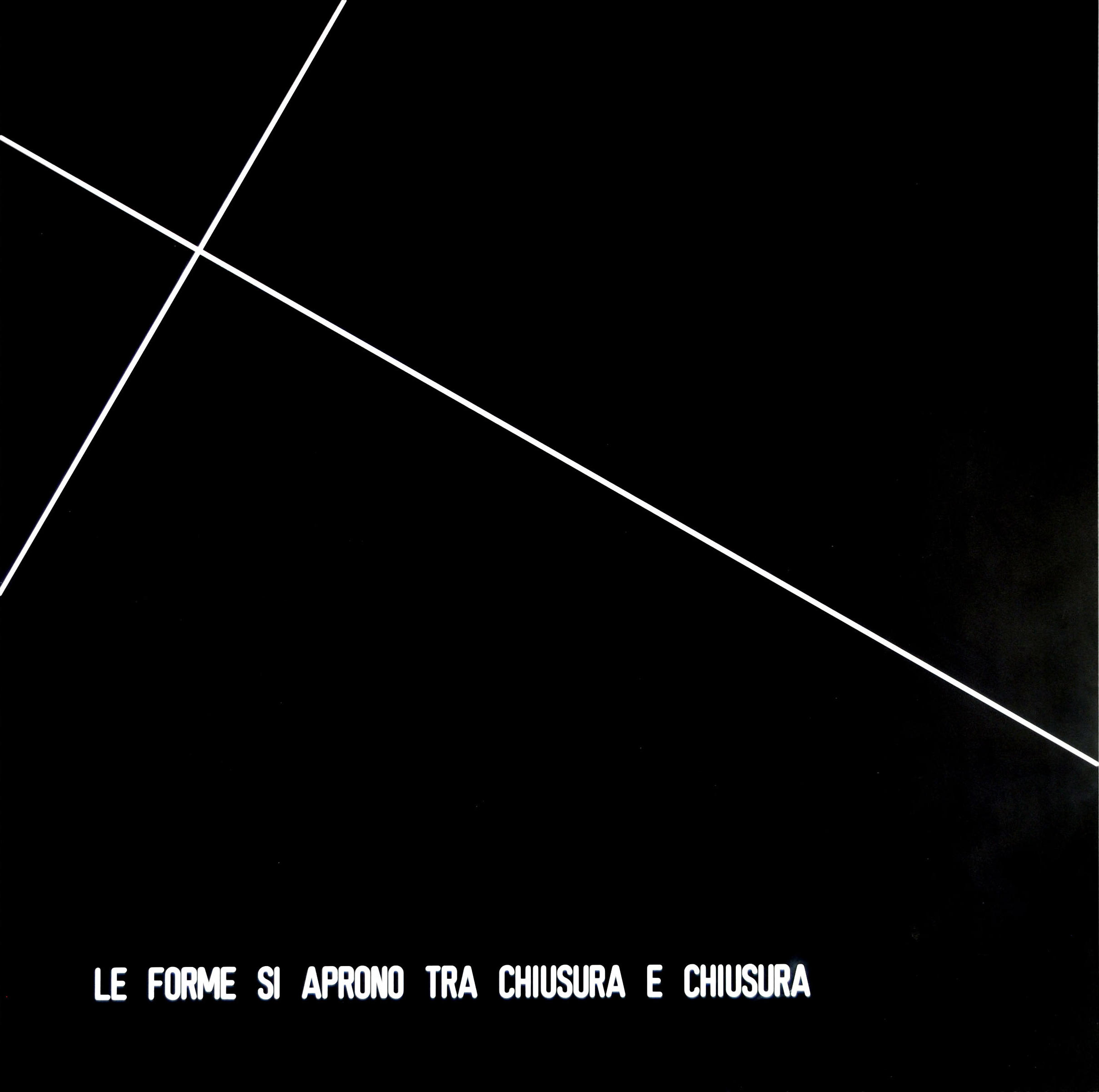
Vincenzo Agnetti was born in Milan in 1926 and lived in Italy for almost his whole life. He studied at the Brera Academy in Milan and subsequently spent time at the Piccolo Teatro theatre school, studying drama. Throughout the late 1950s and 1960s, he produced works relating to the Art Informel movement and wrote poetry, although very little is known about works from these years as none of it appears to have survived.
In 1962, he moved to Argentina where he worked until 1967 in the field of electronic automation. During this period, he kept in contact with the Milanese artistic community, including his friends Enrico Castellani and Piero Manzoni (until the latter's death in 1963).
Agnetti's return to Milan in 1967 marked a new phase of artistic production and he began his career proper as an artist. In the same year, he held his first solo exhibition at Palazzo dei Diamanti in Ferrara, where he showed his work Principia which demonstrated his fascination with and investigation into language and its potential as an art form and medium. Agnetti's preoccupation with language was to become a constant theme in his artworks.
In 1968, the year of student protests across Europe, Agnetti exhibited his work Macchina Drogata (Drugged Machine) in Milan, a specially-programmed Olivetti calculator that produced seemingly nonsense text when activated by the viewer. The work suggested a deconstruction of the power of language and also required the viewer to be involved in the creation of the artwork, a powerful message in a year of social turbulence and mass activism.
Agnetti developed his practice in the 1970s, continuing to question the use of language through his artworks, and establishing himself as one of the leading conceptual artists of the era. He also achieved international recognition, with several exhibitions in important artistic focal points such as Paris and New York.
In addition to creating works of art, Agnetti also wrote criticism about his own artworks, adding another layer of conceptual meaning and self-criticism to his oeuvre. He also produced written publications such as a volume of poems interspersed with images of his works, published in 1978.
Agnetti died suddenly in Milan in September 1981.