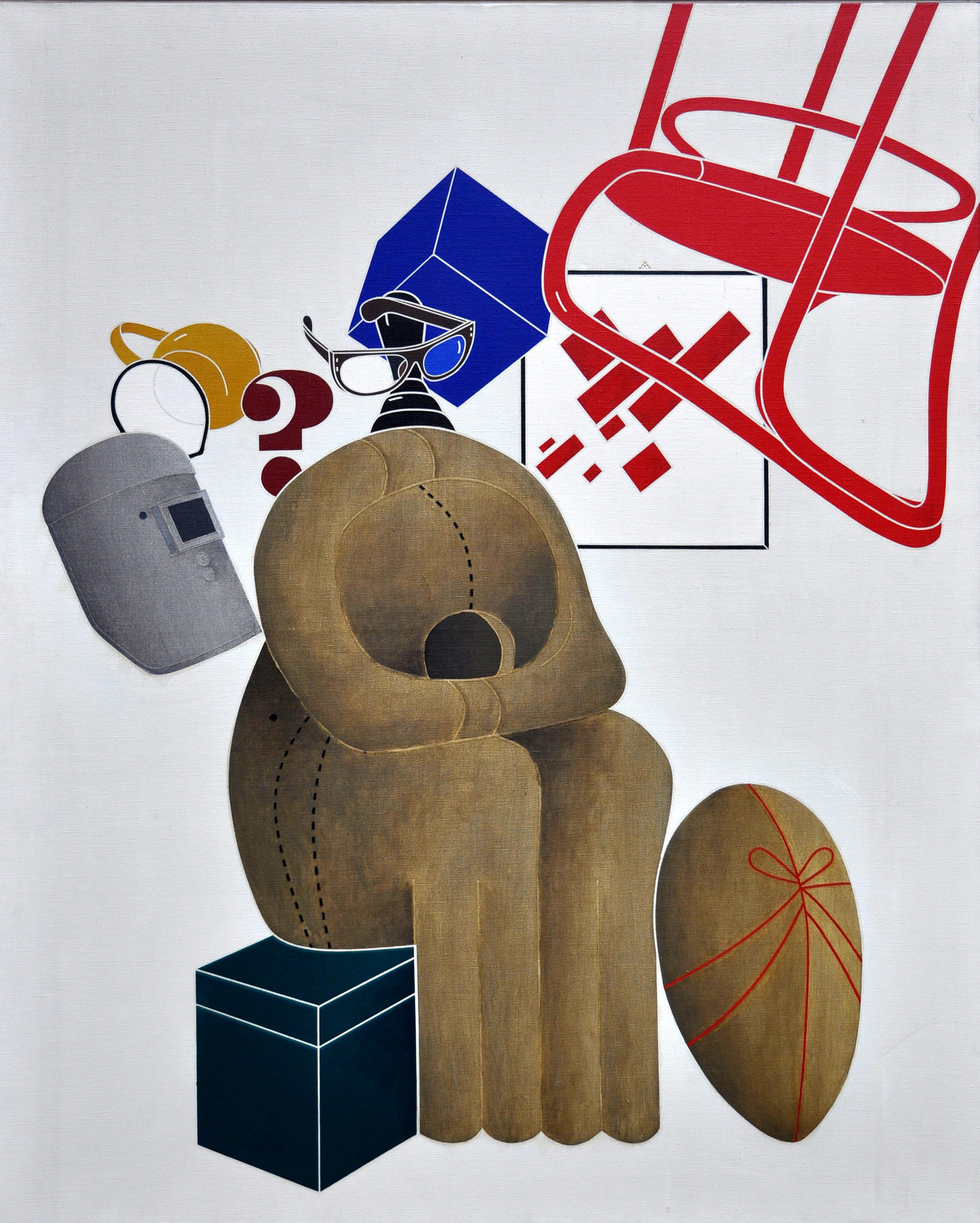
"A writer who paints, a painter who writes" is how Umberto Eco described the multidisciplinary Emilio Tadini, who was born in Milan in 1927 and died in his hometown in 2002. Born as a writer, Tadini approached the world of literature, writing and translation at an early age, a passion that he learned from his father. Starting in the 1950s, Tadini kept company with many important intellectuals of the Milanese scene, and he was able to make a name for himself as an acute writer and essayist, which he developed in parallel with painting.
In addition, during this period, Tadini began to paint, developing an innovative and individual stylistic language. Tadini developed his work in large cycles, constructing the painting according to a technique of overlapping planes where memory and reality, the tragic and the comic, continuously play against each other. Tadini's starting point appeared to be the symbolist tradition, drawing on the visionary Bosh alongside the more contemporary Max Ernst, capturing elements in common. He reinterpreted ideas about the unconscious and the irrational through visual forms. In 1961, his first solo exhibition was held at Il Cavallino gallery in Venice, where his manifesto "Essay on Nazism" was exhibited.
From the 1970s onwards, Tadini's style changed as he joined the contemporary trend of Pop art, as had been developing in England, but blended with Freudian influences and symbolic shapes. Further, in these years, Tadini also engaged with real events, and this is evident in his painting, as shown by elements taken from advertising graphics and comic strips in an ironic combination with the objet trouvé of the Dada tradition. This combination is a way for the artist to investigate the deforming relationship between man, object, mass society, and consumerism.
The 1980-1990s saw a further deviation in Tadini's style, under considerable influence from the work of the German expressionist Max Beckmann, who provided the model for the reformulating Pop art. Tadini's works contain a great iconographic range within which there is harmonious dialogue between diverse styles, concepts, and representations, so much so as to define the work of the Milanese artist as visionary.