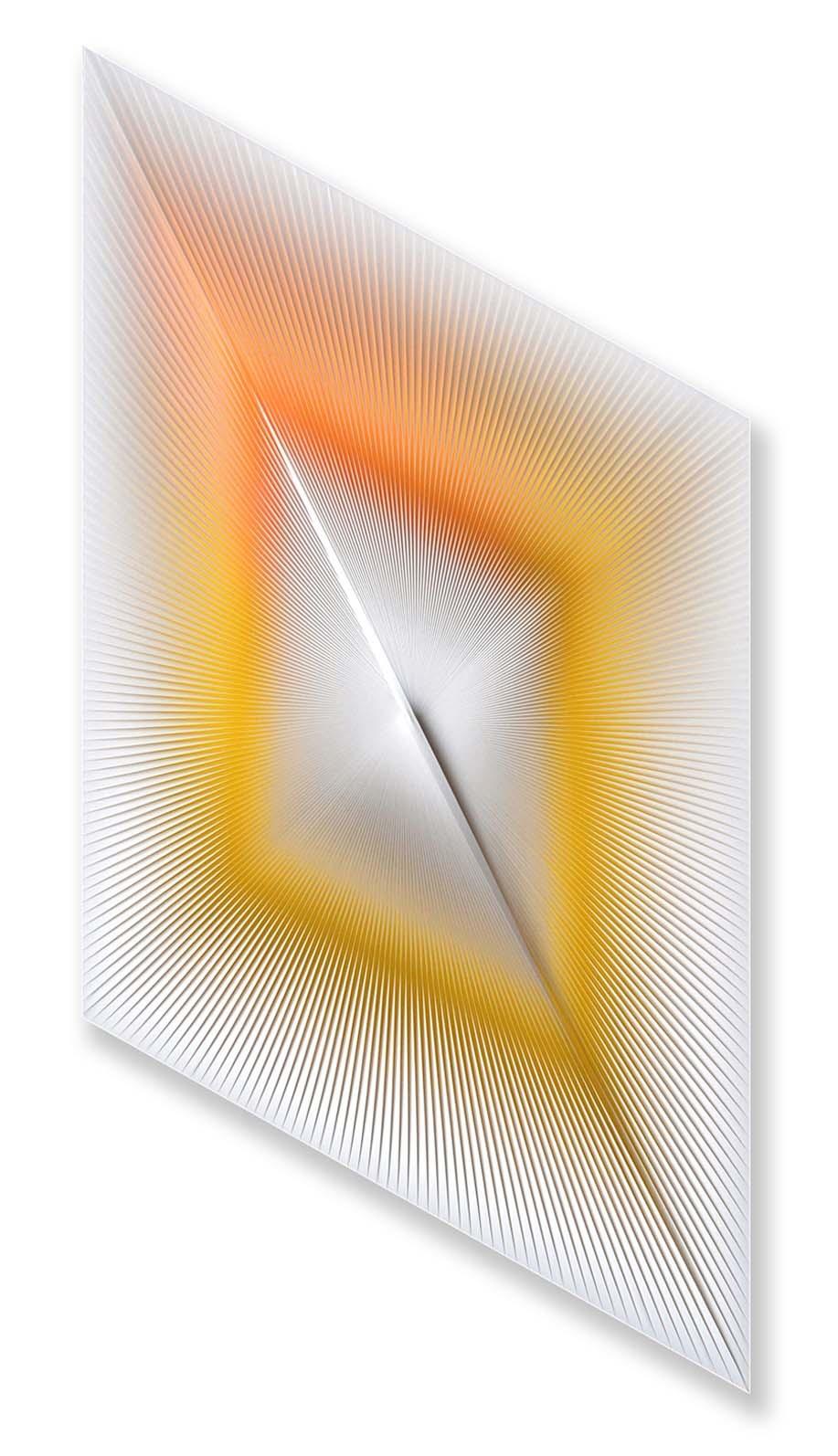
Born in Padua in 1937, Alberto Biasi is one of the foremost artists of the kinetic and optical art (Op art) movements, both in Italy and internationally. His career as an artist began in the 1960s, participating in his first collective exhibition with Castellani, Manzoni and others at the Azimut in Milan in 1960.
In the same year, together with the artist Manfredo Massironi he founded 'Gruppo N', a collective of artists in Padua, that remained active until 1965. These artists sought to rally against an excessively spiritualist philosophy surrounding the figure of the artist, instead promoting a decidedly more scientific, rigorous and above all participatory approach, aimed at investigating the laws existing between form, perception and vision.
During the1960s Biasi, through his investigations of the relationships between the viewer and the object, produced several significant series of works within the Op Art canon. His first series, mainly in 1959-60, was Trame, rectangular and permeable objects that appeared to shift and distort in relation to the viewer's changing standpoint. Following Trame he developed a series of works, Rilievi ottico-dinamici, comprising overlapping membranes of contrasting colours that created dynamic optical effects. Towards the end of the decade, Biasi developed immersive pieces called Ambienti, combining sound and light installations for the viewer to experience, among the first to introduce this form of experiential, participatory art to Italy.
Throughout the 1970s and 1980s, Biasi became best-known for his Politipi works, intricately constructed from interweaving fine strips of material thus playing with the viewer's sense of depth and dimensions. In the last decade of the twentieth century, he focussed his attentions on Assemblaggi, incorporating layers of different surfaces and materials in increasingly three-dimensional forms.
In a varied and ground-breaking career spanning six decades, Biasi has exhibited internationally and his works are today in the collections of some of the world's most prestigious institutions, including the MoMA in New York and the Galleria Nazionale d’Arte Moderna in Rome.