Mimmo Rotella
b. 1918, Catanzaro, Italy
d. 2006, Milan, Italy
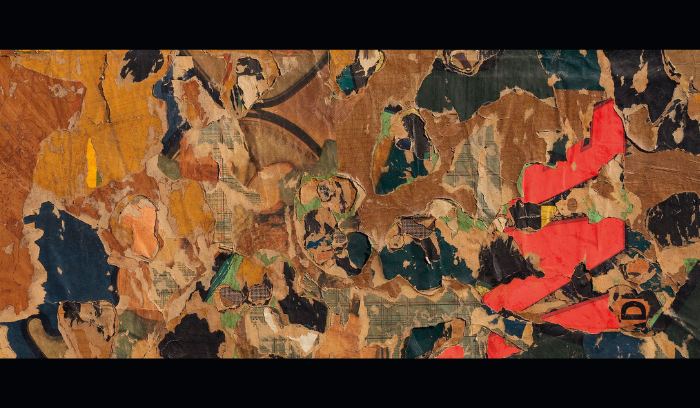
Virus 2
1989
Overpaint on zinc
99.8 x 151 cm (39 1/4 x 59 1/2 in)
Provenance
Private Collection
Literature
Mimmo Rotella, exh. cat. Galleria Biasutti, Turin, 1990 (illustrated).
Mimmo Rotella. Lamiere, exh. cat. Studio Marconi, Milan, 1989, p. 95 (illustrated).
Antonella Soldaini, Mimmo Rotella, exh. cat. Robilant + Voena, London, 2015, pp. 178 and 210, no. 102.
Description
Mimmo Rotella’s experiments made him a living legend in a world of Italian art—fanatical, extravagant, unpredictable. In the early 1950s, Rotella abandoned abstract painting as his primary form of artistic expression. Excited by the bold and colorful movie and advertising posters he saw all around the city, and inspired by the unorthodox innovations of other artists in the Italian capital at this time, including Alberto Burri, Robert Rauschenberg, Salvatore Scarpitta, and Cy Twombly, Rotella began to rip placards, signs, and banners heralding the talents of Marilyn Monroe, ministers, and circus acts from the pockmarked walls of the post-war city and used them as to create his now-famous assemblages.
The works he created throughout the 1950s and 1960s take two distinct forms. In his décollages, Rotella piled and glued advertisements face-up before tearing away and incising individual layers, creating intentional and accidental expressionist juxtapositions of bold words, vibrant colors, and pop cultural imagery. By contrast, in his retro d’affiches, the artist used only the posters’ versos, leaving visible the traces of glue, rust, plaster, and dust that clung to these surfaces as they were ripped from the city walls, underscoring an interest in materiality similar to “art informel” artists such as Alberto Burri and Lucio Fontana, and revealing, quite literally, the underside of consumer dreams. Indeed, rather than celebrating popular tastes, Rotella’s works collapse any semblance of cultural hierarchy onto itself. Similar to his American Pop Art counterparts, Rotella’s excavation of popular imagery roots the décollages in the time of their creation, while simultaneously underscoring the ephemerality of the present moment.
Rotella would spend the next half-century, until his death in 2006, experimenting with many artistic techniques, endlessly seeking to broaden his linguistic and formal horizons: besides the décollages and retro d’affiches, he tried his hand at collage, photographic reproduction, artypos, frottages, effaçages, blanks, and sculpture. Virus 2 (1989) belongs to a way of making Rotella called sovrapitture (meaning “painting over”), explored by the artist in the 1980s. The sovrapitture marked the artist’s return to the basic techniques of the décollages, though now intervening upon their surfaces with words and images created with acrylic paint. In a further departure from his earlier décollages, Rotella glued the assemblages to canvases and, as here, reclaimed metal sheets. Although Rotella noted that the sovrapitture were “a logical continuation of the first mass-media images executed at the beginning of my career using the ‘tearing’ technique,” he also acknowledged the urban influences at the heart of these new, energetic, even violent explosions of shapes, colors, and words: “in 1987, I began to recover old metal panels on which I pasted torn posters: over them I painted figures, symbols, graffiti that I saw not only on the walls of the city, but also in the subways and in some of the advertising in magazines.”1
This heightened interest in the graphic part of the artistic composition, with inspiration taken from the street, echoes the work of the American graffiti artist Jean-Michel Basquiat, and marks a clear response to the postmodernist crisis in art, and especially in painting. As Rotella himself said years later, recalling the period of the sovrapitture: “…I realized that painting changes. I was tired of the insignificant and retrograde painting I was seeing around. I decided to return to the brush and color. In short, I want to show both the new sensitivity and the technique for the new way of expression, adapting to our times. By now, I think aesthetics in art is finished. We have to return to a barbaric type of semi-expressionist painting with rather ugly colors. In short, an anti-painting, a bad painting that becomes beautiful painting, good painting, strong, brilliant and almost magical.”2
1. Mimmo Rotella, L’ora della lucertola, Milan, 2002, p. 254.
2. Rotella, op cit., p. 230.
The artwork described above is subject to changes in availability and price without prior notice. Where applicable ARR will be added.
The works he created throughout the 1950s and 1960s take two distinct forms. In his décollages, Rotella piled and glued advertisements face-up before tearing away and incising individual layers, creating intentional and accidental expressionist juxtapositions of bold words, vibrant colors, and pop cultural imagery. By contrast, in his retro d’affiches, the artist used only the posters’ versos, leaving visible the traces of glue, rust, plaster, and dust that clung to these surfaces as they were ripped from the city walls, underscoring an interest in materiality similar to “art informel” artists such as Alberto Burri and Lucio Fontana, and revealing, quite literally, the underside of consumer dreams. Indeed, rather than celebrating popular tastes, Rotella’s works collapse any semblance of cultural hierarchy onto itself. Similar to his American Pop Art counterparts, Rotella’s excavation of popular imagery roots the décollages in the time of their creation, while simultaneously underscoring the ephemerality of the present moment.
Rotella would spend the next half-century, until his death in 2006, experimenting with many artistic techniques, endlessly seeking to broaden his linguistic and formal horizons: besides the décollages and retro d’affiches, he tried his hand at collage, photographic reproduction, artypos, frottages, effaçages, blanks, and sculpture. Virus 2 (1989) belongs to a way of making Rotella called sovrapitture (meaning “painting over”), explored by the artist in the 1980s. The sovrapitture marked the artist’s return to the basic techniques of the décollages, though now intervening upon their surfaces with words and images created with acrylic paint. In a further departure from his earlier décollages, Rotella glued the assemblages to canvases and, as here, reclaimed metal sheets. Although Rotella noted that the sovrapitture were “a logical continuation of the first mass-media images executed at the beginning of my career using the ‘tearing’ technique,” he also acknowledged the urban influences at the heart of these new, energetic, even violent explosions of shapes, colors, and words: “in 1987, I began to recover old metal panels on which I pasted torn posters: over them I painted figures, symbols, graffiti that I saw not only on the walls of the city, but also in the subways and in some of the advertising in magazines.”1
This heightened interest in the graphic part of the artistic composition, with inspiration taken from the street, echoes the work of the American graffiti artist Jean-Michel Basquiat, and marks a clear response to the postmodernist crisis in art, and especially in painting. As Rotella himself said years later, recalling the period of the sovrapitture: “…I realized that painting changes. I was tired of the insignificant and retrograde painting I was seeing around. I decided to return to the brush and color. In short, I want to show both the new sensitivity and the technique for the new way of expression, adapting to our times. By now, I think aesthetics in art is finished. We have to return to a barbaric type of semi-expressionist painting with rather ugly colors. In short, an anti-painting, a bad painting that becomes beautiful painting, good painting, strong, brilliant and almost magical.”2
1. Mimmo Rotella, L’ora della lucertola, Milan, 2002, p. 254.
2. Rotella, op cit., p. 230.
The artwork described above is subject to changes in availability and price without prior notice. Where applicable ARR will be added.