Mimmo Rotella
b. 1918, Catanzaro, Italy
d. 2006, Milan, Italy
Violenza Segreta (Secret Violence)
1963
Photographic reproduction on canvas
126.5 x 93.7 cm (49 3/4 x 36 7/8 in.)
Provenance
Robilant+Voena
Literature
Catalogo 1, La Tartaruga, Rome, 1964, (illus.);
G. Celant, Mimmo Rotella, Skira, 2007, p.272, n.275 (comparative);
A. Soldaini, Mimmo Rotella, Skira, Robilant + Voena, Milan, 2015, pp. 121 & 209, n. 63 (illus.);
L. M. Barbero, Imagine: New Imagery in Italian Art 1960-1969, Marsilio, 2016, p. 209.
Description
By 1963, Mimmo Rotella was already familiar with the pictorial and photographic ‘montages’ that characterised the historical avant-gardes of the 1920s, Rauschenberg’s artworks that incorporated painting with photography and Warhol’s Pop Art of edited and manipulated silkscreen photograph reproductions. Contrary to photographic manipulation characterised by the use of colour and extensive repetition, Rotella’s self-acclaimed process of reportage - also known as photographic reproductions - sought to communicate through photography’s pure informative nature while reducing the artistic interference to a minimum. More specifically, Rotella’s Photographic Reproductions are employed in two main iconographic nuclei: the socio-political reportages and the portraits, characterized by two different acquisition processes.
For the socio-political reportages, the images are cropped from magazines and newspapers, and then photographed. According to the composition, one or two negatives would be enlarged and projected on to canvas to be treated with photographic emulsion in order to fix the image. For the portraits, the subject is instead photographed directly by the artist while the projection of the negative and the preparation of the base remain the same.
Realising either of the two artistic processes, Rotella formed new images that, despite their alienation from their original context, would still transfer information linked to their political, religious, commercial or promotional designation. With the absence of colours transcending the values of photography’s purely informative communication, Rotella’s refrained gestural participation promotes notions of the dematerialization of art, while reflecting on the iconography and logic of its existence as an experience and as an idea.
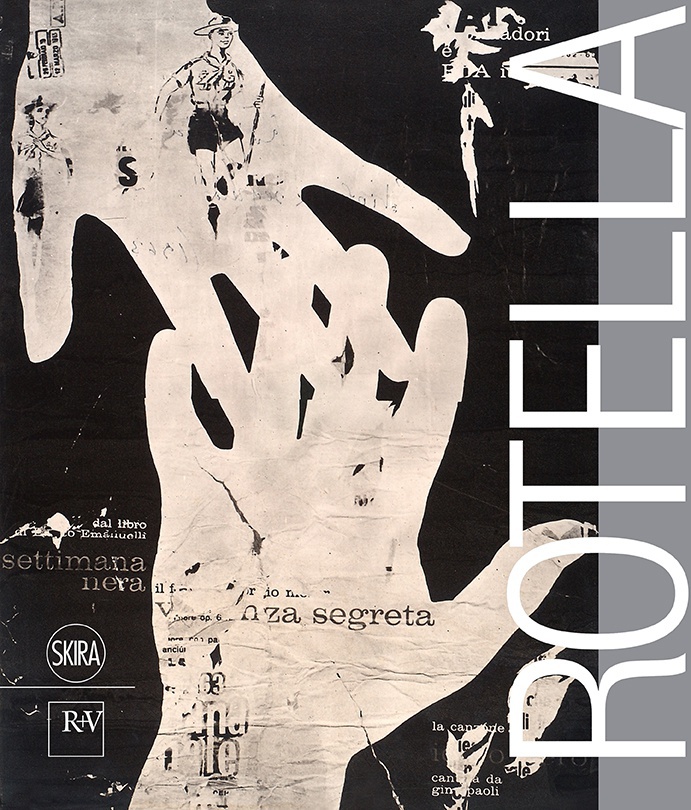
Therefore, Violenza Segreta, 1963 represents one of Rotella’s more emotional photographic reproductions. By eliminating the artist’s gesture to the basic elements of scale and composition, the two intersecting hands, in relation to the artwork’s title Violenza Segreta for Secret Violence, stand as a visual commentary on the use of advertising posters as means of manipulating a society’s consuming or political behaviour. Contrary to the inspired notions of unity that derive from the intimate projection of two touching hands, the almost abusive lack of colour ignites concepts that refer to the uninviting progress of the modern world and its and harmful evolving nature.
The artwork described above is subject to changes in availability and price without prior notice.
Where applicable ARR will be added.
For the socio-political reportages, the images are cropped from magazines and newspapers, and then photographed. According to the composition, one or two negatives would be enlarged and projected on to canvas to be treated with photographic emulsion in order to fix the image. For the portraits, the subject is instead photographed directly by the artist while the projection of the negative and the preparation of the base remain the same.
Realising either of the two artistic processes, Rotella formed new images that, despite their alienation from their original context, would still transfer information linked to their political, religious, commercial or promotional designation. With the absence of colours transcending the values of photography’s purely informative communication, Rotella’s refrained gestural participation promotes notions of the dematerialization of art, while reflecting on the iconography and logic of its existence as an experience and as an idea.
Therefore, Violenza Segreta, 1963 represents one of Rotella’s more emotional photographic reproductions. By eliminating the artist’s gesture to the basic elements of scale and composition, the two intersecting hands, in relation to the artwork’s title Violenza Segreta for Secret Violence, stand as a visual commentary on the use of advertising posters as means of manipulating a society’s consuming or political behaviour. Contrary to the inspired notions of unity that derive from the intimate projection of two touching hands, the almost abusive lack of colour ignites concepts that refer to the uninviting progress of the modern world and its and harmful evolving nature.
The artwork described above is subject to changes in availability and price without prior notice.
Where applicable ARR will be added.