
Josef Albers
b. 1888, Bottrop, Germany
d. 1976, New Haven, CT
Variant Orange Wall
1948–56
Oil on masonite
60.5 x 87.5 cm (23 7/8 x 34 1/2 in.)
Provenance
with Sidney Janis Gallery, New York (#5307);
with Galerie Denise René, Paris;
Private collection;
(Sotheby's London, 1 July 1976, lot 308);
Private collection.
with Galerie Denise René, Paris;
Private collection;
(Sotheby's London, 1 July 1976, lot 308);
Private collection.
Literature
This work will be included in Jeannette Redensek's forthcoming Josef Albers catalogue raisonné.
Description
Josef Albers was born in Bottrop, Germany and originally studied to become a teacher before changing to art, entering the Bauhaus from 1920 to 1933. After emigrating to the United States in 1933, Albers taught at Black Mountain College, North Carolina, and Yale University, New Haven, where he taught the likes of Robert Rauschenberg, Cy Twombly and Eva Hesse. Both a theoretician and a teacher, Albers was an important influence on generations of young artists. His experimentation with colour interaction and geometric shapes transformed the modern art scene and inspired movements such as Geometric Abstraction, Colour Field painting and Op Art.
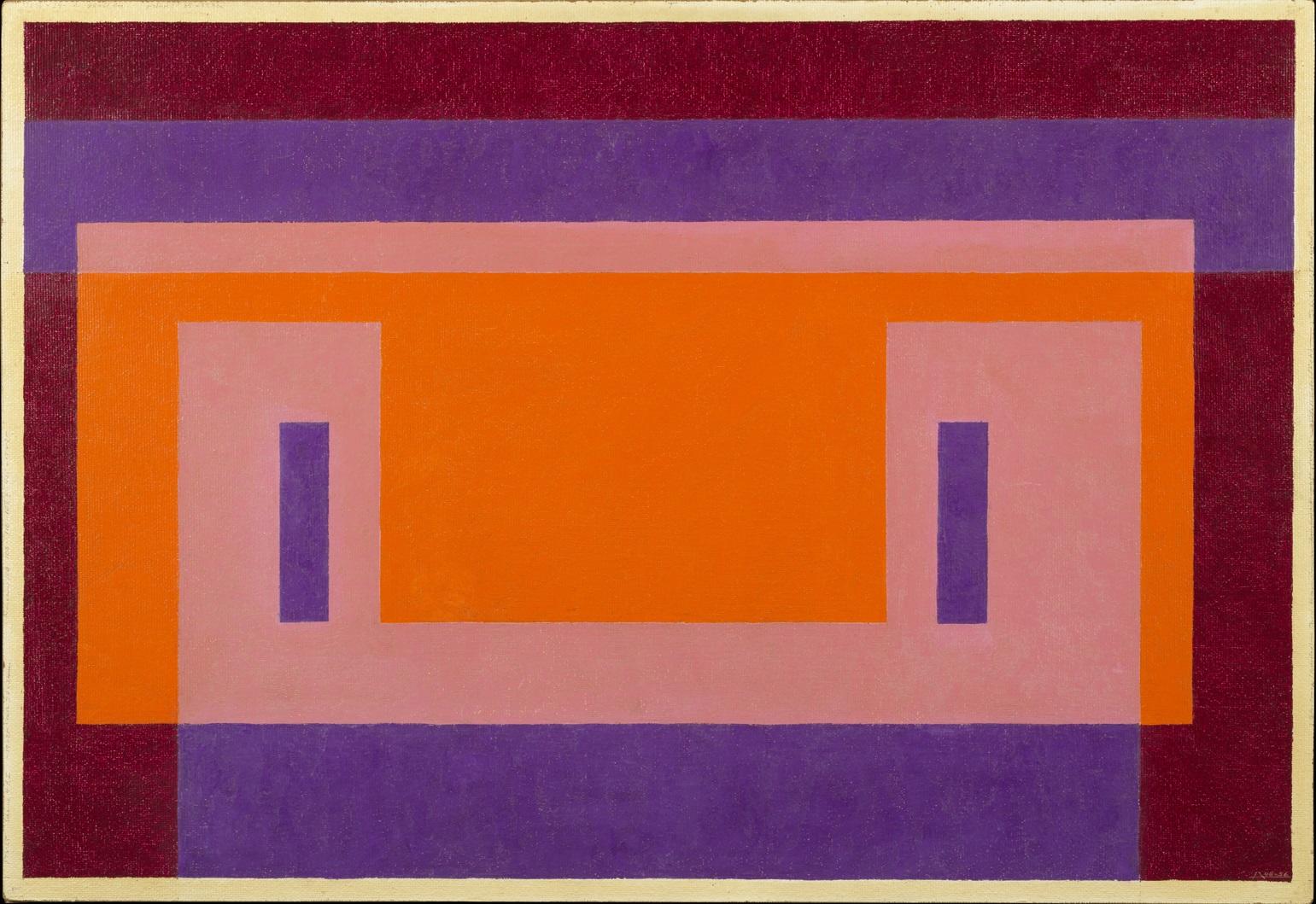
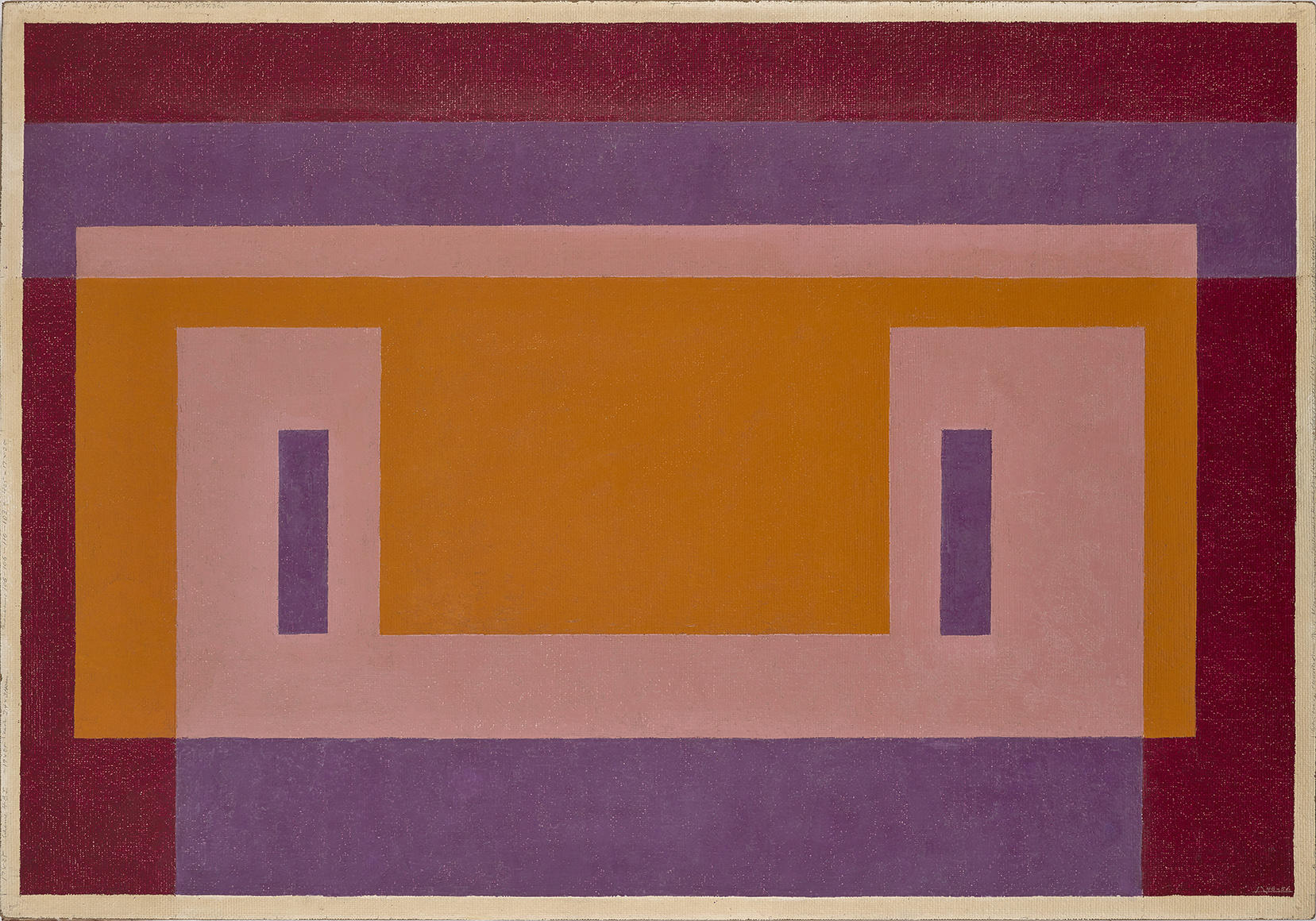
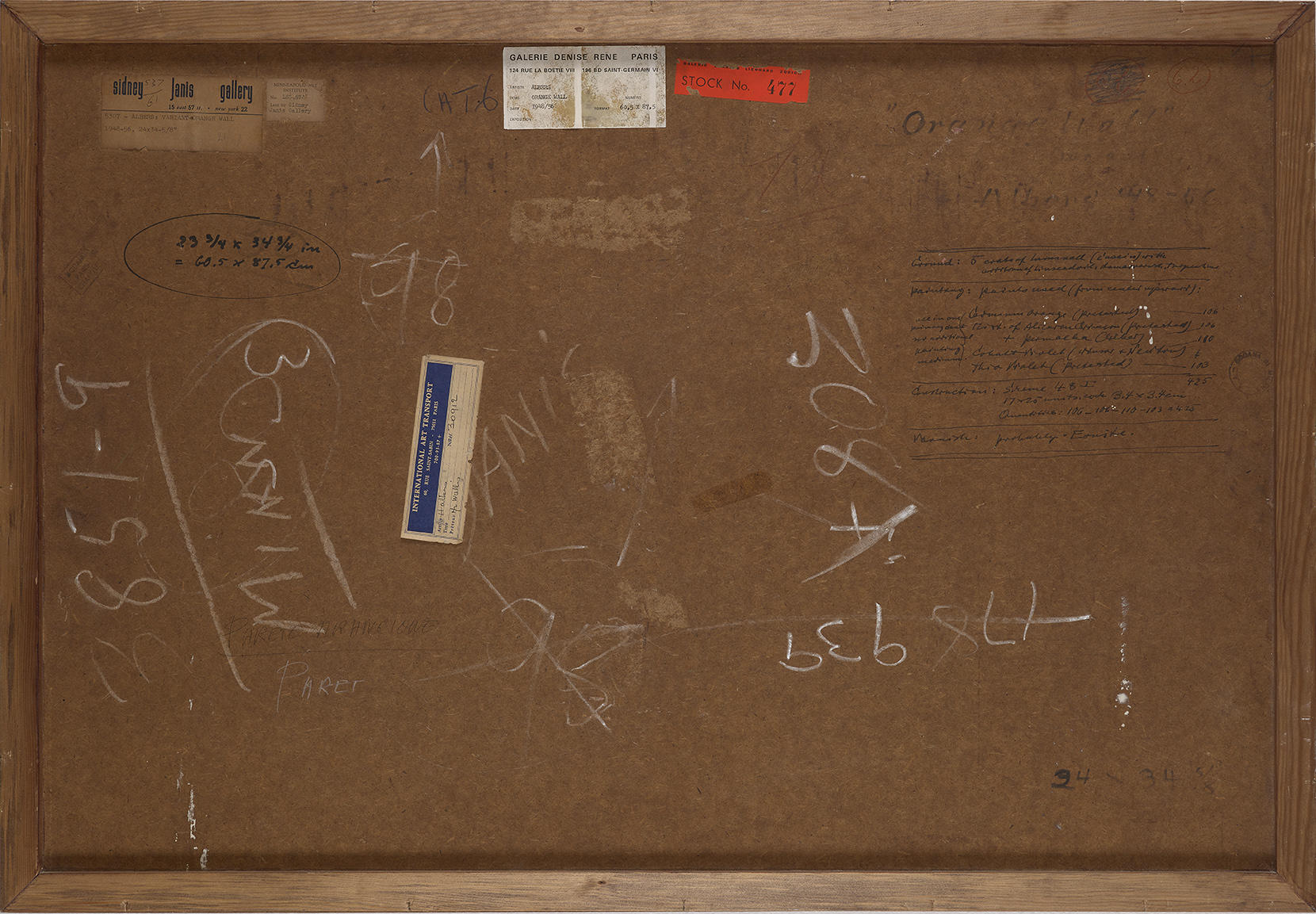
Variant Orange Wall forms part of one of Albers' most seminal bodies of work, the Adobe series. A testimony to Albers technical nature, he carefully noted all the materials and techniques for each of his works on the reverse, documenting the pigments applied and the spatial formula used. Comprised of deep orange and red and unadulterated jewel tones, Variant Orange Wall is architectural in its composition and asymmetrical in arrangement.
The subtle variances of the two rising forms on the left and right side of the surface create a delicate balance that simultaneously creates depth and stark contrast in colour tonalities. An exacting command of the palette knife can be detected in the scrupulous application of pigment. Albers insisted, "Someone else could have executed it," but as Elaine de Kooning explains, "The aseptic, almost militant simplicity of each of Albers’ designs is the result of the long series of rejections - an arduous and complicated exercise of the element of choice." These compositions of pure form and colour are best described by Hans Arp, who said that Albers’ paintings "Contain simple, great statements such as: I’m standing here. I’m resting here. I’m in the world and on the earth. I’m in no hurry to move on. While Mark Rothko sought transcendence, Albers looked for fulfilment here on earth. Mark Rothko approached the ethereal through art. Josef Albers realized ‘the spiritual in art.’” (Weiland Schmied, “Fifteen Notes on Josef Albers," pp. 9–10).
Albers used the basic structure of the brick to build an underlying checkerboard-like pattern to provide a unification of form, whereby the individual square and oblong units permit a precise relationship of the areal quantities of the colours used. Through this series Albers investigated the effect of several pure, unmixed colours juxtaposed with one another. In his writings Albers describes how “the paint is applied with a palette knife directly from the tube to the panel, in one primary coat without under or over painting, without correction.” (Getulio Alviani, ed., Josef Albers, Milan 1988, p. 104). The purpose of these experiments was to see how colours affect one another according to the proportions and quantities used and how this then alters the way the viewer perceives its position in space. These experimentations and theories were then carried through to his later series for which he is best known, Homage to the Square.
Albers begun the Adobe series in 1947, demonstrating the convergence of his exploration of colour theory and background in design and architecture with influences from Mexican culture, all of which have come to be distinguishing aspects of Albers' artistic practice. In 1935, Albers took the first of many trips to Mexico and was greatly inspired by the colours, pre-Columbian architecture and sculpture that he saw there. These trips to Mexico had a profound effect upon his work, as he wrote to Nina and Wassily Kandinsky in 1936, “Mexico is truly the promised land of abstract art.” (Nicholas Fox Weber and Jessica Boissel, Josef Albers and Wassily Kandinsky: Friends in Exile: A Decade of Correspondence, 1929–1940, Manchester and New York 2010). Mexico confirmed Albers’ faith in the expressive power of colour and it was here that he returned to painting, significantly expanding his range of colour. Albers also drew inspiration from many of Mexico’s houses that were built from sun-dried bricks made of adobe clay, originally used by the native American Pueblo Indians, in conceptualizing the Adobe series. In Mexico, Josef Albers met Luis Barragan, one of Mexico's most important architects of the twentieth century, and who considered Albers one of the great influences in his architecture. The two had deep and lasting reciprocal influences on each other that informed both mens' future work. In examining Variant Orange Wall, Albers' influence is clear: the painting’s vibrant colours echo the myriad hues Albers must have encountered on his trips to Mexico, resulting in a powerful composition fusing Albers' lifelong meditation on form and colour with his new-found inspiration.
For details of the inscriptions on the verso of the masonite support please see the attached document.
This work is registered with the Josef Albers Foundation as #JAAF 1948.1.10 and comes with a certificate from the foundation.
The artwork described above is subject to changes in availability and price without prior notice. Where applicable ARR will be added.
Variant Orange Wall forms part of one of Albers' most seminal bodies of work, the Adobe series. A testimony to Albers technical nature, he carefully noted all the materials and techniques for each of his works on the reverse, documenting the pigments applied and the spatial formula used. Comprised of deep orange and red and unadulterated jewel tones, Variant Orange Wall is architectural in its composition and asymmetrical in arrangement.
The subtle variances of the two rising forms on the left and right side of the surface create a delicate balance that simultaneously creates depth and stark contrast in colour tonalities. An exacting command of the palette knife can be detected in the scrupulous application of pigment. Albers insisted, "Someone else could have executed it," but as Elaine de Kooning explains, "The aseptic, almost militant simplicity of each of Albers’ designs is the result of the long series of rejections - an arduous and complicated exercise of the element of choice." These compositions of pure form and colour are best described by Hans Arp, who said that Albers’ paintings "Contain simple, great statements such as: I’m standing here. I’m resting here. I’m in the world and on the earth. I’m in no hurry to move on. While Mark Rothko sought transcendence, Albers looked for fulfilment here on earth. Mark Rothko approached the ethereal through art. Josef Albers realized ‘the spiritual in art.’” (Weiland Schmied, “Fifteen Notes on Josef Albers," pp. 9–10).
Albers used the basic structure of the brick to build an underlying checkerboard-like pattern to provide a unification of form, whereby the individual square and oblong units permit a precise relationship of the areal quantities of the colours used. Through this series Albers investigated the effect of several pure, unmixed colours juxtaposed with one another. In his writings Albers describes how “the paint is applied with a palette knife directly from the tube to the panel, in one primary coat without under or over painting, without correction.” (Getulio Alviani, ed., Josef Albers, Milan 1988, p. 104). The purpose of these experiments was to see how colours affect one another according to the proportions and quantities used and how this then alters the way the viewer perceives its position in space. These experimentations and theories were then carried through to his later series for which he is best known, Homage to the Square.
Albers begun the Adobe series in 1947, demonstrating the convergence of his exploration of colour theory and background in design and architecture with influences from Mexican culture, all of which have come to be distinguishing aspects of Albers' artistic practice. In 1935, Albers took the first of many trips to Mexico and was greatly inspired by the colours, pre-Columbian architecture and sculpture that he saw there. These trips to Mexico had a profound effect upon his work, as he wrote to Nina and Wassily Kandinsky in 1936, “Mexico is truly the promised land of abstract art.” (Nicholas Fox Weber and Jessica Boissel, Josef Albers and Wassily Kandinsky: Friends in Exile: A Decade of Correspondence, 1929–1940, Manchester and New York 2010). Mexico confirmed Albers’ faith in the expressive power of colour and it was here that he returned to painting, significantly expanding his range of colour. Albers also drew inspiration from many of Mexico’s houses that were built from sun-dried bricks made of adobe clay, originally used by the native American Pueblo Indians, in conceptualizing the Adobe series. In Mexico, Josef Albers met Luis Barragan, one of Mexico's most important architects of the twentieth century, and who considered Albers one of the great influences in his architecture. The two had deep and lasting reciprocal influences on each other that informed both mens' future work. In examining Variant Orange Wall, Albers' influence is clear: the painting’s vibrant colours echo the myriad hues Albers must have encountered on his trips to Mexico, resulting in a powerful composition fusing Albers' lifelong meditation on form and colour with his new-found inspiration.
For details of the inscriptions on the verso of the masonite support please see the attached document.
This work is registered with the Josef Albers Foundation as #JAAF 1948.1.10 and comes with a certificate from the foundation.
The artwork described above is subject to changes in availability and price without prior notice. Where applicable ARR will be added.