
Antonio Canal, called Canaletto
b. 1697, Venice, italy
d. 1768, Venica, Italy
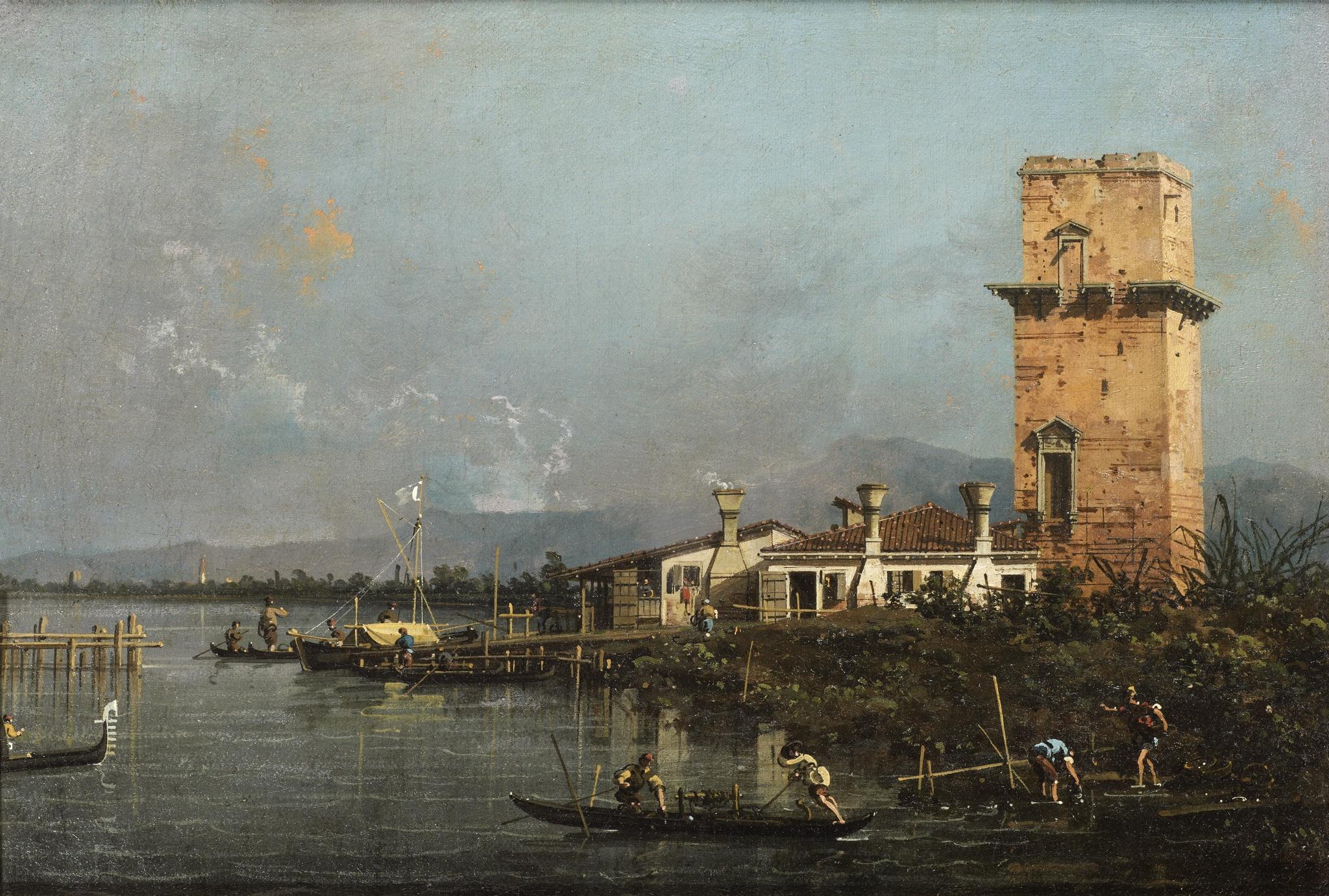
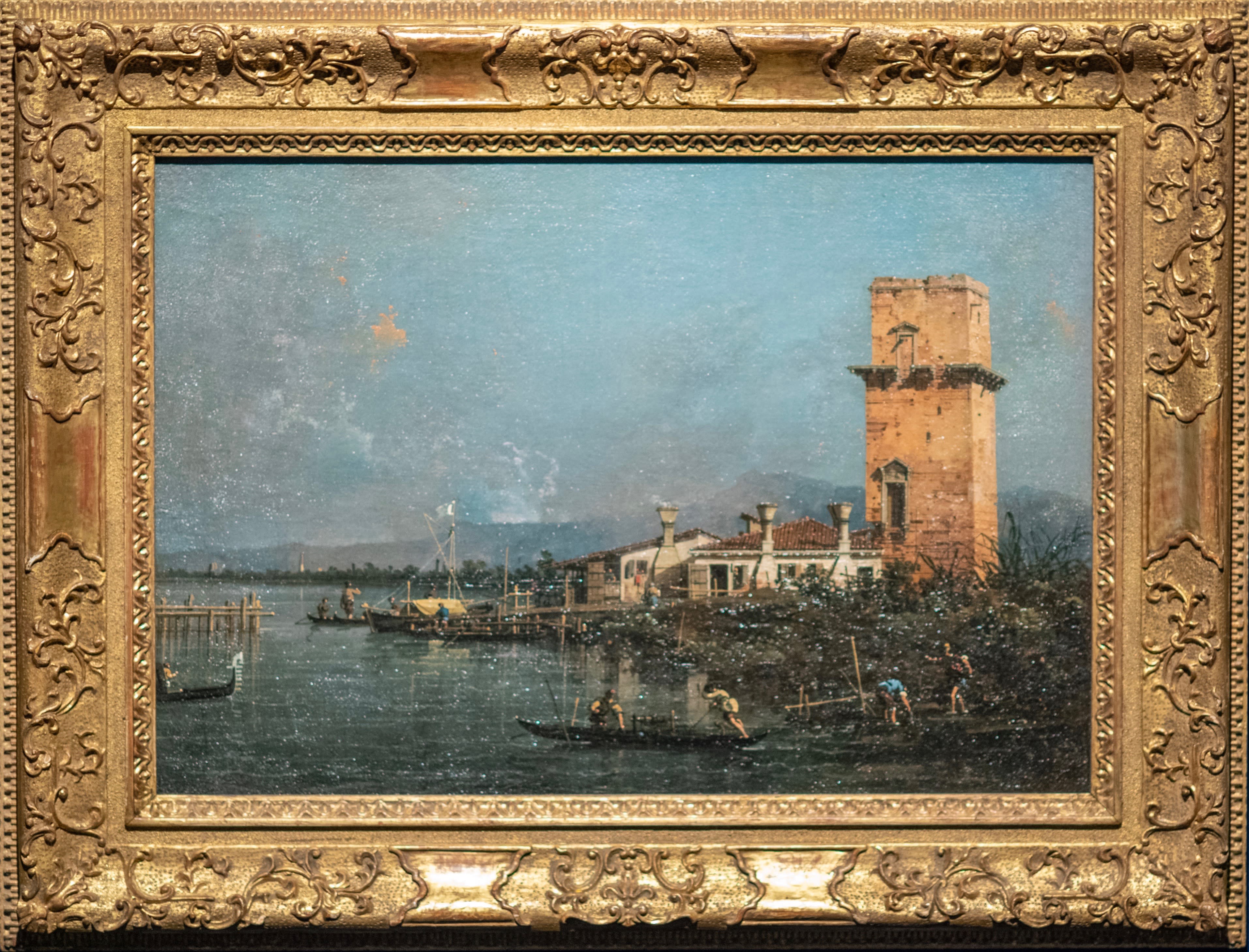
The Tower of Malghera
c. 1740s
Oil on canvas
31.5 x 46.2 cm (12 3/8 x 18 1/4 in.)
With frame: 45.5 x 60 cm (18 x 23 1/2 in.)
Provenance
Dmitri Tziracopoulo, Berlin, before 1939, and subsequently Athens;
Thomas Agnew & Sons Ltd, London, 1984;
Jaime Ortiz Patino;
Thomas Agnew & Sons Ltd, London 1987;
Robert H. Smith, Crystal City, Virginia;
Simon Dickinson;
Private collection.
Literature
W. G. Constable (later editions rev. J. G. Links), Canaletto, London, 1962, vol. 1, pl. 67, and vol. 2, no. 369 (with incorrect width measurement).
Antonio Morassi, Guardi. L’opera completa, Milan, 1968, p. 107, no. 198, illustrated.
Giuseppe Berto and Lionello Puppi, L'opera completa del Canaletto, Milan, 1968, no. 198.
Stefan Kozakiewicz, Bernardo Bellotto, London, 1972, vol. 2, p. 457.
Evelyn Joll in Julian Agnew, ed., Agnew’s 1982–1992, London, 1992, p. 85, illustrated.
Jane Martineau and Andrew Robison, eds., The Glory of Venice: Art in the Eighteenth Century, exh. cat. Royal Academy of Arts, London, and National Gallery of Art, Washington, 1994–95, p. 438, under no. 143, entry by Ruth Bromberg.
Treasures of Venice: Paintings from the Museum of Fine Arts, Budapest, exh. cat. High Museum of Art, Atlanta, Georgia, Seattle Art Museum, Seattle, Washington, and Minneapolis Institute of Arts, Minneapolis, Minnesota, 1995–96, p. 206, in entry by Zsuzsanna Dobos.
J. G. Links, A Supplement to W. G. Constable’s Canaletto, London, 1998, p. 35.
Marc Restellini, ed., De Fra Angelico a Bonnard: Chefs-d’oeuvre de la Collection Rau, exh. cat. Musée du Luxembourg, Paris, 2000–1, p. 48.
Boźena Anna Kowalczyk, ed., Canaletto e Bellotto: l’arte della veduta, exh. cat. Palazzo Bricherasio, Turin, 2008, pp. 180–81, no. 68.
Charles Beddington, ed., Venice: Canaletto and his Rivals, exh. cat. National Gallery, London and National Gallery of Art, Washington, 2010–11, p. 97.
Annalisa Scarpa, ed., Canaletto à Venise, exh. cat. Musée Maillol, Paris, 2012–13, p. 144, entry by Gerard-Julien Salvy.
Description
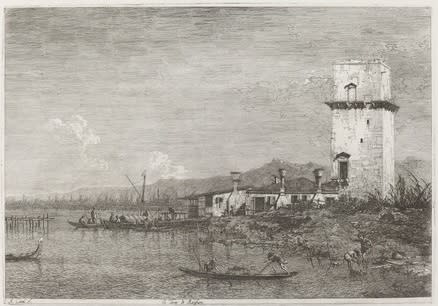
The Torre di Malghera, with the Euganean Hills in the background, became one of the most famous images of the Venetian Lagoon through an etching by Canaletto.2 The etching is one of six large signed and titled views from nature which resulted from Canaletto’s visit to the mainland with his nephew Bernardo Bellotto, probably in 1741, and is convincingly dated by Ruth Bromberg to around 1742. Generally regarded as Canaletto’s masterpiece in the medium, and indeed as one of the masterpieces of Venetian printmaking in the eighteenth century, a first state is known in a unique impression in the Gabinetto Nazionale delle Stampe, Rome, and impressions of the second and third states are in the National Gallery of Art in Washington, the British Museum in London, the Courtauld Institute of Art in London, the Berlin Kupferstichkabinett, the collection of Her Majesty the Queen at Windsor Castle, the Museo Correr, Venice, and elsewhere.
This is Canaletto’s only painting of the subject. As with the paintings by Canaletto corresponding to four of his six other etched mainland views,3 the painting unquestionably follows the etching, with which it corresponds almost exactly in size. As J. G. Links observed, “No authentic painting by Canaletto can be shown to precede a related etching.”4 Many of Canaletto’s paintings from the 1740s onwards are based on graphic sources, and testify to his ability to breathe life into depictions of subjects which he had often not seen for many years (or indeed which he had never seen). On stylistic grounds a date soon after Canaletto’s return to Venice from England, which took place probably in 1755, seems most likely. Zsuzsanna Dobos has suggested that this painting may originally have formed part of a series of mainland views along with a view of The Locks at Dolo in the Museum of Fine Arts, Budapest, and views of Mestre and Dolo now in the Fondation Bemberg, Toulouse, all of identical size and similarly based on Canaletto's own etchings.
The composition was to have a significant influence, and Bernardo Bellotto and Francesco Guardi, the two greatest Venetian view painters after Canaletto, both made versions of it. A painted version by Bellotto is in the collection of the Bristol Museums and Art Gallery, along with a pendant Lagoon Capriccio, also showing the Torre di Malghera in the background.5 Previously unrecorded, those were owned by Admiral Sir Victor Crutchley, V. C., of Mappercornbe Manor, Bridport, and were presented to Bristol after being accepted by Her Majesty’s government in lieu of tax in 1988. Bellotto’s version is larger and in a more horizontal format (37.3 x 62.2 cm.), omitting all the foreground figures and boats. Another painted version given to Bellotto is in the collection of the late Dr. Gusrnv Rau;6 more square in format (43 x 56.5 cm), it corresponds with the Bristol painting with the addition of a man seated on a wall in the lower right corner. The tower was later depicted by Guardi in paintings in the National Gallery, London, the National Gallery of Victoria, Melbourne, and elsewhere.7 A drawing of it by Guardi is based on Canaletto’s etching.8 An anonymous version was formerly in the collection of Conte San Vitale, Venice,8 the architecture implausibly described as “probably by Canaletto”,9 and another is in the Museo del Settecento Veneziano, Ca’ Rezzonico, Venice.10
Dmitri Tziracopoulo assembled an exceptional group of Venetian view paintings, which also included a Capriccio of a Palace Courtyard with Reminiscences of the Scala dei Giganti from Bernardo Bellotto’s second Dresden period11 and a view of Santa Maria della Salute by Michele Marieschi in the Museo Thyssen-Bomemisza, Madrid.12 He also owned a pair of fine capricci by Francesco Guardi,13 a full-size copy of The Reception of the French Ambassador the Comte de Gergy at the Doge’s Palace by Canaletto in the Hermitage, currently in a private collection, Vienna, as the work of Luca Carlevarijs,14 and paintings by lesser Venetian view painters such as Johann Richter.
Although the provenance of this painting before it entered the Tziracopoulo collection is not known, it should be noted that a view of The Fortress of Malghera given to Canaletto and “purchased of Marcato” was in the exceptional collection of G. A. F. Cavendish Bentinck, M.P., P.C., of 3 Grafton Street, London, and Brownsea Island, from which it was sold in his (posthumous) sale at Christie’s, London, 11 July 1891 (=4th day), lot 627; the size is, however, given as 19 ½ x 32 in., a considerable discrepancy even by the standards of nineteenth century cataloguing.
1. When it is referred to as destroyed by Emmanuele Cicogna, Corpus delle iscrizioni di Venezia e delle isole della laguna veneta, Venice, 1842, vol. 5, p. 345.
2. See Ruth Bromberg, Canaletto’s Etchings, London and New York, 1974, and 2nd ed., San Francisco, 1993, pp. 42–47, no. 2, illustrated; see also Bromberg in London and Washington 1994–95, p. 235, no. 143.
3. Bromberg 1974 and 1993, nos. 3, 4, 6 and 7–8.
4. Constable 1962, ed. 1976, vol. 2, p. 650.
5. Boźena Anna Kowalczyk, “Il Bellotto veneziano: grande intendimento ricercasi” Arte Veneta 48, (1996), p. 86, figs. 24–25.
6. Kozakiewicz 1972, no. Z 289.
7. Morassi 1968, vol. 1, pp. 252 and 433–34, nos. 664–67; vol. 2, figs. 620–22 and 624.
8. Antonio Morassi, Guardi: Tutti I disegni di Antonio, Francesco e Giacomo Guardi, Venice, 1975, p. 152, no. 413, fig. 415.
9. Constable 1962, no. 369a.
10. Constable 1962, no. 369b; Dorothea Terpitz, Canaletto, Cologne, 1998, pp. 74–75, pl. 63.
11. Kozakiewicz 1972, no. 309, illustrated.
12. Federico Montecuccoli degli Erri and Filippo Pedrocco, Michele Marieschi, Milan, 1999, p. 382, no. 154, illustrated.
13. Morassi 1975, vol. 1, pp. 486 and 489, nos. 952 and 970; vol. 2, fig. 851; exhibited London, Thomas Agnew & Sons Ltd, Venetian Eighteenth-Century Painting, 1985, nos. 10–11, both illustrated; see also Joll in London 1992, p. 87, both illustrated.
14. Constable 1962, vol. 2, under no. 356.
The artwork described above is subject to changes in availability and price without prior notice.