

Gaspar van Wittel, called Vanvitelli
b. 1653, Amersfoort, Netherlands
d. 1736, Rome, Italy
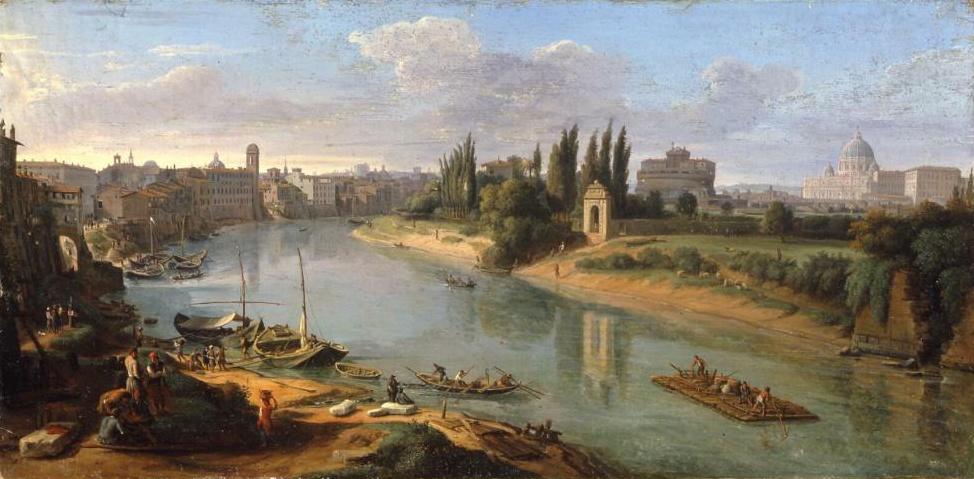
The Tiber at the Porto della Legna, Rome
Oil on canvas
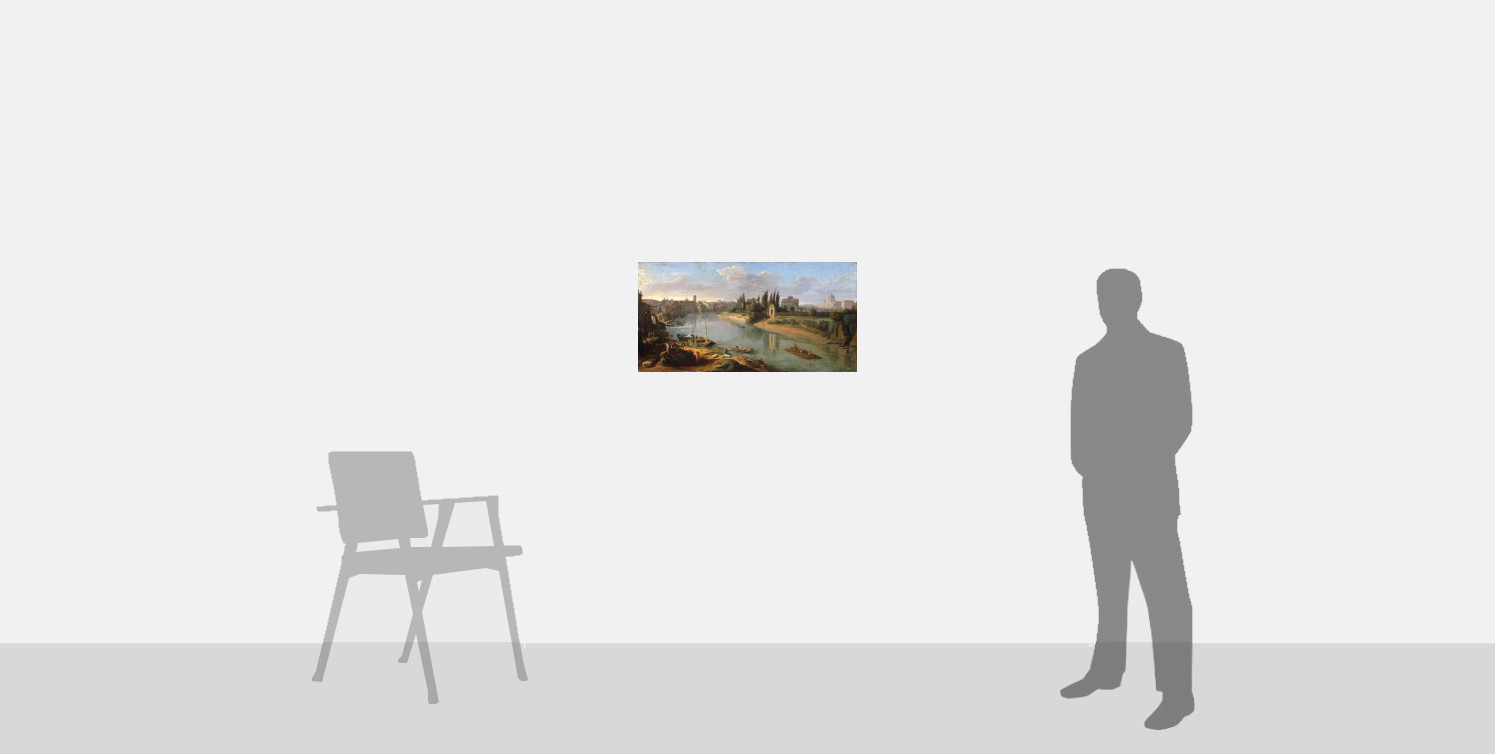
49 x 97.5 cm (19 1/4 x 38 3/8 in.)
Provenance
Purchased, together with its pendant, in Italy in the late Eighteenth century,
France, Private Collection.
Description
This view of the Tiber at the Porto della Legna is the pendant of the View of the Porto di Ripa Grande in the same private collection. These two magnificent topographical views are undated, but can on internal evidence be dated between the late 1680s and the early 1690s. This was a magical phase in Gaspar van Wittel’s career. Only once he had become a naturalized Roman, and had acquired some fame and self-confidence as a topographical painter, did he paint these images of the river life in Rome. They are populated by relatively large figures; after years of patient practice in drawing, he had now achieved considerable technical proficiency in the painting of such figures.
Gaspar van Wittel made a fine preparatory drawing for this View of the Tiber at the Porto della Legna. It is squared for transfer to canvas, and composed of several sheets of paper joined together, exactly as wide as the painting exhibited here. It shows signs of having been heavily used and hence is much worn; it also lacks its left side, probably part of the first sheet (see G. Briganti, 1996, pp. 399-401, D322). The loss of part of the drawing can also be inferred from the numbering of the squares that begin from the number 4. This drawing is in the Biblioteca Nazionale Vittorio Emanuele in Rome, together with some fifty others, all of them preparatory drawings that evidently formed part of the stock-in-trade of the Dutch master. This one, like others of this group, is datable to the early years in van Wittel’s career, undoubtedly before 1685, the year in which he painted the dated tempera of the same subject now in the Palazzo Pitti in Florence. Six versions of the same view derive from the preparatory drawing in the Biblioteca Nazionale; five of them have already been published (see G. Briganti, 1996, pp. 175-177, nos. 119-123). To these we can now add this unpublished version. It is worth pointing out that the tempera of this subject in the collection of Palazzo Colonna is also the pendant of another with the Porto di Ripa Grande as in this case. The two harbour scenes constitute almost the two outlying points of the course of the Tiber through Rome; I say “almost” because in actual fact, further upstream, before the Porto della Legna, there was the Ponte Molle (better known as Ponte Milvio), also portrayed by van Wittel, and further downstream was another point of view, closer to Porta Portese, that permitted a view of the Porto of Ripa Grande from the Ripa Grande itself. This was the last of the sites downstream along the curve of the river portrayed by the artist.
To return to the different versions of the view of the Tiber at Ripa Grande, we know of six of them, including this unpublished one; only one of them is dated: 1685. The latest of the group however must predate 1703, when the work ordered by Clemente XI Albani for the Port of Ripetta began; this harbour is visible on the left bank of the river, immediately after the Porto della Legna, but it is portrayed as it was before the initiation of Clement XI’s important, indeed revolutionary remodelling of the site.
The view is taken from close to the riverbank, at the Porto della Legna. This little harbour was situated roughly halfway along the Strada di Ripetta, close to the still existing church of Santa Maria di Porta Paradisi, now annexed to the hospital of San Giacomo, a few score metres further upstream from the Port of Ripetta. We may observe, from left to right, the landing stage for the unloading of timber (hence is the name: Porto della Legna), constructed in 1615 under the direction of Giovanni Vasanzio and Domenico Maderno. By provision of Paul V who had commissioned it, it was reserved for the unloading of fire-wood. Immediately after it we see the houses flanking Via Ripetta and the Dogana (custom-house) which projects above the others, being built on top of a high archway. Beyond this the line of houses along the riverbank is interrupted; we see the descent to the river and the open space facing the Ripetta, before which various boats are moored. The port of Ripetta appears here as it was in its still rustic state, before the beginning of Alessandro Specchi’s remodelling of the site commissioned by Clement XI in 1703 and completed in 1706. In the upper part of the painting to the left we see the monumental Palazzo Borghese rising behind the port of Ripetta; before it we may note the little campanile of the demolished church of San Gregorio dei Muratori. The campanile of Sant’Agostino follows on the horizon. Facing onto the Tiber, erected over a high basement to protect it from flooding, is the long building of the Collegio Clementino with its characteristic belfry. Behind the college rises the dome of Sant’Agnese in Piazza Navona. The altana (roof loggia) of Palazzo Altemps and the pointed campanile of Santa Maria dell’Anima rise over the rooftops after the college, while the riverbanks is flanked by the houses of Tor di Nona, followed by the dome of the Chiesa Nuova. In the upper part of the view the Villa Lante can be glimpsed on the crest of the Gianicolo. Close to the riverbank on the right side of the river are the perimeter wall and monumental portal of the Villa Altoviti, whose building can clearly be distinguished behind the shrubbery and cypresses. Behind it are the Castel Sant’Angelo and, to the far right, St. Peter’s with the Vatican Palaces. The area of meadowland, with scenes of grazing sheep, that surrounds them and stretches as far as the Borgo, is that of the so called Prati di Castello, destroyed to make way for new suburbs in the later nineteenth century. The Villa Altoviti, which occupies part of the right bank of the river, must often have been visited by Gaspar van Wittel, always on the lookout for new points of view from which to draw his topographical views. Indeed, the Florentine family of the Altoviti always remained among the leading patrons of the Dutch painter, who had only recently arrived in Rome. The family residences, the palazzo facing the Castel Sant’Angelo and this villa on the other side of the Tiber, are frequently represented in van Wittel’s views.
The large figures that populate this View of the Porto della Legna are the men who unload firewood from the boats, or who play, sitting in the foreground. A raft laden with cargo continues its journey along the river. In the background, before the old Porto di Ripetta (before its transformation), is the landing stage for such merchandise as coal, wine, oil and other foodstuffs, shipped downriver from Sabina and Umbria. Boats moor at this quayside and men unload the cargo. These tiny and distant figures are clearly distinguishable the one from the other; they are drawn with great skills by the Dutch artist. Further tiny figures can be distinguished right to the end of Via Ripetta, in front of the imposing façade of the Palazzo Borghese.
Laura Laureati
The artwork described above is subject to changes in availability and price without prior notice.
Where applicable ARR will be added.
Gaspar van Wittel made a fine preparatory drawing for this View of the Tiber at the Porto della Legna. It is squared for transfer to canvas, and composed of several sheets of paper joined together, exactly as wide as the painting exhibited here. It shows signs of having been heavily used and hence is much worn; it also lacks its left side, probably part of the first sheet (see G. Briganti, 1996, pp. 399-401, D322). The loss of part of the drawing can also be inferred from the numbering of the squares that begin from the number 4. This drawing is in the Biblioteca Nazionale Vittorio Emanuele in Rome, together with some fifty others, all of them preparatory drawings that evidently formed part of the stock-in-trade of the Dutch master. This one, like others of this group, is datable to the early years in van Wittel’s career, undoubtedly before 1685, the year in which he painted the dated tempera of the same subject now in the Palazzo Pitti in Florence. Six versions of the same view derive from the preparatory drawing in the Biblioteca Nazionale; five of them have already been published (see G. Briganti, 1996, pp. 175-177, nos. 119-123). To these we can now add this unpublished version. It is worth pointing out that the tempera of this subject in the collection of Palazzo Colonna is also the pendant of another with the Porto di Ripa Grande as in this case. The two harbour scenes constitute almost the two outlying points of the course of the Tiber through Rome; I say “almost” because in actual fact, further upstream, before the Porto della Legna, there was the Ponte Molle (better known as Ponte Milvio), also portrayed by van Wittel, and further downstream was another point of view, closer to Porta Portese, that permitted a view of the Porto of Ripa Grande from the Ripa Grande itself. This was the last of the sites downstream along the curve of the river portrayed by the artist.
To return to the different versions of the view of the Tiber at Ripa Grande, we know of six of them, including this unpublished one; only one of them is dated: 1685. The latest of the group however must predate 1703, when the work ordered by Clemente XI Albani for the Port of Ripetta began; this harbour is visible on the left bank of the river, immediately after the Porto della Legna, but it is portrayed as it was before the initiation of Clement XI’s important, indeed revolutionary remodelling of the site.
The view is taken from close to the riverbank, at the Porto della Legna. This little harbour was situated roughly halfway along the Strada di Ripetta, close to the still existing church of Santa Maria di Porta Paradisi, now annexed to the hospital of San Giacomo, a few score metres further upstream from the Port of Ripetta. We may observe, from left to right, the landing stage for the unloading of timber (hence is the name: Porto della Legna), constructed in 1615 under the direction of Giovanni Vasanzio and Domenico Maderno. By provision of Paul V who had commissioned it, it was reserved for the unloading of fire-wood. Immediately after it we see the houses flanking Via Ripetta and the Dogana (custom-house) which projects above the others, being built on top of a high archway. Beyond this the line of houses along the riverbank is interrupted; we see the descent to the river and the open space facing the Ripetta, before which various boats are moored. The port of Ripetta appears here as it was in its still rustic state, before the beginning of Alessandro Specchi’s remodelling of the site commissioned by Clement XI in 1703 and completed in 1706. In the upper part of the painting to the left we see the monumental Palazzo Borghese rising behind the port of Ripetta; before it we may note the little campanile of the demolished church of San Gregorio dei Muratori. The campanile of Sant’Agostino follows on the horizon. Facing onto the Tiber, erected over a high basement to protect it from flooding, is the long building of the Collegio Clementino with its characteristic belfry. Behind the college rises the dome of Sant’Agnese in Piazza Navona. The altana (roof loggia) of Palazzo Altemps and the pointed campanile of Santa Maria dell’Anima rise over the rooftops after the college, while the riverbanks is flanked by the houses of Tor di Nona, followed by the dome of the Chiesa Nuova. In the upper part of the view the Villa Lante can be glimpsed on the crest of the Gianicolo. Close to the riverbank on the right side of the river are the perimeter wall and monumental portal of the Villa Altoviti, whose building can clearly be distinguished behind the shrubbery and cypresses. Behind it are the Castel Sant’Angelo and, to the far right, St. Peter’s with the Vatican Palaces. The area of meadowland, with scenes of grazing sheep, that surrounds them and stretches as far as the Borgo, is that of the so called Prati di Castello, destroyed to make way for new suburbs in the later nineteenth century. The Villa Altoviti, which occupies part of the right bank of the river, must often have been visited by Gaspar van Wittel, always on the lookout for new points of view from which to draw his topographical views. Indeed, the Florentine family of the Altoviti always remained among the leading patrons of the Dutch painter, who had only recently arrived in Rome. The family residences, the palazzo facing the Castel Sant’Angelo and this villa on the other side of the Tiber, are frequently represented in van Wittel’s views.
The large figures that populate this View of the Porto della Legna are the men who unload firewood from the boats, or who play, sitting in the foreground. A raft laden with cargo continues its journey along the river. In the background, before the old Porto di Ripetta (before its transformation), is the landing stage for such merchandise as coal, wine, oil and other foodstuffs, shipped downriver from Sabina and Umbria. Boats moor at this quayside and men unload the cargo. These tiny and distant figures are clearly distinguishable the one from the other; they are drawn with great skills by the Dutch artist. Further tiny figures can be distinguished right to the end of Via Ripetta, in front of the imposing façade of the Palazzo Borghese.
Laura Laureati
The artwork described above is subject to changes in availability and price without prior notice.
Where applicable ARR will be added.