

Luca Giordano
b. 1634, Naples, Italy
d. 1705, Naples, Italy
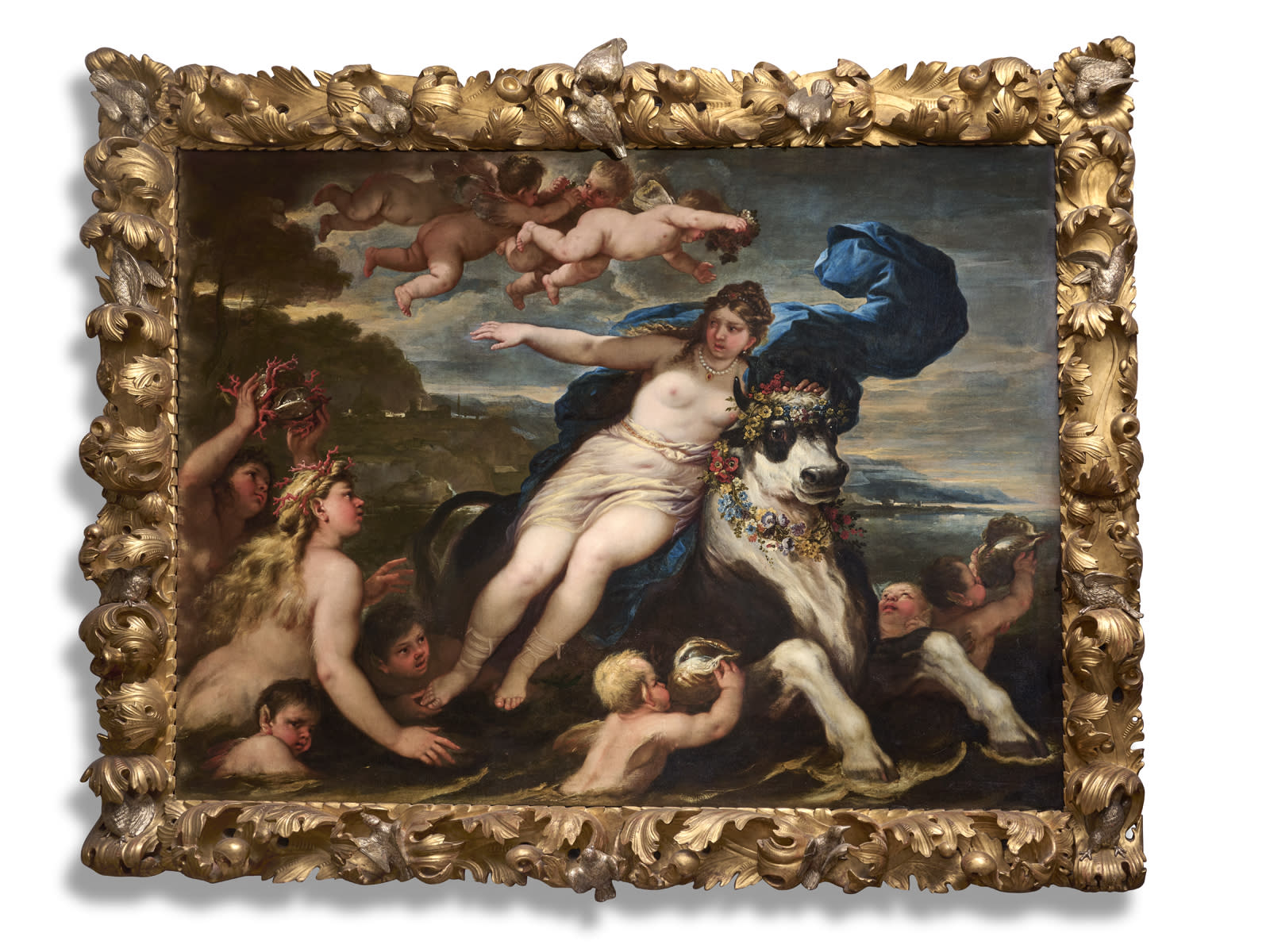
The Rape of Europa
Oil on canvas
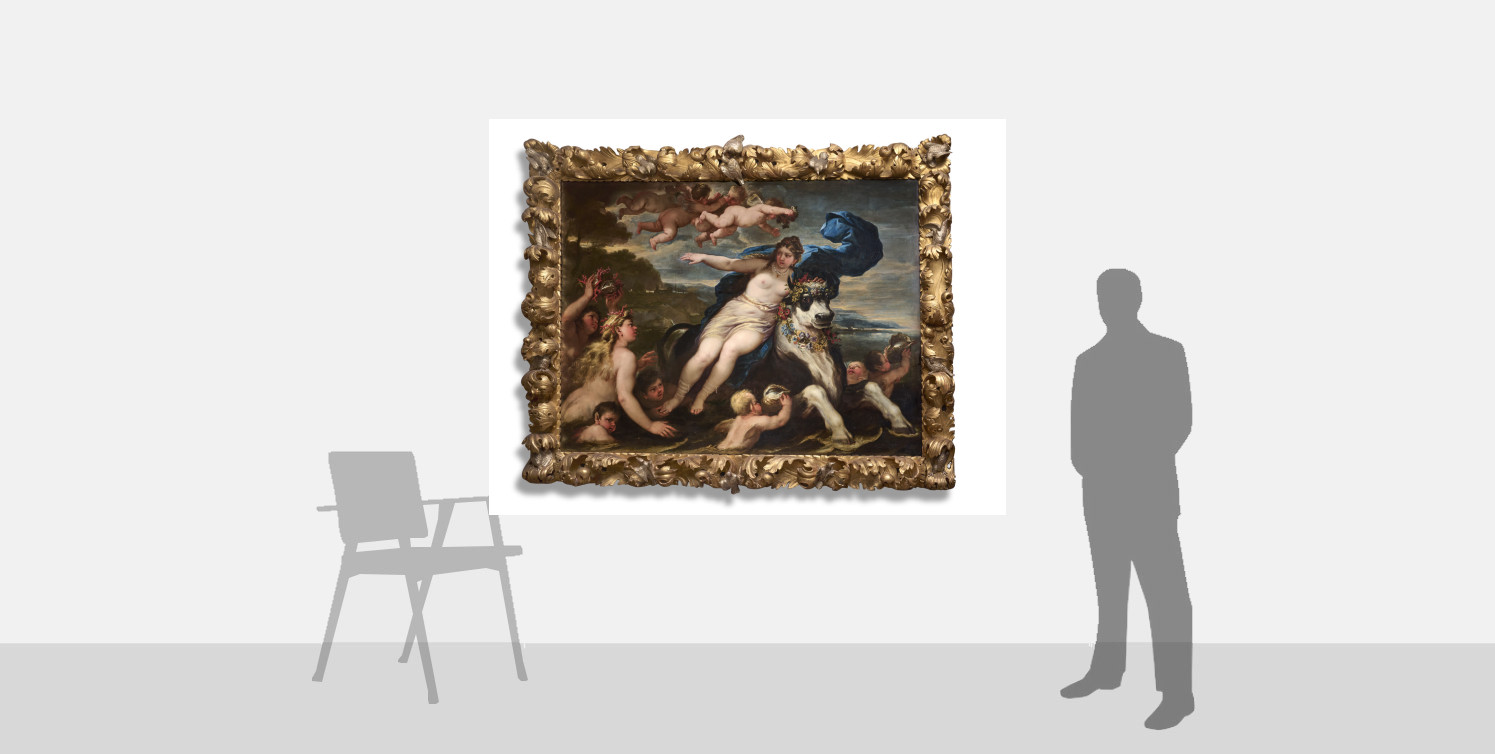
176 x 230 cm (69 1/4 x 90 1/2 in.)
Provenance
Villa Orsini Colonna, Mombello,
Private collection, Milan.
Literature
N. Spinosa in Luca Giordano 1634 – 1705, exhibition catalogue, Naples 2001, pp. 284 – 285;
O. Ferrari – G. Scavizzi, Luca Giordano. Nuove ricerche e inediti, Naples 2003, pp. 63, 179;
E. Capretti in Il mito di Europa. Da fanciulla rapita a continente, exhibition catalogue, Florence 2003, p. 272.
Description
The Rape of Europa, certainly one of the masterpieces realized by Luca Giordano in his maturity, has remained unknown to scholars and to the public until recent years. In fact, the painting appeared for the first time only in the major monographic exhibition held in Naples, Vienna and Los Angeles in 2001-2002. Until that moment, incredibly, the painting has been kept in the halls of Villa Orsini Colonna in Imbersago, in northwest Lombardy.
The ancient history of the painting is still partly shrouded in mystery: as argued by Nicola Spinosa, who first studied the work, in the late nineteen century the painting was part of the Pio Falcò collection, which included works formerly belonging to the Orsini family from Rome, the Pio family from Savoy and to the Falcò family from Lombardy. Among them, the most likely to have included the painting in question is the collection of the Pio family from Savoy. Indeed, an inventory dated 1724 reports two canvases depicting the Rape of Europe, both attributed to Titian, among the assets of the family.
The resemblance of Luca Giordano’s painting to the model realised by Titian for Philip II – today shown Isabella Stewart Gardner Museum in Boston (Fig. 1) - may possibly have induced the drafter of the inventory in error.
Among the members of the Pio of Savoy family, two could be the potential commissioner of the painting realised by Luca Giordano. The first might be the cardinal Carlo Pio of Savoy (1622 – 1689), a prominent member of the Roman Curia during the reign of Pope Innocent X, Alexander VII, Clement IX, Clement X and Innocent XI. The second potential commissioner could be the cardinal’s nephew Francesco Pio of Savoy (1672 - 1723), the third prince of San Gregorio, who lived at the court of Madrid.
The Rape of Europa depicts a famous passage from Ovid’s Metamorphoses (2, 838 – 875) which tells how Jupiter, infatuated by Europa, the young and graceful daughter of the king of Tyre, Agenor, turned into a bull and kidnapped the young lady while she was playing on the beach with some maidens. The passage continues telling how Jupiter brought Europa back to Crete, where their union gave birth to Sarpedon, Minos and Radamanthus, destined to become kings of Hades.
In choosing this topic, Giordano could count on a long tradition, which, in the Neapolitan painting of the early seventeenth century, had already achieved remarkable results, such as the work of Bernardo Cavallino, characterized by the refined chromatic beauty.
However, rather than taking inspiration from the local examples cited above, Giordano, in the grandeur of his composition, confronts himself directly with the already mentioned model of Titian, as shown by the pose of Europa and the bull that seems almost a paraphrase of the painting that today hangs in Boston.
The theme of the painting had already been challenged by Giordano in previous years. First in the work dated 1675 that today is featured in the collection of the City Art Gallery in Leeds, then in the massive canvas realized at the end of the century that is today part of the collection of the Count of Exeter held in Burghley House, and, lastly, in the painting of 1686 conserved in the Wadsworth Museum in Hartford (Fig. 2), which is the most similar to the picture in question.
Furthermore, the Rape of Europe, which belonged to the Orsini Colonna collection, was painted around the same time of the bright frescos realized by Giordano in the Palazzo Medici Riccardi (1683/85, fig. 3) during his second stay in Florence. As for the large canvas, the frescos show a renewed interest in the activities of the Florentine Pietro da Cortona, which is also combined with increased attention to the examples of luminous and pleasant brightness of the glorious season of the sixteenth-century Venetian painting - Titian and Paolo Veronese, for instance.
As Nicola Spinosa argues, however, ‘in the Rape of Europa the references to the two Venetian masters reveal a new visual intensity and a substantial emotional impact with a width and depth of breath of clear Mediterranean taste. This taste is evident in the delightful landscape visible on the horizon that lays on the azure expanse of the sea – almost a continuation of the enchanted landscapes by Micco Spadaro and the young Salvator Rosa in mid-century. Even the precious inserts of the polychrome flower garland on the bull’s neck and the elegant branches of glowing coral in the hands of the graceful maidens (Fig. 4) are sharp examples of the Mediterranean flavour of the composition’.
The canvas is surrounded by a sumptuous baroque frame gilded and carved with racemes interspersed with doves in silver carved wood.
The artwork described above is subject to changes in availability and price without prior notice.
The ancient history of the painting is still partly shrouded in mystery: as argued by Nicola Spinosa, who first studied the work, in the late nineteen century the painting was part of the Pio Falcò collection, which included works formerly belonging to the Orsini family from Rome, the Pio family from Savoy and to the Falcò family from Lombardy. Among them, the most likely to have included the painting in question is the collection of the Pio family from Savoy. Indeed, an inventory dated 1724 reports two canvases depicting the Rape of Europe, both attributed to Titian, among the assets of the family.
The resemblance of Luca Giordano’s painting to the model realised by Titian for Philip II – today shown Isabella Stewart Gardner Museum in Boston (Fig. 1) - may possibly have induced the drafter of the inventory in error.
Among the members of the Pio of Savoy family, two could be the potential commissioner of the painting realised by Luca Giordano. The first might be the cardinal Carlo Pio of Savoy (1622 – 1689), a prominent member of the Roman Curia during the reign of Pope Innocent X, Alexander VII, Clement IX, Clement X and Innocent XI. The second potential commissioner could be the cardinal’s nephew Francesco Pio of Savoy (1672 - 1723), the third prince of San Gregorio, who lived at the court of Madrid.
The Rape of Europa depicts a famous passage from Ovid’s Metamorphoses (2, 838 – 875) which tells how Jupiter, infatuated by Europa, the young and graceful daughter of the king of Tyre, Agenor, turned into a bull and kidnapped the young lady while she was playing on the beach with some maidens. The passage continues telling how Jupiter brought Europa back to Crete, where their union gave birth to Sarpedon, Minos and Radamanthus, destined to become kings of Hades.
In choosing this topic, Giordano could count on a long tradition, which, in the Neapolitan painting of the early seventeenth century, had already achieved remarkable results, such as the work of Bernardo Cavallino, characterized by the refined chromatic beauty.
However, rather than taking inspiration from the local examples cited above, Giordano, in the grandeur of his composition, confronts himself directly with the already mentioned model of Titian, as shown by the pose of Europa and the bull that seems almost a paraphrase of the painting that today hangs in Boston.
The theme of the painting had already been challenged by Giordano in previous years. First in the work dated 1675 that today is featured in the collection of the City Art Gallery in Leeds, then in the massive canvas realized at the end of the century that is today part of the collection of the Count of Exeter held in Burghley House, and, lastly, in the painting of 1686 conserved in the Wadsworth Museum in Hartford (Fig. 2), which is the most similar to the picture in question.
Furthermore, the Rape of Europe, which belonged to the Orsini Colonna collection, was painted around the same time of the bright frescos realized by Giordano in the Palazzo Medici Riccardi (1683/85, fig. 3) during his second stay in Florence. As for the large canvas, the frescos show a renewed interest in the activities of the Florentine Pietro da Cortona, which is also combined with increased attention to the examples of luminous and pleasant brightness of the glorious season of the sixteenth-century Venetian painting - Titian and Paolo Veronese, for instance.
As Nicola Spinosa argues, however, ‘in the Rape of Europa the references to the two Venetian masters reveal a new visual intensity and a substantial emotional impact with a width and depth of breath of clear Mediterranean taste. This taste is evident in the delightful landscape visible on the horizon that lays on the azure expanse of the sea – almost a continuation of the enchanted landscapes by Micco Spadaro and the young Salvator Rosa in mid-century. Even the precious inserts of the polychrome flower garland on the bull’s neck and the elegant branches of glowing coral in the hands of the graceful maidens (Fig. 4) are sharp examples of the Mediterranean flavour of the composition’.
The canvas is surrounded by a sumptuous baroque frame gilded and carved with racemes interspersed with doves in silver carved wood.
The artwork described above is subject to changes in availability and price without prior notice.