
Giovanni Baglione
b. 1566, Rome, Italy
d. 1643, Rome, Italy
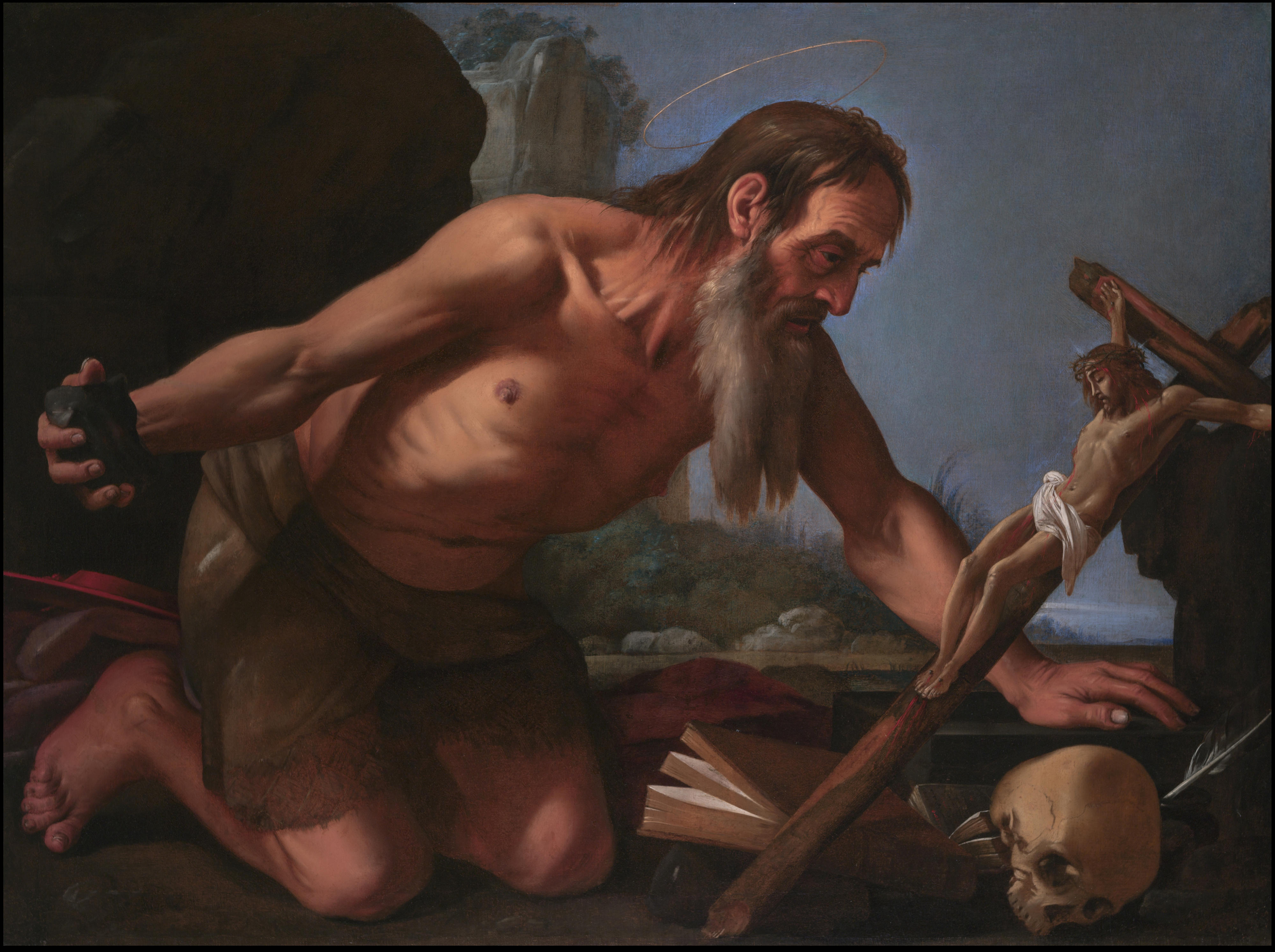
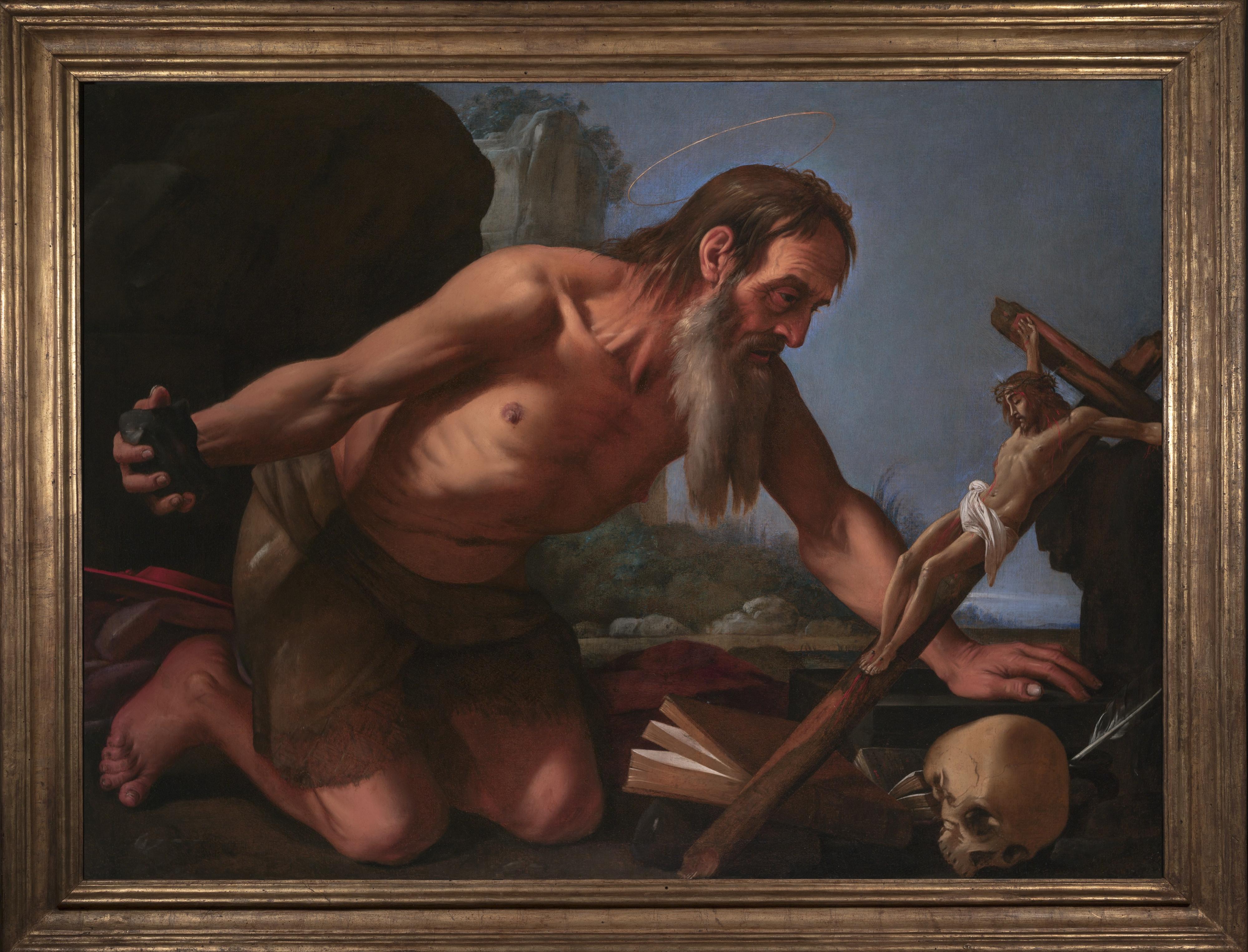
The Penitent Saint Jerome
c. 1610–1615
Oil on canvas
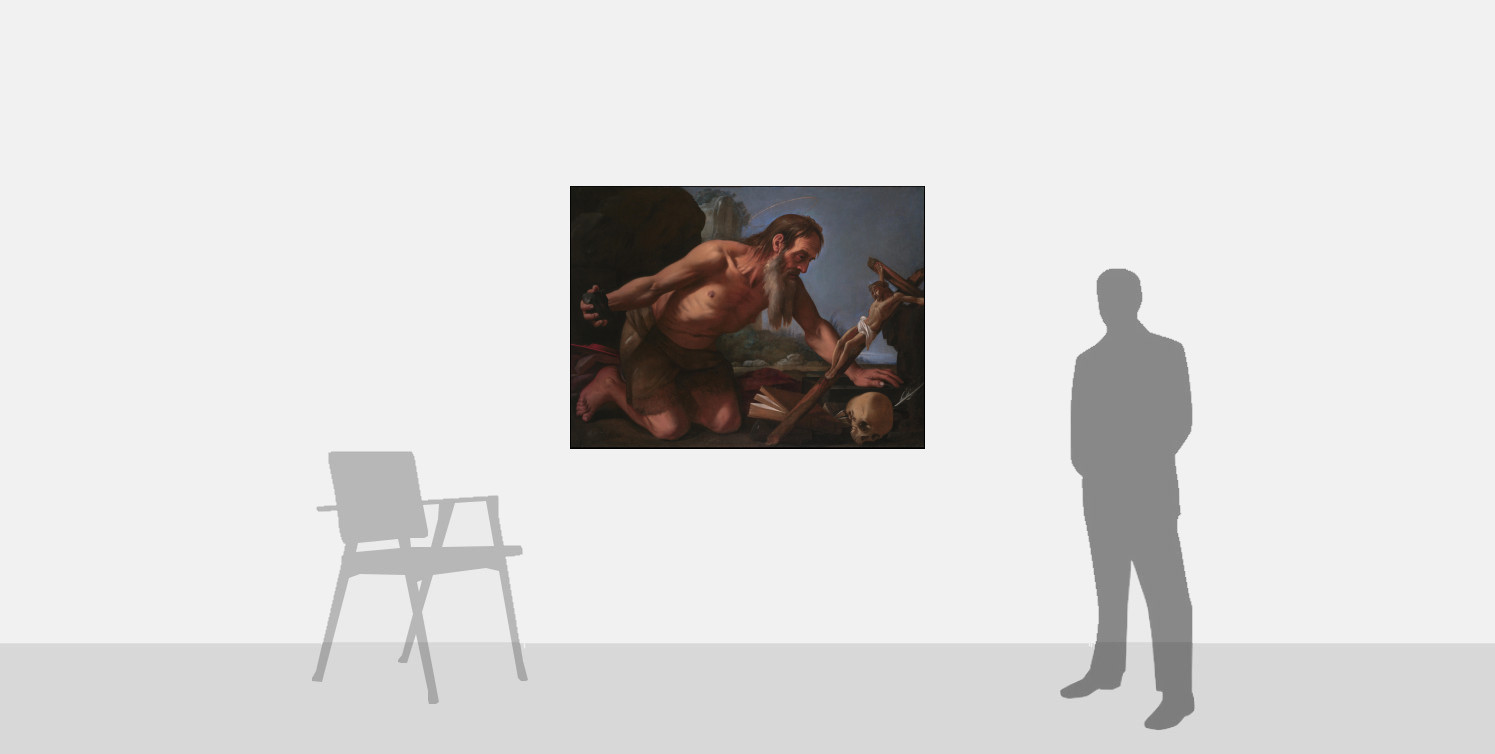
117 x 158 cm (46 1/8 x 62 1/4 in.)
Description
The scene represented by Baglione takes place in a cave, surrounded by rocks and sparse traces of vegetation. Saint Jerome is represented in the act of penance, kneeling to contemplate the crucifix in front of him, while with his right hand he prepares to hit his chest with a stone. The objects that symbolise all the different periods of his life are displayed around him in a wise, naturalistic narration: the feather pen and the books reflect his role as translator of the Bible in Latin, the purple-red cloak and the cardinal's galero just behind him remind us of his title as a prince (and doctor) of the Church. His naked body, barely covered by a cloth tied to his waist and decorated with a curious fringe with an intertwined pattern, shows the fatigues of his old age, even on his particularly defined and vigorous arm and shoulder. The painter chose to occupy diagonally all the space of the scene with the Saint’s arms opening which follow the two divergent diagonals of the canvas. This solution gives the painting great effect. Passion for prayer and physical torment are underlined by the emotional impulse with which Saint Jerome strives towards the vision of Christ, who is found bleeding from the stigmata and with his head surrounded by light. This strong scene is totally in contrast with the placid landscape in the background, where small lake merges with the clear sky.
This penitent Saint Jerome - unknown to experts until now - is one of the major additions in the last few years in Giovanni Baglione’s catalogue raisoneé. For its exceptional quality it is counted among the greatest results of the happiest periods of his long career, during the first and second decade of the seventeenth century.
As a protagonist of the Roman art scene between the end of the sixteenth and the first decades of the seventeenth century, Baglione is widely known for the events that saw him first follow the innovations introduced by Caravaggio, and then strongly oppose him in the famous trial for defamation in 1603. The posthumous fame of the artist is linked to his fundamental activity as a biographer– Caravaggio’s life among others - and to the publication of “Le Vite de’ pittori scultori e architetti”(Rome 1642), a fundamental source of information for knowledge of the artistic panorama of those times.
After a Mannerist period, documented above all by his fresco production, and influenced by Giuseppe Cesari d'Arpino’s style, Baglione seems to sense the strength of the Caravaggesque revolution already in 1600, and updated his naturalistic research on light, based on strong chiaroscuro contrasts. In the first decade of the seventeenth century he executed some masterpieces that consecrated his fame, whilst always working on a double track: on one hand distinguishing himself as an academic painter, able to paint important altarpieces (for example for San Pietro in Rome) and cycles of frescoes ( San Giovanni in Laterano and Santa Maria Maggiore); on the other hand as a prolific and captivating author of 'room paintings' for the main art patrons of the time (Giustiniani, Del Monte, Borghese, Sfondrato).
The figure of Giovanni Baglione has been the subject of great attention by art critics in the last few years, thanks to the arrival of paintings of exceptional quality that emerged on the old masters market (Apparition of the angel to St. Joseph, 1599, today Moscow, Pushkin Museum [MORANDOTTI, TERZAGHI 2009], the St. John the Baptist already in the Nauman collection [NAUMANN, SIMON 2014], signed and dated 1610, the Judith with the head of Holofernes from a private collection, about 1605-1610 [PAPI 2014]). Baglione’s catalogue raisoneé, that counts over two hundred paintings, has been the subject of a new and more philological reorganization (NICOLACI 2016a) in recent times, which allows us to understand the stylistic choices of the painter, sometimes in apparent contrast, and therefore to orientate in a not obvious chronological succession in his oeuvre.
The attribution to Baglione of the Penitent Saint Jerome can be based on resolute comparisons, with certain works in particular from the period of the first and second decade of the seventeenth century, such as the Penitent Saint Peter in the Galleria Sabauda in Turin (1606), the Unveiled Christ (1606) and the Judith (1608) both at the Galleria Borghese, or Saint Peter and Saint Paul in Galleria Spada in Rome (1606-1607); and from the second decade the Penitent Magdalene in San Domenico Gubbio (1612), for the similar composition with the figure in the landscape. The execution of the feet and gnarled hands in the Saint Peter in Turin is particularly compelling with those of Saint Jerome. The painter’s attention to the naturalistic effects of his facial skin, deep wrinkles and analogous cut of the eyes, which resemble a physiognomy of an old recurrent model in the work of the Roman painter.
It is undeniable that Baglione executed the artwork for a very important commissioner, as evidenced by the attention to details - from his hair arranged in strands to the fine filaments of the beard, from the conscious accentuation of the dirty fingernails to the elements of still life, such as the skull and the living crucifix.
Although there is no documentation to confirm it, it is worth pointing out some old inventories: in the "Inventory of the paintings in Rome in the Palazzo dello 'Ill.mo Scipione Lancellotti", dated October 15, 1640 is registered at the «n. 133: a Saint Jerome by Baglione in golden frame»(Lancellotti Archive, Palazzo, file 26, letter E, CAVAZZINI 1998, pp. 160, 196). The painting is recorded in the family collections until 1769 (inventory of Ottavio Maria II Lancellotti, f.258). Then we lose track of it. More interesting is perhaps a reference in the Guide of Villa Borghese written by Domenico Montelatici (1700, p.221) that mentions a "St. Jerome kneeling in front of the Crucifix as a penitent hitting his chest with a stone" by Baglione of which, however, there is no previous reference in the family collection. However, Baglione painted this subject several times. The inventory of the painter after his death certifies three paintings with this subject (but whose measurements do not seem to correspond), to be recognized perhaps in those left in the possession of heirs until at least 1652 (on the legacy of the painter see NICOLACI 2016b).
The background dominated by the sky executed in a blue uniform tonality, even if not evidenced, but flattened by a non-homogenous conservative state, is a new entry in Baglione’s production and shows the strong influence of the Venetian style on the Roman master.
In fact, if already the passion of Jerome’s gesture with his arms wide open and the body leaning towards the crucifix, recalls the famous painting by Lorenzo Lotto (now in Madrid, Museo del Prado), the impact of the figure of the penitent saint which stands out against the landscape strongly evokes the painting by Giovanni Gerolamo Savoldo, today at the National Gallery in London. Savoldo's painting separates artistically from his previous Titianist paintings (both from the canvas already in the Gonzaga collection and today in the Louvre, and from the altarpiece already in Santa Maria Nova in Venice and today in Brera), by the strong presence of the saint in the foreground and the importance given to the sky, which changes to a twilight tonality, offering a model to Baglione also on the compositional level, which the painter presents in a different horizontal format. We are still to discover when Baglione was able to see Savoldo's painting - which previous provenance is unknown - or whether, more generally, the Penitent Saint Jerome may come from other Venetian prototype, skillfully reinterpreted by Baglione in this version. He had easy access to the main Roman collections, where certainly there were many Venetian paintings by sixteenth century masters, and he himself was in Venice - on at least one documented occasion- in the late summer of 1614 (NICOLACI 2016b, p. 65). The artistic contacts between Rome and Venice had several channels, for example through figures such as the Venetian Carlo Saraceni or Federico Zuccari and the Cavalier d'Arpino, who had stayed a long time in Venice.
This artwork will be included next publication of the Catalogue raisoneé of the artist curated by Michele Nicolaci.
Rome, October, 2018
Maria Cristina Terzaghi
Literature+:
CAVAZZINI 1998
P. CAvazzini, Palazzo Lancellotti ai Coronari, Roma 1998.
MORANDOTTI, TERZAGHI 2009
A. Morandotti, M. C. Terzaghi, Giovanni Baglione: un dipinto ritrovato, Milano 2009.
NAUMANN, SIMON 2014
O. Naumann, R. Simon, Looking South. Three Centuries of Italian Paintings, catalogo della mostra (New York), New York 2014.
NICOLACI 2016a
M. Nicolaci, Giovanni Baglione (1566/1568-1643). Catalogo ragionato dell’opera pittorica, Ph. Diss., Sapienza Università di Roma, 2 voll., 2016.
NICOLACI 2016b
M. Nicolaci, Giovanni Baglione e i “Virtuosi al Pantheon”. Precisazioni sulla Natività di Gesù con san Giuseppe e sull’eredità del pittore, in La collezione della pontificia Insigne Accademia di Belle Arti e Lettere dei Virtuosi al Pantheon, a cura di V. Tiberia, catalogo a cura di A. Capriotti, P. Castellani, Reggio Emilia 2016, pp. 60-74.
PAPI 2014
G. Papi, Giovanni Baglione. Judith and her Maidservant, Firenze 2014.
This penitent Saint Jerome - unknown to experts until now - is one of the major additions in the last few years in Giovanni Baglione’s catalogue raisoneé. For its exceptional quality it is counted among the greatest results of the happiest periods of his long career, during the first and second decade of the seventeenth century.
As a protagonist of the Roman art scene between the end of the sixteenth and the first decades of the seventeenth century, Baglione is widely known for the events that saw him first follow the innovations introduced by Caravaggio, and then strongly oppose him in the famous trial for defamation in 1603. The posthumous fame of the artist is linked to his fundamental activity as a biographer– Caravaggio’s life among others - and to the publication of “Le Vite de’ pittori scultori e architetti”(Rome 1642), a fundamental source of information for knowledge of the artistic panorama of those times.
After a Mannerist period, documented above all by his fresco production, and influenced by Giuseppe Cesari d'Arpino’s style, Baglione seems to sense the strength of the Caravaggesque revolution already in 1600, and updated his naturalistic research on light, based on strong chiaroscuro contrasts. In the first decade of the seventeenth century he executed some masterpieces that consecrated his fame, whilst always working on a double track: on one hand distinguishing himself as an academic painter, able to paint important altarpieces (for example for San Pietro in Rome) and cycles of frescoes ( San Giovanni in Laterano and Santa Maria Maggiore); on the other hand as a prolific and captivating author of 'room paintings' for the main art patrons of the time (Giustiniani, Del Monte, Borghese, Sfondrato).
The figure of Giovanni Baglione has been the subject of great attention by art critics in the last few years, thanks to the arrival of paintings of exceptional quality that emerged on the old masters market (Apparition of the angel to St. Joseph, 1599, today Moscow, Pushkin Museum [MORANDOTTI, TERZAGHI 2009], the St. John the Baptist already in the Nauman collection [NAUMANN, SIMON 2014], signed and dated 1610, the Judith with the head of Holofernes from a private collection, about 1605-1610 [PAPI 2014]). Baglione’s catalogue raisoneé, that counts over two hundred paintings, has been the subject of a new and more philological reorganization (NICOLACI 2016a) in recent times, which allows us to understand the stylistic choices of the painter, sometimes in apparent contrast, and therefore to orientate in a not obvious chronological succession in his oeuvre.
The attribution to Baglione of the Penitent Saint Jerome can be based on resolute comparisons, with certain works in particular from the period of the first and second decade of the seventeenth century, such as the Penitent Saint Peter in the Galleria Sabauda in Turin (1606), the Unveiled Christ (1606) and the Judith (1608) both at the Galleria Borghese, or Saint Peter and Saint Paul in Galleria Spada in Rome (1606-1607); and from the second decade the Penitent Magdalene in San Domenico Gubbio (1612), for the similar composition with the figure in the landscape. The execution of the feet and gnarled hands in the Saint Peter in Turin is particularly compelling with those of Saint Jerome. The painter’s attention to the naturalistic effects of his facial skin, deep wrinkles and analogous cut of the eyes, which resemble a physiognomy of an old recurrent model in the work of the Roman painter.
It is undeniable that Baglione executed the artwork for a very important commissioner, as evidenced by the attention to details - from his hair arranged in strands to the fine filaments of the beard, from the conscious accentuation of the dirty fingernails to the elements of still life, such as the skull and the living crucifix.
Although there is no documentation to confirm it, it is worth pointing out some old inventories: in the "Inventory of the paintings in Rome in the Palazzo dello 'Ill.mo Scipione Lancellotti", dated October 15, 1640 is registered at the «n. 133: a Saint Jerome by Baglione in golden frame»(Lancellotti Archive, Palazzo, file 26, letter E, CAVAZZINI 1998, pp. 160, 196). The painting is recorded in the family collections until 1769 (inventory of Ottavio Maria II Lancellotti, f.258). Then we lose track of it. More interesting is perhaps a reference in the Guide of Villa Borghese written by Domenico Montelatici (1700, p.221) that mentions a "St. Jerome kneeling in front of the Crucifix as a penitent hitting his chest with a stone" by Baglione of which, however, there is no previous reference in the family collection. However, Baglione painted this subject several times. The inventory of the painter after his death certifies three paintings with this subject (but whose measurements do not seem to correspond), to be recognized perhaps in those left in the possession of heirs until at least 1652 (on the legacy of the painter see NICOLACI 2016b).
The background dominated by the sky executed in a blue uniform tonality, even if not evidenced, but flattened by a non-homogenous conservative state, is a new entry in Baglione’s production and shows the strong influence of the Venetian style on the Roman master.
In fact, if already the passion of Jerome’s gesture with his arms wide open and the body leaning towards the crucifix, recalls the famous painting by Lorenzo Lotto (now in Madrid, Museo del Prado), the impact of the figure of the penitent saint which stands out against the landscape strongly evokes the painting by Giovanni Gerolamo Savoldo, today at the National Gallery in London. Savoldo's painting separates artistically from his previous Titianist paintings (both from the canvas already in the Gonzaga collection and today in the Louvre, and from the altarpiece already in Santa Maria Nova in Venice and today in Brera), by the strong presence of the saint in the foreground and the importance given to the sky, which changes to a twilight tonality, offering a model to Baglione also on the compositional level, which the painter presents in a different horizontal format. We are still to discover when Baglione was able to see Savoldo's painting - which previous provenance is unknown - or whether, more generally, the Penitent Saint Jerome may come from other Venetian prototype, skillfully reinterpreted by Baglione in this version. He had easy access to the main Roman collections, where certainly there were many Venetian paintings by sixteenth century masters, and he himself was in Venice - on at least one documented occasion- in the late summer of 1614 (NICOLACI 2016b, p. 65). The artistic contacts between Rome and Venice had several channels, for example through figures such as the Venetian Carlo Saraceni or Federico Zuccari and the Cavalier d'Arpino, who had stayed a long time in Venice.
This artwork will be included next publication of the Catalogue raisoneé of the artist curated by Michele Nicolaci.
Rome, October, 2018
Maria Cristina Terzaghi
Literature+:
CAVAZZINI 1998
P. CAvazzini, Palazzo Lancellotti ai Coronari, Roma 1998.
MORANDOTTI, TERZAGHI 2009
A. Morandotti, M. C. Terzaghi, Giovanni Baglione: un dipinto ritrovato, Milano 2009.
NAUMANN, SIMON 2014
O. Naumann, R. Simon, Looking South. Three Centuries of Italian Paintings, catalogo della mostra (New York), New York 2014.
NICOLACI 2016a
M. Nicolaci, Giovanni Baglione (1566/1568-1643). Catalogo ragionato dell’opera pittorica, Ph. Diss., Sapienza Università di Roma, 2 voll., 2016.
NICOLACI 2016b
M. Nicolaci, Giovanni Baglione e i “Virtuosi al Pantheon”. Precisazioni sulla Natività di Gesù con san Giuseppe e sull’eredità del pittore, in La collezione della pontificia Insigne Accademia di Belle Arti e Lettere dei Virtuosi al Pantheon, a cura di V. Tiberia, catalogo a cura di A. Capriotti, P. Castellani, Reggio Emilia 2016, pp. 60-74.
PAPI 2014
G. Papi, Giovanni Baglione. Judith and her Maidservant, Firenze 2014.