
Master of the Cernuschi Pentecost
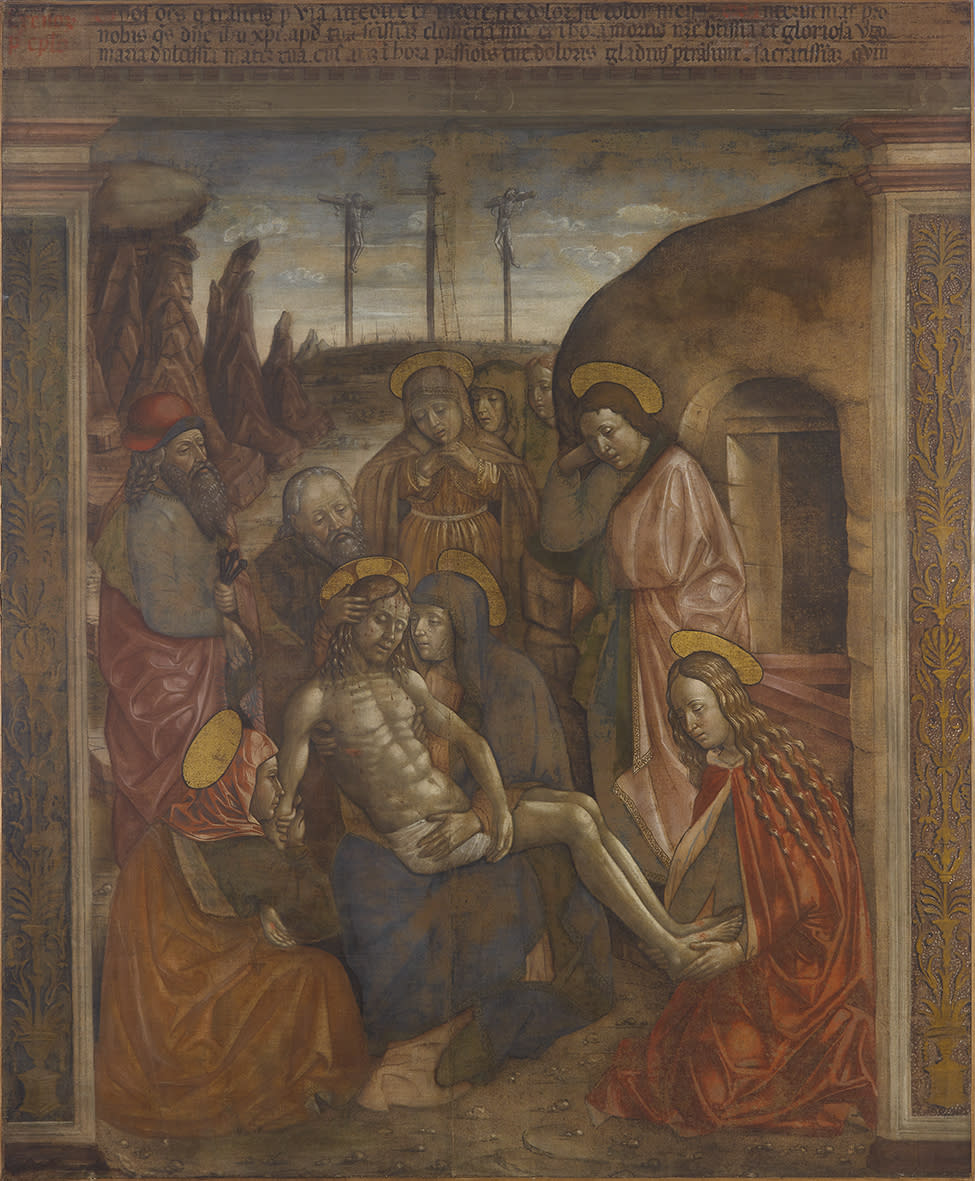
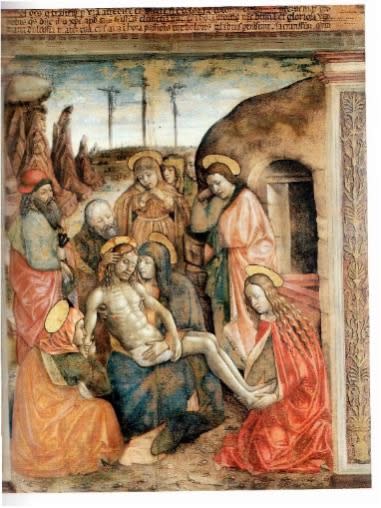
The Lamentation over the Dead Christ
Tempera on linen canvas
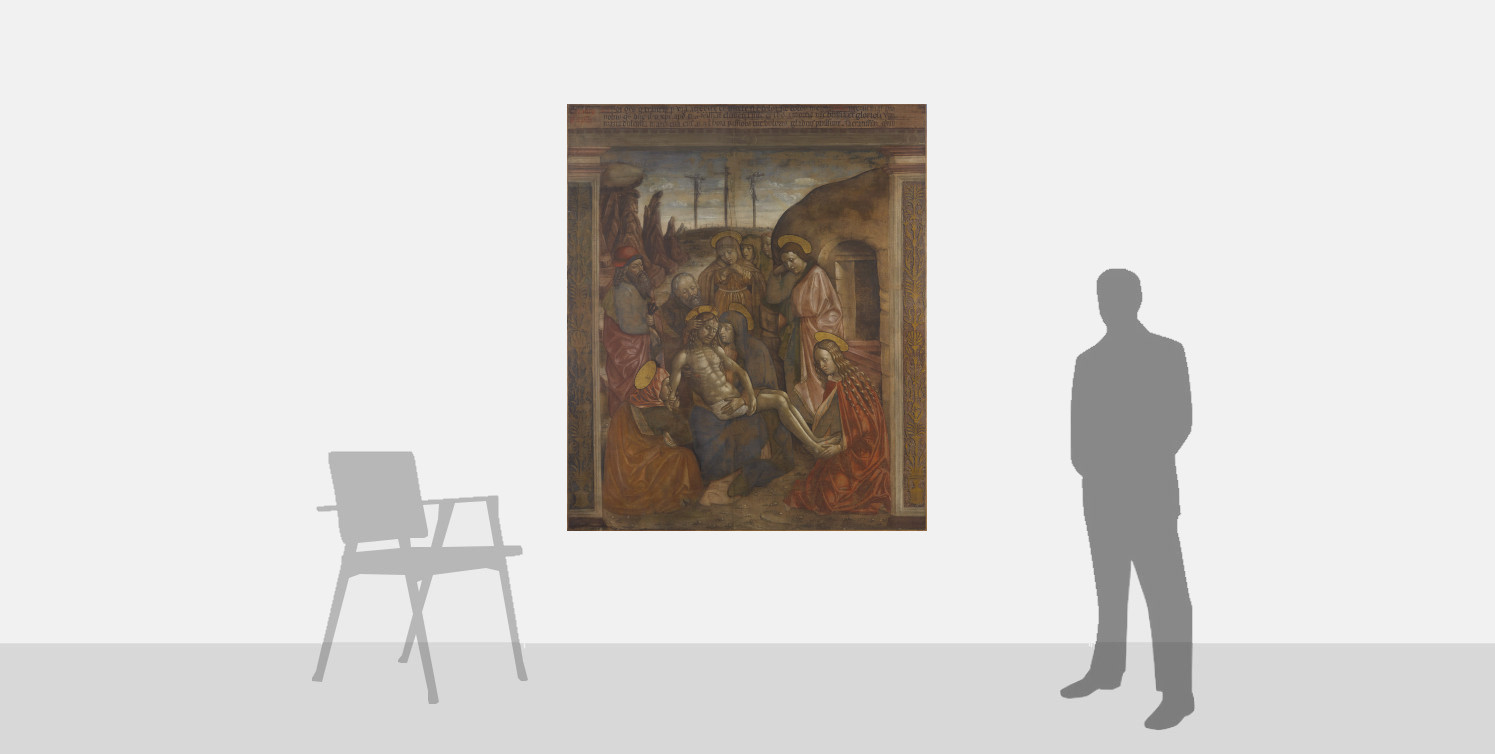
190 x 160 cm (74 3/4 x 63 in.)
Provenance
Literature
M. Natale, Un repertorio della pittura italiana dal '300 al '500: istruzioni per l'uso, in Pittura italiana dal '300 al '500, Milan, 1991, pp. 13–14, fig. 9.
L.
Gnaccolini, ‘Antonio da Pandino e la Vetrata del Nuovo Testamento
nel Duomo di Milano’, in Arte Cristiana, no. 759, 1993, 759, p. 408.
F. Moro, 'Maestro della Pentecoste Cernuschi', in Pittura Lombarda 1450–1650, Milan, 1994, pp. 26 –31.
Description
The present Lamentation over the Dead Christ is a product of the fascinating cultural interchange that characterised painting in the last decades of the fifteenth century along the borders of Lombardy and Liguria, centred on the artist Vincenzo Foppa. In a survey of fifteenth-century painting in the Po Valley, it is not uncommon to find tempera paintings on a canvas support, especially in large-scale works, as this makes them easier to transport. The present example is in particularly good condition, with most of the original glazing and gold highlights still intact. The support consists of two linen cloths sewn together lengthwise in the centre of the painting. There are two candle burns in the Virgin's cloak and in St. John's robe. In certain areas, the paint layer is a little worn and the canvas shows through.
The composition likely takes inspiration from an important fresco by Vincenzo Foppa, found on the tramezzo, or rood screen, of the church of Sant'Angelo in Milan, lost when the tramezzo was demolished following decrees by the Tridentine Council (A. Nova, ‘I tramezzi in Lombardia tra XV e XVI secolo: scene della Passione e devozione francescana’, in Il francescanesimo in Lombardia. Storia ed arte, Milan, 1983, p. 202; Natale 1991). The entire cycle is recorded in a copy made on the tramezzo of the church of Santa Maria delle Grazie in Bellinzona (G. Romano, ‘Gottardo Scotto’ in Zenale e Leonardo. Tradizione e rinnovamento della pittura lombarda, exhibition catalogue, Milan, 1982, p. 84), frescoed during the second decade of the sixteenth century by a still anonymous painter who had kept up to date with the innovations of Gaudenzio Ferrari.
The influence of Foppa’s ideas can be seen not only in the present Lamentation, but also in another similar picture, partly cut down along the sides, found in the Milanese church of San Bernardino alle Ossa, and dated to around the first decade of the century (M. Natale, Alberto e Martino Piazza: problemi aperti, in Piazza da Lodi. Una tradizione di pittori nel Cinquecento, exhibition catalogue, Milan, 1989, pp. 101, 110) and in Vincenzo Civerchio's Salita al Calvario in the parish church of Travagliato (Natale, 1991, pp. 13–14)
The author of the present painting takes his name from a depiction of the Pentecost that appeared in the Paris sale of the Cernuschi collection (Gallery Georges Petit, 25–26 May 1900, no. 74, attributed to Bramantino). It later formed part of the Fontaine collection in Lille (W. Suida, ‘Studien zur lombardischen Malerei des XV. Jahrhunderts’, in Monatsheften zur Kunstwissenschaft, 1908, pp. 490–91), and the painting then reappeared on the Florentine antiquities market in the 1980s, only to be given its first clear critical interpretation (R. Battaglia, ‘Maestro della Pentecoste Cernuschi’, in Piemontesi e lombardi tra Quattrocento e Cinquecento, catalogue edited by G. Romano, Turin, 1989, pp. 22–29). As Roberta Battaglia rightly points out, this subject rarely appears in altarpieces, more frequently depicted in pictorial cycles dedicated to the life of Christ or Mary. The layout of the painting, framed by pillars and topped by an inscription on the architrave, suggests it was probably a decorative element of a larger cycle featuring other scenes.
The two works known so far by the so-called Master of the Cernuschi Pentecost can also be linked to another painting on densely woven linen canvas, depicting The Madonna and Child Enthroned with Saints, Devotees and Angels (tempera on canvas, 125.5 x 158 cm, private collection). The Virgin seated on the throne turns her gaze towards a large group of praying devotees, arranged symmetrically at her feet. Her acceptance of their prayers is suggested by her outstretched arm and open hand, and the Christ Child seated on her knee repeats the gesture, in a solemn act of benediction. On either side of the throne we can probably identify the figures of St. Joachim (rather than St. Joseph) and St. Anne, the Virgin's parents. Kneeling atop the pillars of her monumental throne are two praying angels who, in their three-quarter position, mark the depth of the picture, already emphasised by the large volumes of drapery. The thick folds in the drapery, with deep, even angular or sharp furrows, suggests a date around the penultimate decade of the fifteenth century, supported by the numerous references to the figurative culture that developed along the axis of Milan, Pavia and Genoa. Links to Vincenzo Foppa are joined by certain nods to Donato de' Bardi and a suggestion of the harshness found in the work of Bernardino Butinone.