

Pierre Subleyras
b. 1699, Saint-Gilles, France
d. 1749, Rome, Italy
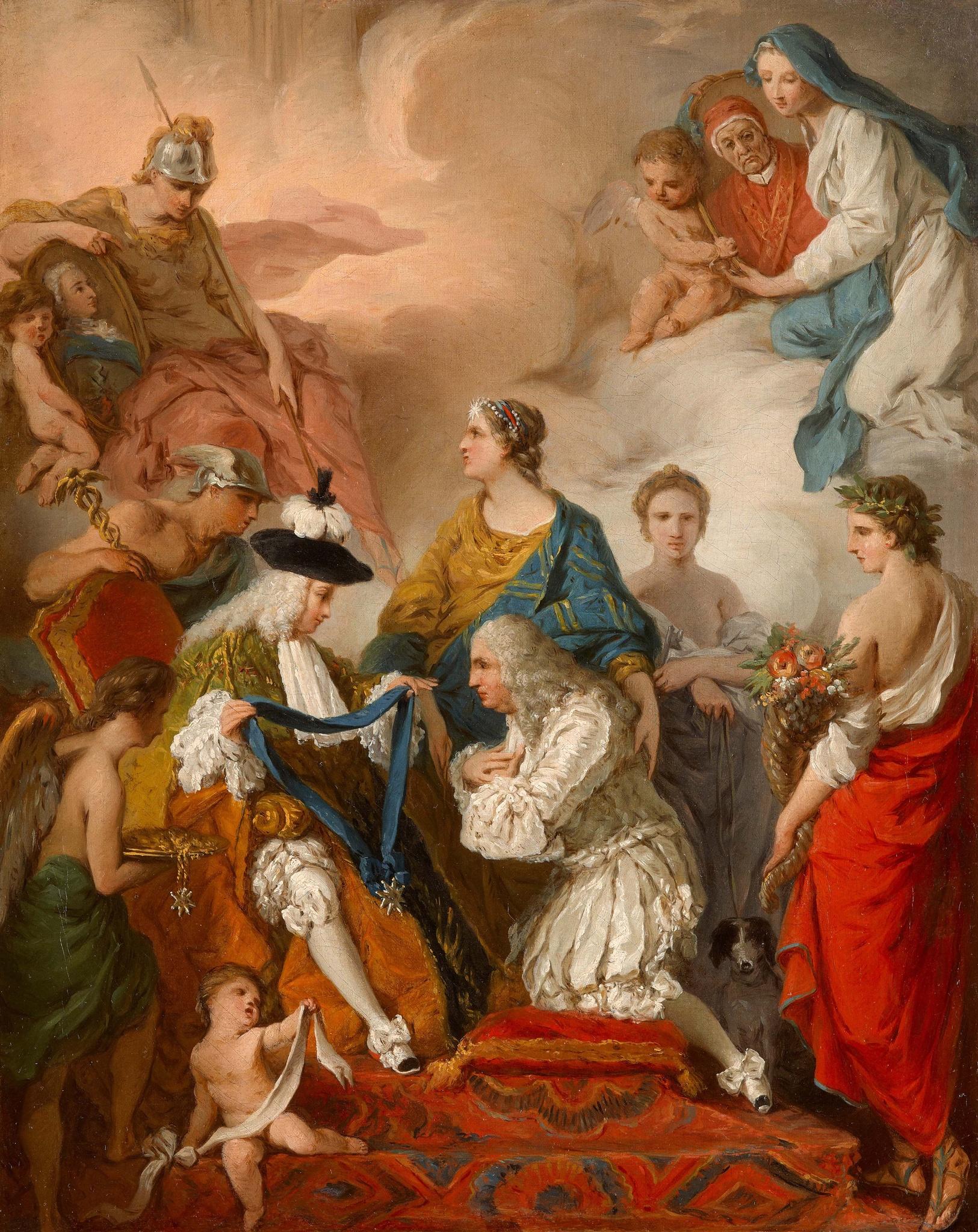
The Duke of Saint-Aignan Investing Girolamo Vaini, Prince of Cantalupe and Duke of Selci, with the Insignia of a Knight of the Order of the Holy Spirit
1737
Oil on canvas
50 x 40 cm (19 3/4 x 15 3/4 in.)
With frame: 68.5 x 57.5 cm ( 27 x 22 3/4 in.)
Provenance
Collection of the artist H. Lemonnier, Paris;
(his sale, Paris, 26–27 November 1810, lot 16).
In 1861, Louis, Comte de Sinéty (1811–1865), Aix-en Provence; Lieuville, Toul;
with Fabius, Paris;
acquired in October 1922 by Maurice Hottinguer, Château de Guermantes, and by descent;
Private Collection, Paris.
Literature
Probably V. Papillon de la Ferté, Extraits d'ouvrages sur la vie des peintres, Paris, 1776.
Probably Gault de Saint-Germain, Guide de l'amateur de peinture, Paris, 1841, vol. 2, p. 279. Léon Lagrange, “Exposition régionale des Beaux-Arts à Marseille” Gazette des Beaux-Arts 11 (1861), p. 544.
Marius Chaumelin, Les trésors d'art de la Provence exposés à Marseille en 1861, Paris and Marseille, 1862, p. 257.
O. Arnaud, “Subleyras” in L. Dimier, ed., Les peintres français du XVIIIe siècle. Histoire des vies et catalogue des oeuvres (Paris and Brussels, 1930), vol. 2, p. 59 and pp. 80–81, no. 101.
B. Lossky, L'art français et l’Europe aux XVIIème et XVIIIème siècles, exh. cat., Musée national de l'Orangerie, Paris, 1958, mentioned under the entry no. 40.
M. Le Moël and P. Rosenberg, “La collection de tableaux du duc de Saint-Aignan et le catalogue de sa vente illustré par Gabriel de Saint-Aubin”, Revue de l'Art (1969), no. 6, p. 53, note 11.
P. Rosenberg and O. Michel, Subleyras 1699–1749, exh. cat. Musée du Luxembourg, Paris, and Académie de France, Villa Médicis, Rome, 1987, p. 214, no. 43, illustrated.
A. Brejon de Lavergnée and P. Durey, Settecento. Le siècle de Tiepolo. Peintures italiennes du XVIIIe siècle exposées dans les collections publiques françaises, exh. cat. Musée des beaux-arts, Lyon and Palais des beaux-arts, Lille, 2000–1, mentioned p. 242.
Description
The investiture of Girolamo Vaini, Duke of Selci, Prince of Cantalupo,[i] and Marquess of Vacone (1677–1744) with the collar and riband of the French royal Order of the Holy Spirit took place in Rome on the 15 September 1737 in the church of San Luigi dei Francesi. The investiture of knights of this Order, the highest chivalric distinction conferred by the kings of France,[ii] usually took place in a ceremony presided over by the King, but that was impossible when the recipient was a foreigner unable to attend the court. On such occasions the king would either despatch a member of the royal family to confer the decorations—the convention when the recipient was himself a royal prince—or delegate his ambassador to do so. In such cases it was essential for the ambassador, acting as the king’s representative, to be a fellow member of the Order—the French ambassador, Paul-Hippolyte de Beauvilliers, Duke of Saint Aignan (1684–1776), had been admitted to the Order on 27 October 1722, in the second promotion of Louis XV’s reign.
Vaini’s father had been honoured with the same award by Louis XIV, in recognition of the important role he had played in arguing the French case for the right of the Duke of Anjou to succeed to the Spanish throne—Pope Clement XI’s endorsement of this right had been a crucial element in the complex diplomacy that resulted in the Bourbons coming to reign in Spain. Vaini, however, had been regarded with some amusement by his contemporaries for his immense vanity, sufficient to earn him the criticism of the Duke of Saint-Simon, hardly renowned for personal modesty himself. The award to his son Girolamo was made in no small part as recognition of his own part in furthering France’s interests in Rome but also to recall the achievements of his father. The honour had been announced in January 1737; the other knights whose admission were announced at the same time were François, Duke of Villeroi (1695–1766), the elderly Charles, Duke of Biron (1663–1756), Prince François Maximilien Ottolinksi, Count of Teczin (1676–1756)[iii] and Antoine, Marquess of Monti (1684–1738).[iv] Unable to attend the ceremony held in Versailles on 2 February 1737 when the other knights were admitted, it was decided to arrange a suitable ceremony in Rome. As this proved impossible during the summer months, the ceremony was delayed until September, in the presence of ten cardinals and much of the Roman nobility, as well as foreign ambassadors and ministers.[v]
Subleyras was born in Uzès, in Provence, and studied first with Antoine Rivalz in Toulouse; his master soon recognised his talent and advised him to go to Paris where he entered the Academy schools in 1726. The following year he was awarded the Prix de Rome for a painting of Le Serpent d'airain (now in the Musée des Beaux Arts, Nîmes) and in 1728 joined the other students at the French Academy, then established in the Palazzo Mancini. There he married the miniaturist Maria Felice Tibaldi whose small copies of her husband’s paintings have allowed scholars to confirm some attributions; the young couple settled permanently in the Eternal City where Pierre soon established a formidable reputation as a portraitist, history, and genre painter. Subleyras had made the acquaintance of the Duke of Saint Aignan soon after the latter’s appointment as Ambassador to the Pope in 1731 and was a natural choice to paint this scene, which required the skills of a formidable portraitist who was also thoroughly familiar with the conventions of historical subject painting.
It is evident from the numerous studies—both of individual figures and the entire composition— that Subleyras gave great importance to this commission. There are no fewer than three complete versions of the composition—firstly our finished composition sketch, then a larger, full version evidently done for the Ambassador himself and which remains with the descendants of the Dukes of Saint Aignan, and finally a large version, today in the collection of the Musée de la Légion d'Honneur in Paris (measuring 323 x 242 cm), which Subleyras probably employed some assistants to complete, painted for Prince Vaini. The large version dominates the interior of Subleyras’ studio in a large-scale painting which includes several other works that the artist considered among his masterpieces; this magistral composition now hangs in the kademie der bildenden Künste in Vienna. There are also three surviving portraits of the principal protagonists in the Musée Carnavalet, two of the Duke of Saint-Aignan, one seated and the other standing (the latter pose being ultimately the one adopted) and one of the kneeling Prince Vaini, receiving his riband and badge from the hands of the ambassador.
Subleyras’s painting is at one level a simple historical record of the event, the participant’s robes and the chivalric insignia all accurately observed, but it is at the same time an allegory of French power. The Prince kneels before the Ambassador in recognition of the considerable honour being accorded him; on this occasion Saint Aignan represents his royal master at a time when France was still the dominant military power in continental Europe. In the upper part of the composition Minerva, Goddess of Wisdom, holds the portrait of Louis XV while a personification of the Catholic Faith presents the portrait of the pope, Clement XII. Immediately below them the Ambassador is assisted in his task by Mercury, here as the messenger of the French King bearing the gold and enamel collar of the Order, while behind the kneeling prince stand the figures of Fidelity and Honour, in recognition of the virtues which had justified this chivalric reward.
The same occasion was the subject of a later painting by Giovanni Paolo Panini (dating from 1752, now in the Musée des beaux-arts, Caen); it is very likely that Panini had been employed to design the staging for this occasion, as he had for other important ceremonies involving the French presence in Rome.[vi] Panini’s more prosaic and conventional composition relies directly on Subleyras for the poses of the ambassador and prince, but places the scene in the interior of the church with crowded balconies on either side, draped in red and gold velvet placed above a large assembly of notables looking at the ceremony or chattering among themselves.
[i] The Papal fief of Cantalupe had been elevated to princely status by Pope Innocent XII on 26 January 1697 for Marquess Guido Vaini, Girolamo’s father. When Girolamo died he left no issue and his estates passed to the heirs of his sister, Angela Maria (1676 –1722), married to Don Luigi Lante Montefeltro della Rovere, 2nd Prince of Belmonte and 3rd Duke of Bomarzo.
[ii] The Order had been founded by Henri III on 15 December 1578.
[iii] Ottolinski had served as grand marshal of the Court for Louis’s father-in-law, Stanislas Leczynski when the latter was king of Poland and accompanied his royal master into exile, being appointed grand marshal of the court at Nancy, after Stanislas was granted the duchy of Lorraine.
[iv] Monti was the brother of Cardinal Monti and although originally intended for a career in the church had become a soldier, eventually being promoted Lieutenant General in the French army. He had come to the notice of the French court after being employed by Cardinal Alberoni in Spain, who introduced him to cardinal Fleury. As French ambassador to Poland in 1730 had attempted to secure the crown for Stanislas Leczsynski and later accompanied the King to Lorraine, where he died the following year.
[v] O. Arnaud, "Subleyras" in Louis Dimier, ed., Les peintres français du XVIIIe siècle. Histoire des vies et catalogue des oeuvres (Paris and Brussels, 1930), vol. 2, p. 58.
[vi] For example, the fete in the Piazza Navona celebrating the birth of the Dauphin (Louvre, Paris), and the celebrations in the Palazzo Farnese for the birth of the Duke of Burgundy (Waddesdon Manor, Buckinghamshire).