


Michele Marieschi
b. 1710, Venice, Italy
d. 1744, Venice, Italy
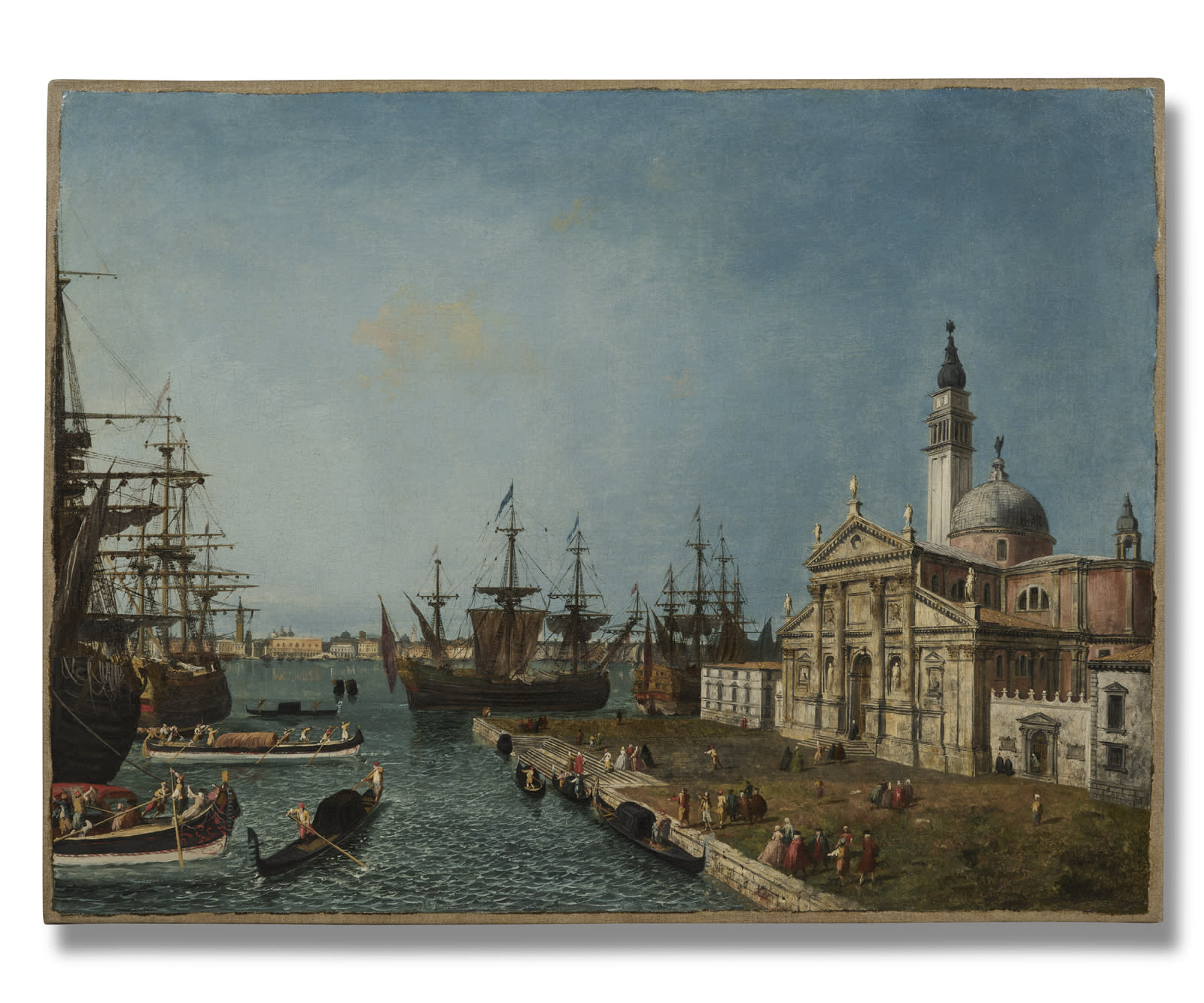
The Bacino di San Marco from the Island of San Giorgio Maggiore
c. 1742
Oil on canvas
53.5 x 70.5 cm (21 1/8 x 27 3/4 in.)
66.5 x 83 cm ( 26 1/4 x 32 3/4 in.) Framed
Provenance
Christie’s, London, 24 November 1967, lot 23;
Richard Green London, 1970;
Galleria Caretto, Turin, 1971;
Bruno Meissner Zurich;
Private collection, France;
Galerie Sanct Lucas, Vienna;
Robilant + Voena, London;
Private collection, Switzerland.
Literature
Egidio Martini, La pittura del Settecento veneto, Trieste, 1981, p. 537.
Ralph Toledano, Michele Marieschi. L’opera completa, Milan, 1988, p. 96, no. V.22.1.
Ralph Toledano, Michele Marieschi. Catalogo ragionato. Seconda edizione riveduta e corretta, Milan, 1995, pp. 98–99, no. V.28.d.
Description
This painting by Michele Marieschi shows the church and island of San Giorgio Maggiore in Venice, with the Bacino di San Marco beyond, and a distant view of the Piazzetta, the Molo, and their landmark buildings, the Campanile, the Palazzo Ducale, and the Ponte dei Sospiri (the Bridge of Sighs). This particular view seems to be unique to Marieschi and was not painted by any vedutista before or contemporary to him. It is moreover a view to which Marieschi returned on a number of occasions and was also engraved by the artist as part of his Magnificentiores Selectioresque Urbis Venetiarum Prospectus of 1741, a date which provides a terminus ante quem for the design.1
In this painting, as in the other variants, Marieschi intentionally exaggerated the distance between San Giorgio and the Molo to create a sense of depth. The viewpoint is quite high, and the composition seems to have been carefully constructed to create a contrast between the monumental Palladian structure of San Giorgio in the right foreground and the atmospheric expanse of water to the left of the painting. The quay in front of San Giorgio recedes along a sharp diagonal, drawing the eye towards the centre of the picture, to the vast Bacino, through the imposing shipping vessels moored by the island of San Giorgio, and ultimately to the buildings on the distant shore. The result is a strikingly modern and unusual view of the Venetian lagoon, a familiar destination for all Grand Tourists travelling to Italy in the eighteenth century.
There are a number of variants of this composition, each of them slightly different in the details of boats and staffage but essentially taken from the same viewpoint, demonstrating the popularity of the composition and the demand for it amongst Marieschi’s clientele.2 On account of the variety and specificity of the boats depicted, the very light and brilliant palette in the sky and sea, and the dense brushwork used to create the architecture, both Egidio Martini and Ralph Toledano consider the work to be the most mature version of the subject, and date the work to around 1742.
The excellent condition of this painting allows us to admire the painting technique that distinguished Marieschi from other vedutisti: the wide-angled panoramic view is enveloped in atmospheric light; the expanse of water is punctuated by gentle waves, the crests of which are painted with a swift touch of the brush; and the impasto on the façade of the church of San Giorgio and on the paving in front successfully conveys the effect of dappled sunlight on marble and stone. It is unclear what time of day it is, whether it is sunny or cloudy, but the figures on land and water go about their daily business with Marieschi, and, by extension, the viewer, observing.
1. For the engraving see Dario Succi, Michiel Marieschi. Catalogo Ragionato dell'Opera Incisa, Turin 1987, pp. 56–7, no. 6, illustrated.
2. The autograph variants published by Toledano in his 1995 monograph include: the painting sold Phillips, London, 3 July 1990, lot 75; a second sold Sotheby’s, London, 2 July 1986, lot 125 (as Jacopo Marieschi); a third at Schloß Charlottenburg, Berlin (attributed by Manzelli to Albotto); and a fourth sold, Sotheby’s, London, 4 July 2012, lot 43. For the autograph variants see Toledano 1995, pp. 94–95, cat. nos. V.28a–d, all illustrated. For the paintings considered attributed by Manzelli to Albotto see Mario Manzelli, Michele Marieschi e il suo alter-ego Francesco Albotto, Venice, 1991, p. 81. Further versions, with studio assistance, were sold Christie’s, London, 21 April 2004, lot 102, and Sotheby’s, New York, 30 May 1991, lot 63.
The artwork described above is subject to changes in availability and price without prior notice.
In this painting, as in the other variants, Marieschi intentionally exaggerated the distance between San Giorgio and the Molo to create a sense of depth. The viewpoint is quite high, and the composition seems to have been carefully constructed to create a contrast between the monumental Palladian structure of San Giorgio in the right foreground and the atmospheric expanse of water to the left of the painting. The quay in front of San Giorgio recedes along a sharp diagonal, drawing the eye towards the centre of the picture, to the vast Bacino, through the imposing shipping vessels moored by the island of San Giorgio, and ultimately to the buildings on the distant shore. The result is a strikingly modern and unusual view of the Venetian lagoon, a familiar destination for all Grand Tourists travelling to Italy in the eighteenth century.
There are a number of variants of this composition, each of them slightly different in the details of boats and staffage but essentially taken from the same viewpoint, demonstrating the popularity of the composition and the demand for it amongst Marieschi’s clientele.2 On account of the variety and specificity of the boats depicted, the very light and brilliant palette in the sky and sea, and the dense brushwork used to create the architecture, both Egidio Martini and Ralph Toledano consider the work to be the most mature version of the subject, and date the work to around 1742.
The excellent condition of this painting allows us to admire the painting technique that distinguished Marieschi from other vedutisti: the wide-angled panoramic view is enveloped in atmospheric light; the expanse of water is punctuated by gentle waves, the crests of which are painted with a swift touch of the brush; and the impasto on the façade of the church of San Giorgio and on the paving in front successfully conveys the effect of dappled sunlight on marble and stone. It is unclear what time of day it is, whether it is sunny or cloudy, but the figures on land and water go about their daily business with Marieschi, and, by extension, the viewer, observing.
1. For the engraving see Dario Succi, Michiel Marieschi. Catalogo Ragionato dell'Opera Incisa, Turin 1987, pp. 56–7, no. 6, illustrated.
2. The autograph variants published by Toledano in his 1995 monograph include: the painting sold Phillips, London, 3 July 1990, lot 75; a second sold Sotheby’s, London, 2 July 1986, lot 125 (as Jacopo Marieschi); a third at Schloß Charlottenburg, Berlin (attributed by Manzelli to Albotto); and a fourth sold, Sotheby’s, London, 4 July 2012, lot 43. For the autograph variants see Toledano 1995, pp. 94–95, cat. nos. V.28a–d, all illustrated. For the paintings considered attributed by Manzelli to Albotto see Mario Manzelli, Michele Marieschi e il suo alter-ego Francesco Albotto, Venice, 1991, p. 81. Further versions, with studio assistance, were sold Christie’s, London, 21 April 2004, lot 102, and Sotheby’s, New York, 30 May 1991, lot 63.
The artwork described above is subject to changes in availability and price without prior notice.