


Antonio Joli
b. 1700, Modena, Italy
d. 1777, Naples, Italy
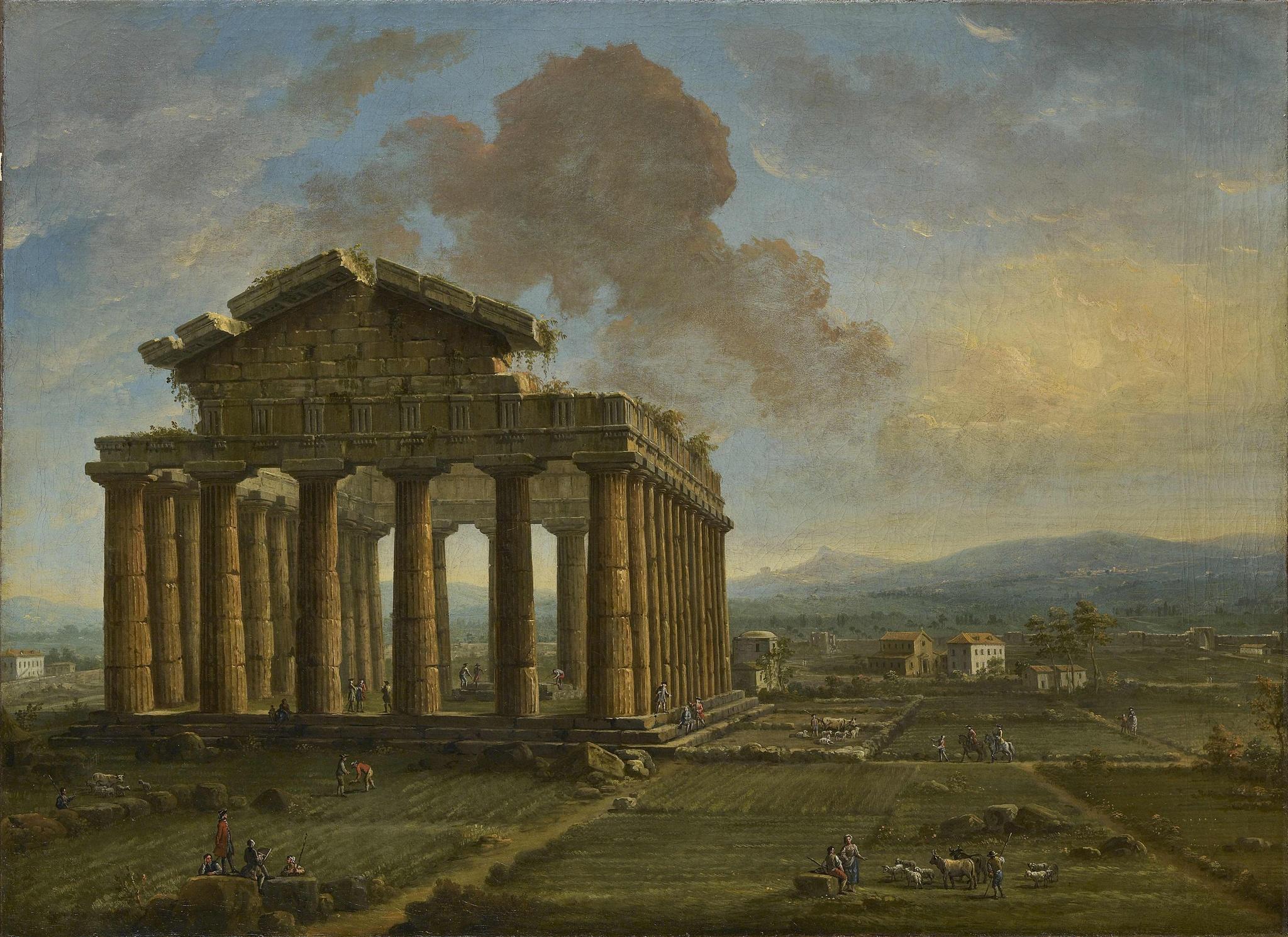
Temple of Poseidon at Paestum
late 1750s
Oil on canvas
74 x 101.5 cm (29 1/8 x 40 in.)
118.5 x 91 cm (46 3/4 x 35 7/8 in.) Framed
Provenance
Private collection.
Literature
Ralph Toledano, Antonio Joli, Turin, 2006, p. 401.
Description
Established as a Greek colony under the name of Poseidonia, Paestum in in southern Italy was eventually conquered by the local Lucanians and later the Romans. The Lucanians renamed it to Paistos and the Romans gave the city its current name. As Paestum, the town became a bishopric, but it was abandoned in the early Middle Ages, when the progressive silting up of the River Salso rendered the area swampy and insalubrious. There is no more information about Paestum until the sixteenth century, when the works of painters and writers such as Pietro Summonte rekindled interest in the city by portraying the state of the ruins. Nevertheless, the true “rediscovery” of the city did not take place until the eighteenth century when Paestum became a significant destination on the Grand Tour. From then on, illustrious visitors, including Goethe, Piranesi, Dos Passos, Shelley, Canova, and others, were attracted by its renowned beauty and spread news of it throughout Europe.
Born in Modena, Antonio Joli went to Rome as a young man and studied under Giovanni Paolo Pannini. After Joli moved to Venice in 1735, Canaletto encouraged his art, and Joli became one of the finest architectural view painters of his day. Joli travelled throughout Italy enjoying a successful career as a painter of vedute and capricci, principally aimed at the English Grand Tourists. The Temple of Poseidon at Paestum exemplifies the mid eighteenth-century taste for ruins reflecting the classical past.
Joli was one of the first artists to paint views of the three remarkably well-preserved Doric temples at Paestum, and a number of paintings of the site, seen from different vantage points, are known. Its popularity as a stop on the Grand Tour was such that Joli found a ready market for his views amongst his English clientele, and the artist is known to have made views of Paestum for Lord Brudenell, Sir Thomas Gray, and Sir William Hamilton. In June 1756, Lord Brudenell visited the temples, possibly accompanied by Joli, and on 15 June, his tutor Henry Lyte referred to the visit in a letter addressed to Lord Cardigan: “We returned yesterday from Pesti, an ancient colony of the Greeks. The Curiosities there are well worth going to see. They consist of three temples of the Doric order, the most ancient that are anywhere to be found so entire…They appear to be built for eternity. A gentleman of this place has had drawings made of them which are now engraving and will be soon published…” The “gentleman of this place” has been identified as Count Felice Gazzola, a military engineer in the employ of the Court of Naples, who started to survey the temples in 1755 under the supervision of the architect who had discovered the site, Mario Gioffedi. The engravings produced by Gazzola were published posthumously in 1784, preceded by about twenty others executed by Filippo Morghen, who in 1765 produced Sei vedute delle rovine di Pesto, of which five are based upon paintings by Joli.
The artwork described above is subject to changes in availability and price without prior notice.
Born in Modena, Antonio Joli went to Rome as a young man and studied under Giovanni Paolo Pannini. After Joli moved to Venice in 1735, Canaletto encouraged his art, and Joli became one of the finest architectural view painters of his day. Joli travelled throughout Italy enjoying a successful career as a painter of vedute and capricci, principally aimed at the English Grand Tourists. The Temple of Poseidon at Paestum exemplifies the mid eighteenth-century taste for ruins reflecting the classical past.
Joli was one of the first artists to paint views of the three remarkably well-preserved Doric temples at Paestum, and a number of paintings of the site, seen from different vantage points, are known. Its popularity as a stop on the Grand Tour was such that Joli found a ready market for his views amongst his English clientele, and the artist is known to have made views of Paestum for Lord Brudenell, Sir Thomas Gray, and Sir William Hamilton. In June 1756, Lord Brudenell visited the temples, possibly accompanied by Joli, and on 15 June, his tutor Henry Lyte referred to the visit in a letter addressed to Lord Cardigan: “We returned yesterday from Pesti, an ancient colony of the Greeks. The Curiosities there are well worth going to see. They consist of three temples of the Doric order, the most ancient that are anywhere to be found so entire…They appear to be built for eternity. A gentleman of this place has had drawings made of them which are now engraving and will be soon published…” The “gentleman of this place” has been identified as Count Felice Gazzola, a military engineer in the employ of the Court of Naples, who started to survey the temples in 1755 under the supervision of the architect who had discovered the site, Mario Gioffedi. The engravings produced by Gazzola were published posthumously in 1784, preceded by about twenty others executed by Filippo Morghen, who in 1765 produced Sei vedute delle rovine di Pesto, of which five are based upon paintings by Joli.
The artwork described above is subject to changes in availability and price without prior notice.