
Giorgio Morandi
b. 1890, Bologna, Italy
d. 1964, Bologna, Italy
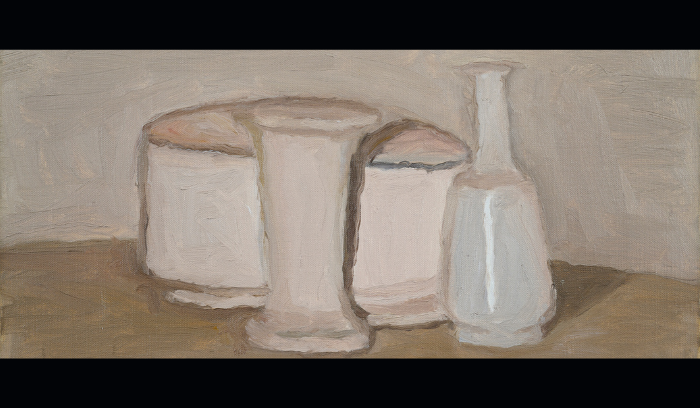
Giorgio Morandi, Still Life, 1955, S18.R900.M1606.T0517
1955
Oil on canvas
30 x 35.5 cm (11 3/4 x 14 in.)
Provenance
Professor Lionello Venturi, Rome (acquired directly from the artist in 1955);Gift to his daughter and his son-in-law, Rosabianca and Albert Skira, Geneva ;Private Collection, Lausanne (acquired by descent from the above);Galerie Kornfeld, Bern (June 15, 2018; lot 130);With Robilant+Voena.
Description
Among the most celebrated and influential Italian artists of the twentieth century, Giorgio Morandi (1890-1964) is best known for his paintings, drawings, and etchings depicting still life arrangements of quotidian objects. Although Morandi spent nearly his entire life in his hometown of Bologna and rarely traveled outside of Italy, his work was exhibited internationally and was widely admired by the avant-garde, as well as traditional schools, both during and after his lifetime. In 1913-1914, he established connections and exhibited with Italian Futurist artists such as Umberto Boccioni, Giacomo Balla, and Fortunato Depero, and in 1918-1919, he worked briefly as part of the Scuola Metafisica with Giorgio de Chirico and Carlo Carrà. By 1920, Morandi established the small-scale depictions of still lifes and landscapes that he would pursue throughout his oeuvre, and that were associated with no other school or style but his own.
Over the course of his five-decade career, Morandi was most prolific during the postwar years from 1948 until his death in 1964, when he executed more than half of his entire output of paintings. Throughout these intensely creative years, Morandi worked almost exclusively in series. Remaining dedicated to the repertoire of subjects that had occupied him since the early 1910s, including tabletop still lives of bottles, boxes, vases, and flowers, as well as occasional landscapes, his variations on a given compositional motif became more persistent, nuanced, and abstract in the later half of his life. The artist's favored subjects, including a yellow Persian bottle, a white fluted vase, a water jug, and boxes, appear repeatedly in different compositions, variously arranged in irregular configurations and tightly compacted so as to layer, abut, and obfuscate the shapes of adjacent forms, elaborating Morandi's credo that "Nothing is more abstract than reality."1 Through subtle shifts in color, tone, scale, and mark-making, Morandi was able to convey the ever-changing perceptual understanding and memory of the objects and spaces one encounters.
This work's emphasis on tonal variation, reductive forms, and spatial ambiguity exemplifies Morandi's long-standing concern with space, light, color, and form over subject matter—aspects that had a profound
influence on twentieth-century art.
1Giorgio Morandi, quoted in an interview with Professor Peppino Mangravite, The Voice of America, April 25,
1957, cited in Laura Mattioli Rossi, ed., The Later Morandi: Still Lifes 1950-1964. Exh. cat. (Milan: Mazzotta,
1998), p. 13.
Lamberto Vitali, Morandi, Catalogo generale, No. 964, reprod.
Certificate of authenticity by the artist on the back of a photograph, signed and dated 25 February 1964, with the archive no. 761, is attached
Over the course of his five-decade career, Morandi was most prolific during the postwar years from 1948 until his death in 1964, when he executed more than half of his entire output of paintings. Throughout these intensely creative years, Morandi worked almost exclusively in series. Remaining dedicated to the repertoire of subjects that had occupied him since the early 1910s, including tabletop still lives of bottles, boxes, vases, and flowers, as well as occasional landscapes, his variations on a given compositional motif became more persistent, nuanced, and abstract in the later half of his life. The artist's favored subjects, including a yellow Persian bottle, a white fluted vase, a water jug, and boxes, appear repeatedly in different compositions, variously arranged in irregular configurations and tightly compacted so as to layer, abut, and obfuscate the shapes of adjacent forms, elaborating Morandi's credo that "Nothing is more abstract than reality."1 Through subtle shifts in color, tone, scale, and mark-making, Morandi was able to convey the ever-changing perceptual understanding and memory of the objects and spaces one encounters.
This work's emphasis on tonal variation, reductive forms, and spatial ambiguity exemplifies Morandi's long-standing concern with space, light, color, and form over subject matter—aspects that had a profound
influence on twentieth-century art.
1Giorgio Morandi, quoted in an interview with Professor Peppino Mangravite, The Voice of America, April 25,
1957, cited in Laura Mattioli Rossi, ed., The Later Morandi: Still Lifes 1950-1964. Exh. cat. (Milan: Mazzotta,
1998), p. 13.
Lamberto Vitali, Morandi, Catalogo generale, No. 964, reprod.
Certificate of authenticity by the artist on the back of a photograph, signed and dated 25 February 1964, with the archive no. 761, is attached