

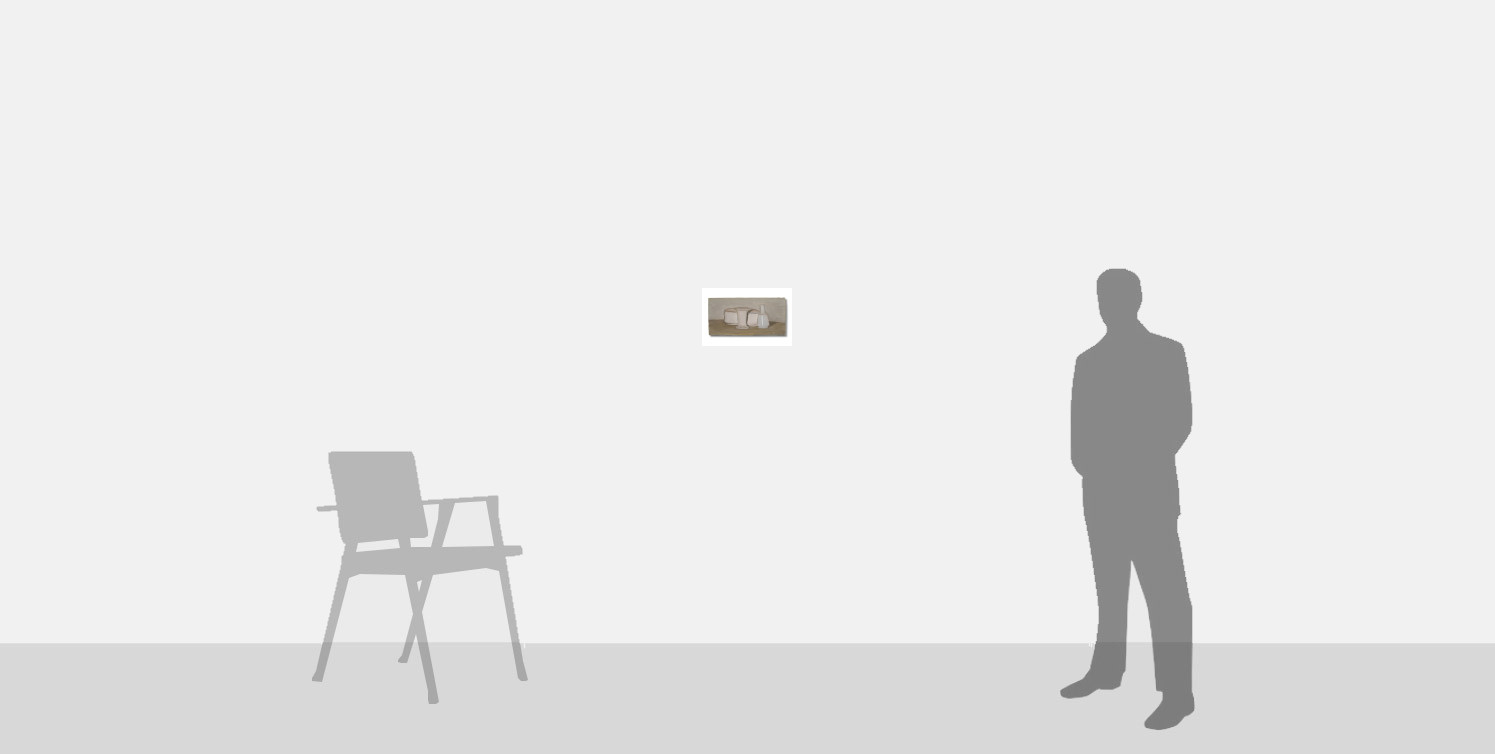

Giorgio Morandi
b. 1890, Bologna, Italy
d. 1964, Bologna, Italy
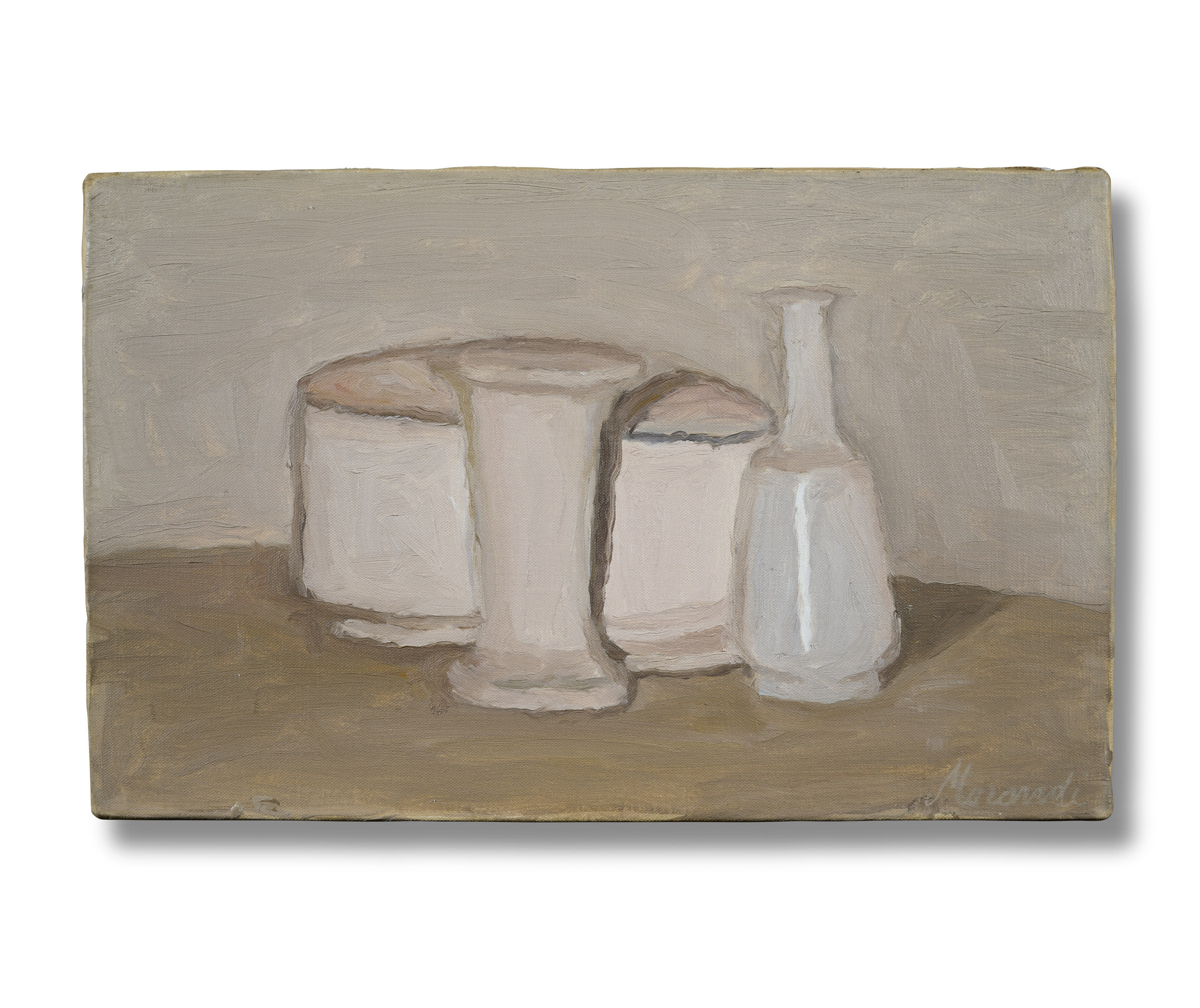
Still Life
1943
Oil on canvas
26 x 40 cm (10 1/4 x 15 3/4 in.)
Provenance
with Galleria Il Milione, Milan
Fila Collection, Biella
Mario Crepaldi, Milan
Private Collection, Milan, acquired in 1984/85
(Sotheby's, Milan, 26 November 2019, lot 29)
Fila Collection, Biella
Mario Crepaldi, Milan
Private Collection, Milan, acquired in 1984/85
(Sotheby's, Milan, 26 November 2019, lot 29)
Literature
L. Vitali, Morandi. Catalogo generale. Volume secondo 1948–1964, Milan, 1977, no. 1345, illustrated.
Description
“It is the miracle of his genius that out of the humble boxes, tin cans, outmoded oil lamps, and dusty bottles, emerge works of art full of poetry and often most justly called ‘songs without words.’”—Vitale Bloch in Giorgio Morandi: Paintings and Prints, exh. cat., Arts Council of Great Britain, London, 1954
Giorgio Morandi was born in 1890 in Bologna, and rarely ever left his native city. Except for occasional trips to Venice, Florence or Rome for exhibitions of his paintings and etchings, or summer holidays in the village of Grizzana in the Apennine hills, Morandi spent his days working quietly in a modest studio and apartment in the via Fondazza that he shared with his mother and three sisters. He was tall, thoughtful and soft spoken, and his quiet and contemplative demeanour, together with his reclusive nature, are reflected in his hermetic compositions and subtle painting techniques. Or, as Morandi himself once said, “I’m a painter of the kind of…composition that communicates a sense of tranquility and privacy, moods which I have always valued above all.”
Yet despite his unassuming public profile—Morandi granted only two published interviews, both near the end of his life—his beautifully contemplative still-life paintings quickly came to be known and in demand across Europe, as well as in North and South America. He was, moreover, embraced by Italy’s intellectual elite, and his works were championed by well-known painters, prominent writers and publishers, and distinguished art historians and professors. As early as 1934, Roberto Longhi, then Professor of Renaissance Art at the University of Bologna and a preeminent cultural voice in Italy, recognized Morandi as “arguably the greatest Italian painter of the twentieth century.” In 1949 he was featured in the seminal exhibition Twentieth-Century Italian Art at the Museum of Modern Art in New York, and in 1957 he was awarded the Grand Prize for painting at the São Paulo Biennale in Brazil, ahead of Jackson Pollock and Marc Chagall. Since Morandi’s death in 1964, his work has had a significant impact on subsequent generations of artists and movements, and has come to be included in many prominent public and private collections worldwide. Morandi also made headlines in 2009 when President Barack Obama chose two small paintings by the artist to be hung in the White House, with Morandi being only one of two non-American artists to be featured there.
Finding himself unable to relate to the artistic context of the modern era, Morandi consciously distanced himself from the problems faced by his contemporaries, who felt the need to renew themselves and their style. He instead remained faithful to himself alone, choosing to repeat himself obsessively, to study and deepen his understanding of each of his subjects in the smallest details and in the widest possible range of nuances. As such, Morandi is best known for his still life paintings of the same selection of familiar items, including bottles, bowls, vases, jugs, pots and boxes, rendered in delicate hues. In his works, these objects are bereft of any domestic purpose, and become instead sculptural forms that invite meditation and contemplation. Yet while superficially the paintings Morandi made from the 1920s through the 1960s may all look rather similar, they are in fact full of small, sensitive shifts and inflections, dependent on precisely which objects are placed where, in what combination, in which colors and under what sort of light. It was through this repeated examination of these simple items that Morandi achieved a sense of eternal timelessness and truth.
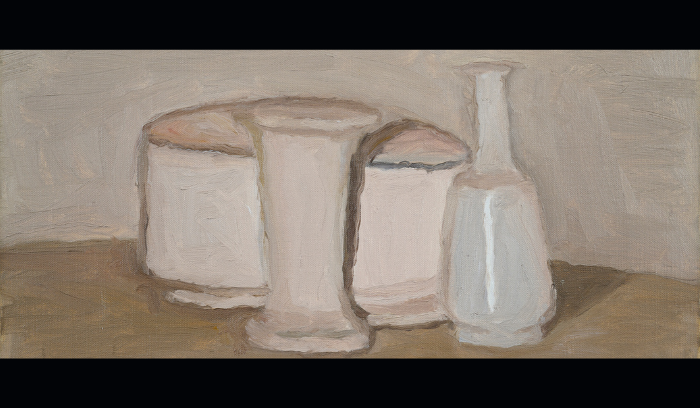
Morandi painted the present still life in 1943, a year fraught with peril for the artist. Italy entered the Second World War in 1940 as an Axis ally of Nazi Germany, a decision for which the Italian people would suffer enormously during the next five years. Morandi had friends involved with the resistance, and when a postcard from the artist was found in the possession of his friend Carlo Ragghianti, who had been arrested for anti-fascist activity, agents of the secret police appeared at Morandi’s door during the afternoon of 23 May 1943 and took him to prison. No incriminating evidence was found in Morandi’s home—he had fortuitously destroyed any compromising correspondence—and because he was an esteemed professor of art at the Accademia di Belle Arti, part of the University of Bologna, friends with connections high in the Ministry of Education managed to obtain his release within days. But no less dangerous times were still to come. During the summer, the Italian government deposed and imprisoned Benito Mussolini, and Italy then signed a secret armistice with the Allies, who had already invaded the Italian mainland after their victory over Axis forces in Sicily. Hitler would not allow Italy to defect to the Allied cause, and rescued Mussolini, while the German army quickly occupied the country, bringing with them the Gestapo, which began to hunt down members of the resistance and implement the Nazi final solution for Italian Jews. As a major artery of military transportation, Bologna endured severe Allied bombing for the remainder of the war, forcing Morandi to seek safety in the countryside at Grizzana.
There may be some hint of the painter’s uneasy state of mind in the slightly off-center composition of the present still life, or in his decision to station two vases like sentinels, guarding a vulnerable, open bowl. Yet in truth it is difficult to identify obvious signs of the war in the familiar elements of Morandi’s still life paintings, of the kind he had been making for almost two decades, except by way of contrast. These paintings, with their humble and unassuming humanity, so silent and contemplative, appear to be far removed from the daily experience of violence, chaos and death shattering the world around them. Indeed, the character of Morandi’s work could provide a balm for the troubled spirit, as the critic Giuseppe Marchiori recalled in 1963: “During the tragedy of conflict and oppression we were consoled in our sorrow by the thought of the man in a room on the Via Fondazza…Morandi was in all probability painting a picture of bottles, lamps and dusty boxes. Amid the clamor of war his silent and lonely steadfastness was a bulwark; it was a noble protest of the man ‘the most out of step’ in the world” (quoted in Janet Abramowicz, Giorgio Morandi: The Art of Silence, New Haven, 2004, p. 165).
Morandi’s fundamental response to the horror around him was to paint, just as Picasso continued to paint in occupied Paris, and the sensitive internalization of his experiences lend a special gravitas to his wartime expressions. “Some of the works that Morandi painted during the war are among the most beautiful of his career,” Abramowicz has declared. “His paintings of the 1940s have a different palette from the works of the 1930s. The light in these works varies from a lugubrious dark crimson to austere sackcloth browns" (Ibid., p. 168). Notwithstanding the terrible reality that threatened to impinge upon his private world in the studio, Morandi painted steadily and with increasing productivity during the early years of the war, completing nearly twenty pictures in 1940, forty-six in 1941 and sixty-seven in 1943, numbers that fell off substantially when he returned from Grizzana to Bologna in June 1944. When the artist’s friend Roberto Longhi organized a show of Morandi’s paintings in Florence in that year following the liberation of that city, Morandi was still cut off in Bologna, alive and well, but his fate remained unknown to his friends until the war was over.
Please note that the availability and price of the above work are subject to change without prior notice. Where applicable ARR will be added.
Giorgio Morandi was born in 1890 in Bologna, and rarely ever left his native city. Except for occasional trips to Venice, Florence or Rome for exhibitions of his paintings and etchings, or summer holidays in the village of Grizzana in the Apennine hills, Morandi spent his days working quietly in a modest studio and apartment in the via Fondazza that he shared with his mother and three sisters. He was tall, thoughtful and soft spoken, and his quiet and contemplative demeanour, together with his reclusive nature, are reflected in his hermetic compositions and subtle painting techniques. Or, as Morandi himself once said, “I’m a painter of the kind of…composition that communicates a sense of tranquility and privacy, moods which I have always valued above all.”
Yet despite his unassuming public profile—Morandi granted only two published interviews, both near the end of his life—his beautifully contemplative still-life paintings quickly came to be known and in demand across Europe, as well as in North and South America. He was, moreover, embraced by Italy’s intellectual elite, and his works were championed by well-known painters, prominent writers and publishers, and distinguished art historians and professors. As early as 1934, Roberto Longhi, then Professor of Renaissance Art at the University of Bologna and a preeminent cultural voice in Italy, recognized Morandi as “arguably the greatest Italian painter of the twentieth century.” In 1949 he was featured in the seminal exhibition Twentieth-Century Italian Art at the Museum of Modern Art in New York, and in 1957 he was awarded the Grand Prize for painting at the São Paulo Biennale in Brazil, ahead of Jackson Pollock and Marc Chagall. Since Morandi’s death in 1964, his work has had a significant impact on subsequent generations of artists and movements, and has come to be included in many prominent public and private collections worldwide. Morandi also made headlines in 2009 when President Barack Obama chose two small paintings by the artist to be hung in the White House, with Morandi being only one of two non-American artists to be featured there.
Finding himself unable to relate to the artistic context of the modern era, Morandi consciously distanced himself from the problems faced by his contemporaries, who felt the need to renew themselves and their style. He instead remained faithful to himself alone, choosing to repeat himself obsessively, to study and deepen his understanding of each of his subjects in the smallest details and in the widest possible range of nuances. As such, Morandi is best known for his still life paintings of the same selection of familiar items, including bottles, bowls, vases, jugs, pots and boxes, rendered in delicate hues. In his works, these objects are bereft of any domestic purpose, and become instead sculptural forms that invite meditation and contemplation. Yet while superficially the paintings Morandi made from the 1920s through the 1960s may all look rather similar, they are in fact full of small, sensitive shifts and inflections, dependent on precisely which objects are placed where, in what combination, in which colors and under what sort of light. It was through this repeated examination of these simple items that Morandi achieved a sense of eternal timelessness and truth.
Morandi painted the present still life in 1943, a year fraught with peril for the artist. Italy entered the Second World War in 1940 as an Axis ally of Nazi Germany, a decision for which the Italian people would suffer enormously during the next five years. Morandi had friends involved with the resistance, and when a postcard from the artist was found in the possession of his friend Carlo Ragghianti, who had been arrested for anti-fascist activity, agents of the secret police appeared at Morandi’s door during the afternoon of 23 May 1943 and took him to prison. No incriminating evidence was found in Morandi’s home—he had fortuitously destroyed any compromising correspondence—and because he was an esteemed professor of art at the Accademia di Belle Arti, part of the University of Bologna, friends with connections high in the Ministry of Education managed to obtain his release within days. But no less dangerous times were still to come. During the summer, the Italian government deposed and imprisoned Benito Mussolini, and Italy then signed a secret armistice with the Allies, who had already invaded the Italian mainland after their victory over Axis forces in Sicily. Hitler would not allow Italy to defect to the Allied cause, and rescued Mussolini, while the German army quickly occupied the country, bringing with them the Gestapo, which began to hunt down members of the resistance and implement the Nazi final solution for Italian Jews. As a major artery of military transportation, Bologna endured severe Allied bombing for the remainder of the war, forcing Morandi to seek safety in the countryside at Grizzana.
There may be some hint of the painter’s uneasy state of mind in the slightly off-center composition of the present still life, or in his decision to station two vases like sentinels, guarding a vulnerable, open bowl. Yet in truth it is difficult to identify obvious signs of the war in the familiar elements of Morandi’s still life paintings, of the kind he had been making for almost two decades, except by way of contrast. These paintings, with their humble and unassuming humanity, so silent and contemplative, appear to be far removed from the daily experience of violence, chaos and death shattering the world around them. Indeed, the character of Morandi’s work could provide a balm for the troubled spirit, as the critic Giuseppe Marchiori recalled in 1963: “During the tragedy of conflict and oppression we were consoled in our sorrow by the thought of the man in a room on the Via Fondazza…Morandi was in all probability painting a picture of bottles, lamps and dusty boxes. Amid the clamor of war his silent and lonely steadfastness was a bulwark; it was a noble protest of the man ‘the most out of step’ in the world” (quoted in Janet Abramowicz, Giorgio Morandi: The Art of Silence, New Haven, 2004, p. 165).
Morandi’s fundamental response to the horror around him was to paint, just as Picasso continued to paint in occupied Paris, and the sensitive internalization of his experiences lend a special gravitas to his wartime expressions. “Some of the works that Morandi painted during the war are among the most beautiful of his career,” Abramowicz has declared. “His paintings of the 1940s have a different palette from the works of the 1930s. The light in these works varies from a lugubrious dark crimson to austere sackcloth browns" (Ibid., p. 168). Notwithstanding the terrible reality that threatened to impinge upon his private world in the studio, Morandi painted steadily and with increasing productivity during the early years of the war, completing nearly twenty pictures in 1940, forty-six in 1941 and sixty-seven in 1943, numbers that fell off substantially when he returned from Grizzana to Bologna in June 1944. When the artist’s friend Roberto Longhi organized a show of Morandi’s paintings in Florence in that year following the liberation of that city, Morandi was still cut off in Bologna, alive and well, but his fate remained unknown to his friends until the war was over.
Please note that the availability and price of the above work are subject to change without prior notice. Where applicable ARR will be added.