
Gianni Colombo
b. 1937
d. 1993
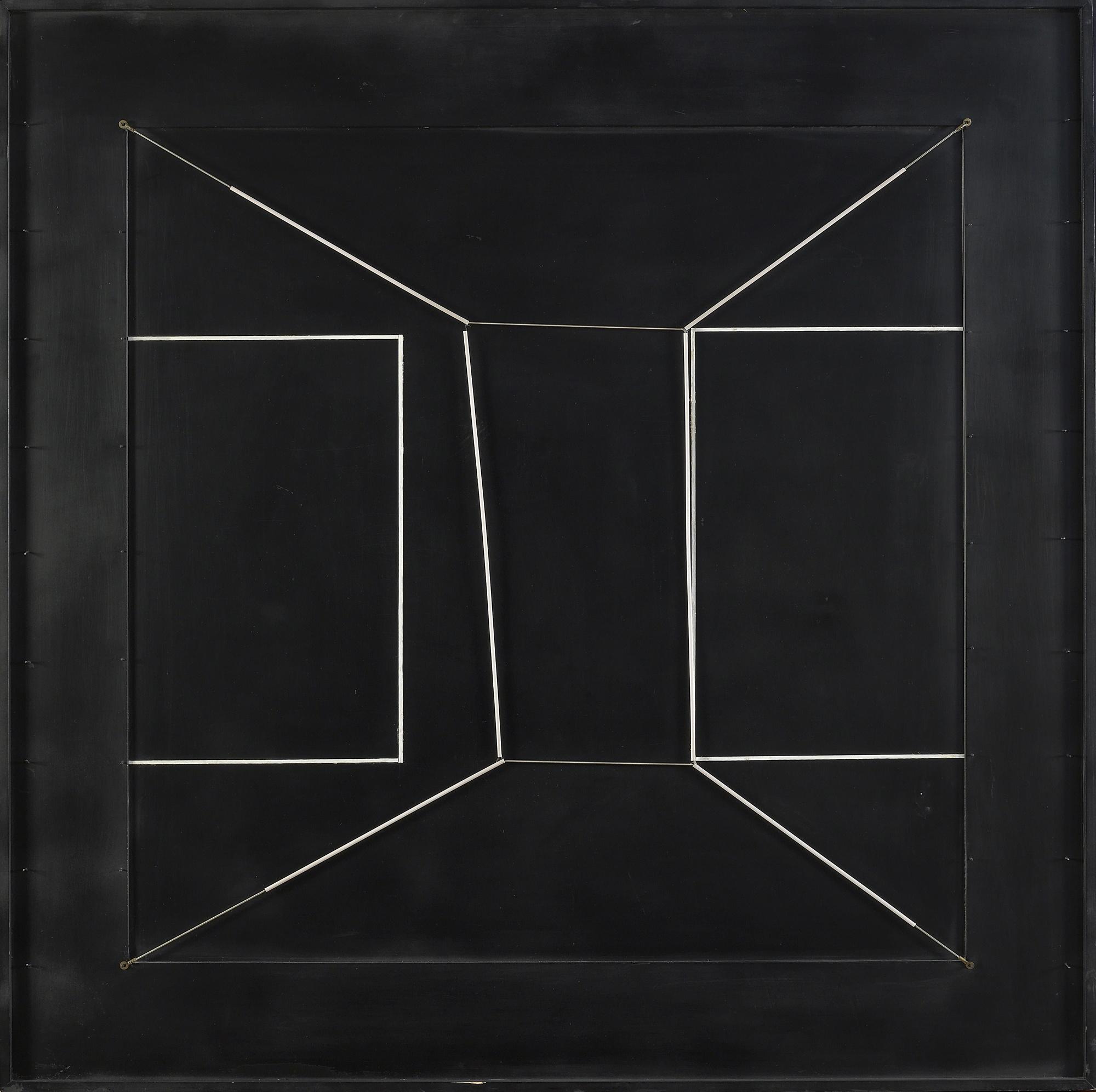
Spazio Elastico Intermutabile, Due Doppi Quadrati Incompiuti (Intermutable Elastic Space, Two Incomplete Double Squares)
1979
Wood, paint, nails, elastic metal cord
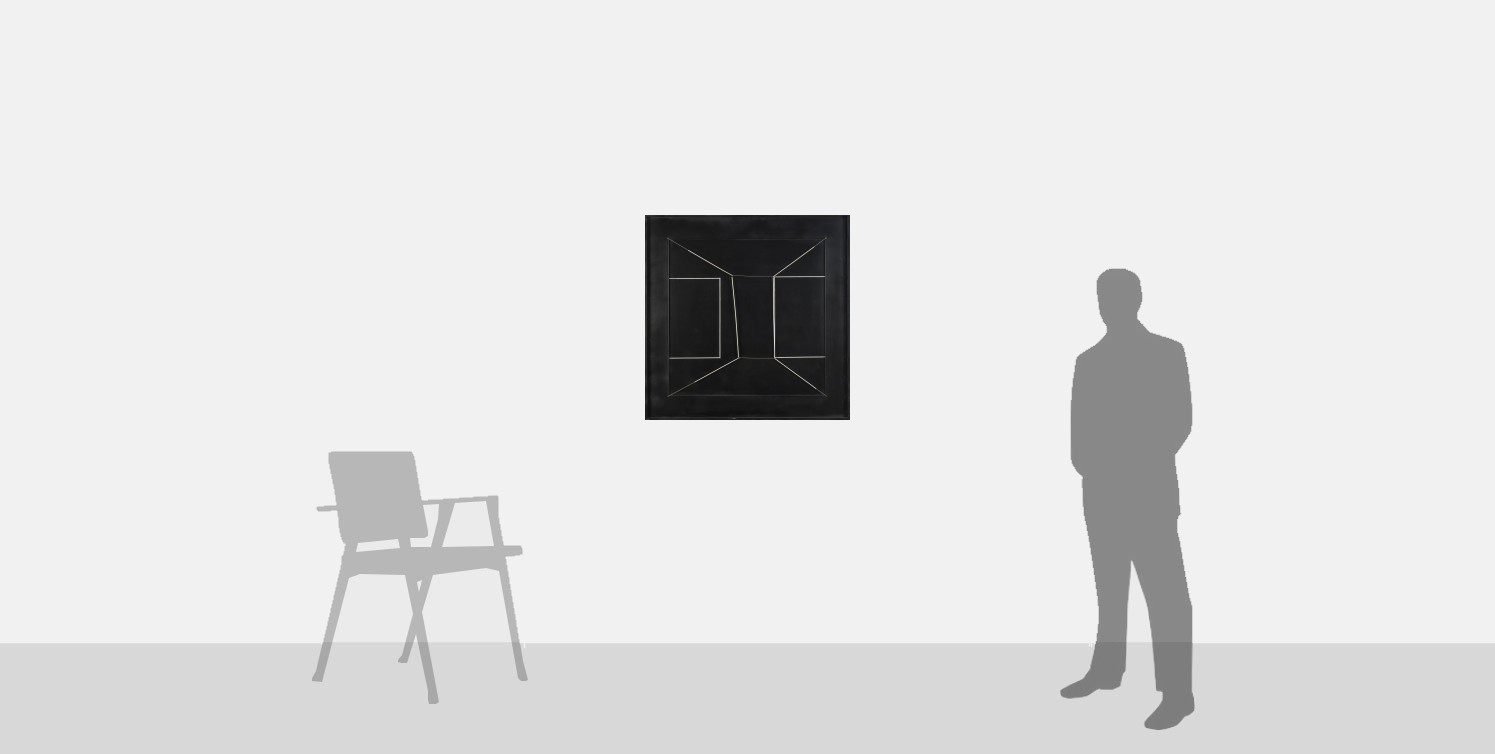
91.2 x 91.2 cm (35 7/8 x 35 7/8 in.)
Literature
F. Pola & M. Scotini, Gianni Colombo The Body and the Space 1959-1980, Milan, Marsilio-Robilant+Voena, 2015, ill. pp. 154, 221 (fig. 143).
Description
A further example of the concept of “elastic space” is the construction of real object-paintings in which the conceptual and perceptive non-determination of form, structure and image is achieved by other means. The subject of the work is the condition of space, at once projective and appropriated, the transformation of a sign, which displays the theoretical features of geometrical design at first, into something physical. Once more, the focus is on the arbitrary modifiability of a structure, which can be constructed in a number of ways, as a result of the viewer’s participation, thanks to the elasticity of the metal threads that are used as signs.
(Flaminio Gualdoni, in Gianni Colombo, catalogue of the exhibition held at Studio Gariboldi, Milan, 7 October 2010)
Gianni Colombo (Milan, 1937 - Melzo, 1993) produced his first artworks – paintings, sculptures, and ceramics – in 1955. He studied at the Academy of Brera, where he attended the courses of painting held by Achille Funi and Pompeo Borra. He shared his first studio on via Montegrappa in Milan with Davide Boriani and Gabriele Devecchi, and eventually moved to a studio next to the one of his brother Joe. He experimented with different materials and languages, and in 1959 founded Gruppo T with Giovanni Anceschi, Davide Boriani, and Gabriele Devecchi, becoming an internationally acclaimed protagonist of kinetic and programmed art.
Colombo was both a technician of manipulable, kinetic objects, and a Dadaist architect: he was an artist who truly enjoyed doing what each of his experiments required. His desire to go beyond a traditional conception of the work of art, of transforming viewers into technicians, led Gianni Colombo to experiment with new structures of perception by means of light effects and unusual balances. His aim was to modify the viewer’s sensations, surprising him with the creation of synaesthetic places, of fields of interaction between different sensory organs. He wished to disturb the perceptive passivity of places, such as galleries and museums, houses and palaces, and show the inertia that characterised their use.
Colombo experimented with his elastic spaces in several forms: from the early nets of cubes consisting of elastic threads set in motion by engines or by means of Wood’s light (1964), to the installation of an “environmental” elastic space at the Attico gallery in Rome (1967-1968), an idea of which he would later develop variants on different occasions. At the close of the 1970s, besides walk-in environments, he also developed a series of elastic spaces built through lightweight metal structures in the shape of cubes hanging from the ceiling by means of simple nylon threads set in motion by engines. However, the importance of the viewer’s active role becomes once more prominent in another series of elastic spaces the artist developed from 1974 onwards, to which the present work, dated 1979, belongs. Colombo uses the traditional surface of a painting, transforming it into a panel that the subject can influence by moving the elastic threads with their hands. The drawings that can thus be obtained absorb the viewer in a relationship that has the seeming lightness of a game ... and “game” and “lightness” are two keywords of Gianni Colombo’s poetics. Gianni Colombo and I were among the few who pursued a simplicity and precision that was also lightness, reminisces François Morellet.
The artwork described above is subject to changes in availability and price without prior notice.
Where applicable ARR will be added.
(Flaminio Gualdoni, in Gianni Colombo, catalogue of the exhibition held at Studio Gariboldi, Milan, 7 October 2010)
Gianni Colombo (Milan, 1937 - Melzo, 1993) produced his first artworks – paintings, sculptures, and ceramics – in 1955. He studied at the Academy of Brera, where he attended the courses of painting held by Achille Funi and Pompeo Borra. He shared his first studio on via Montegrappa in Milan with Davide Boriani and Gabriele Devecchi, and eventually moved to a studio next to the one of his brother Joe. He experimented with different materials and languages, and in 1959 founded Gruppo T with Giovanni Anceschi, Davide Boriani, and Gabriele Devecchi, becoming an internationally acclaimed protagonist of kinetic and programmed art.
Colombo was both a technician of manipulable, kinetic objects, and a Dadaist architect: he was an artist who truly enjoyed doing what each of his experiments required. His desire to go beyond a traditional conception of the work of art, of transforming viewers into technicians, led Gianni Colombo to experiment with new structures of perception by means of light effects and unusual balances. His aim was to modify the viewer’s sensations, surprising him with the creation of synaesthetic places, of fields of interaction between different sensory organs. He wished to disturb the perceptive passivity of places, such as galleries and museums, houses and palaces, and show the inertia that characterised their use.
Colombo experimented with his elastic spaces in several forms: from the early nets of cubes consisting of elastic threads set in motion by engines or by means of Wood’s light (1964), to the installation of an “environmental” elastic space at the Attico gallery in Rome (1967-1968), an idea of which he would later develop variants on different occasions. At the close of the 1970s, besides walk-in environments, he also developed a series of elastic spaces built through lightweight metal structures in the shape of cubes hanging from the ceiling by means of simple nylon threads set in motion by engines. However, the importance of the viewer’s active role becomes once more prominent in another series of elastic spaces the artist developed from 1974 onwards, to which the present work, dated 1979, belongs. Colombo uses the traditional surface of a painting, transforming it into a panel that the subject can influence by moving the elastic threads with their hands. The drawings that can thus be obtained absorb the viewer in a relationship that has the seeming lightness of a game ... and “game” and “lightness” are two keywords of Gianni Colombo’s poetics. Gianni Colombo and I were among the few who pursued a simplicity and precision that was also lightness, reminisces François Morellet.
The artwork described above is subject to changes in availability and price without prior notice.
Where applicable ARR will be added.
