Carlo Dolci
b. 1616
d. 1686
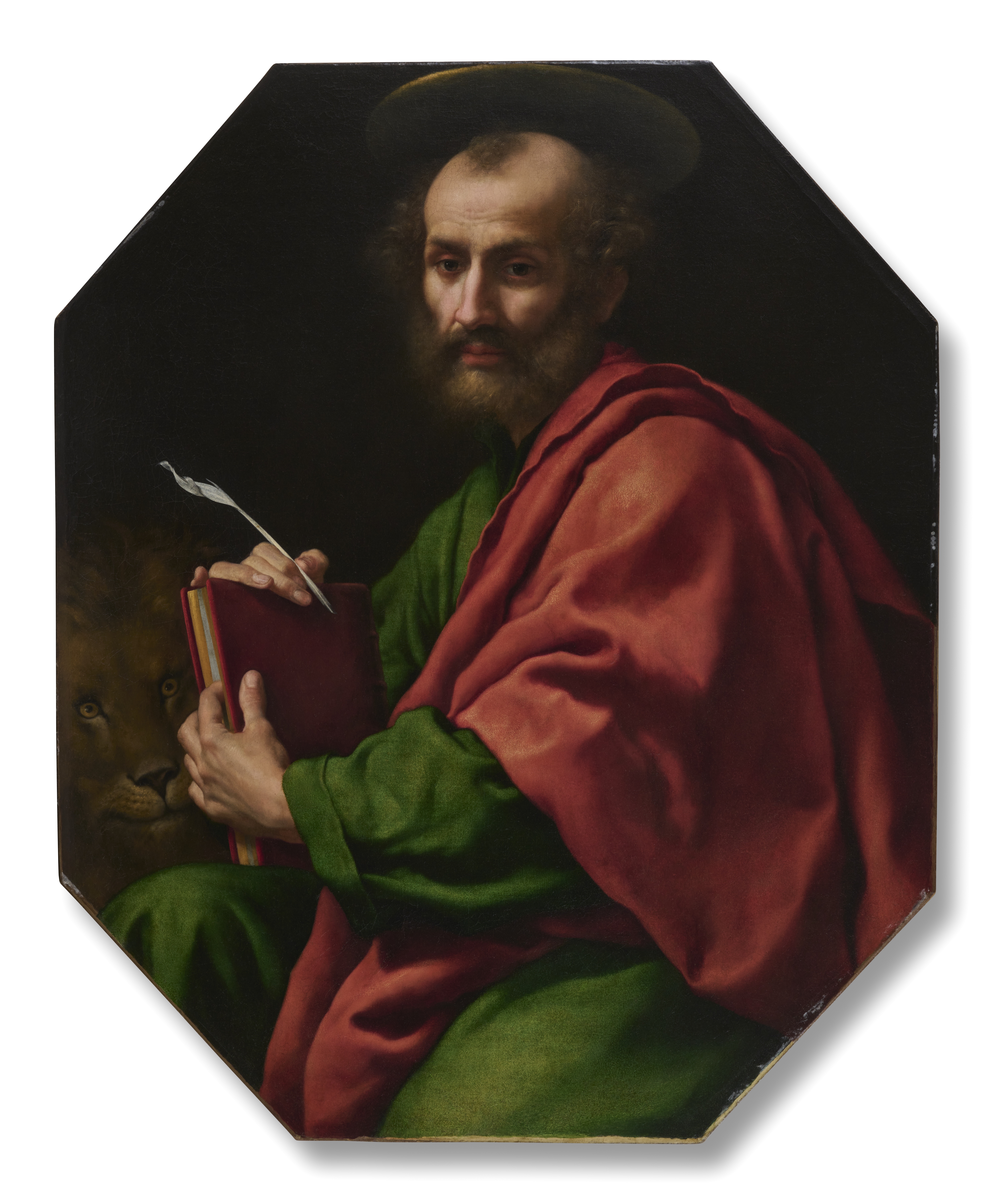
Saint Mark the Evangelist
c. 1640
Oil on canvas
101.5 x 83 cm (40 x 32 5/8 in.)
Provenance
Painted for the artist’s confessor (probably Domenico Carpanti), Florence (according to Baldinucci, see below);
GiovanniBattista Galli (b. 1642), who purchased the set (possibly from the above) for 120 scudi before 1677, Palazzo Galli, via Pandolfini, Florence;
Marchese Cosimo Riccardi (1671–1751), Palazzo Medici-Riccardi, Florence, and by descent until 1810;
Acquired by Lucien Bonaparte (1775–1840);
Sold Stanley’s, London, 16 May 1816, lot 154, “St. Mark, forming one of the Series of Four Evangelists, formerly in the Riccardi Palace. The character of the Head, the drawing of the Hands, and the cast of the Draperies, are excellent”;
Acquired by Nieuwenhuys, Paris, 8 July 1826;
William, Prince of Orange, subsequently King William II of the Netherlands (1792–1849), by 1837;
His sale, J. de Vries, C. F. Roos, J. A. Brondgeest, The Hague,12–20 August 1850, lot 153, erroneously described as Saint Luke, “L’apôtreest représenté écrivant l'Évangile. Son attitude indique qu’il estplongé dans la réflexion; dans l’ombre on découvreun lion. Ce beau tableau, quoique d’un grand fini, est peint d’une maniére large, etles couleurs y ont cette transparence qu’onadmire dans toutes les oeuvres de l’artiste”, 14 October 1850;
Purchased by Friedrich zu Wied, Prince of the Netherlands;
By inheritance to Marie zu Wied, Princess of the Netherlands, Schloss Neuwied, Germany;
Sold her sale, Sotheby’s, London, 5 July 1967, lot 18, as “C. Dolci,”, to Waddingham;
Anonymous sale, Christie’s, London, 8 December 1995, lot 103, where purchased by the former owners.
Literature
Giovanni Cinelli and Francesco Bocchi, Le bellezze della città di Firenze, Florence 1677, p. 370.
Francesco Baldinucci, Notizie de’ professori del disegno da Cimabue in qua, Florence 1681–1728, ed. 1845–1847, V, 1846, p. 341.
Marc’Antonio Frecchioni, Inventario delle masserizie, mobili, argenti, stagni etc. esistenti nel palazzo di Via Larga degl’Ill.mi Sig.ri Marchesi Riccardi, ms, 1753, Archivio di Stato, Florence, Riccardi 274, p. 12, item 127, “Carlino Dolci. Quattro quadri compagni ottagoni bislunghi, alti br. 1 4/5 rappresentano i quattro Evangelisti.Con ornamenti grandi, intagliati a grottesca antica, con angiolini esimboli di ciascheduno, e tutti Dorati.”
Charles Nicolas Cochin, Voyage d’Italie, Paris 1758, II, p. 76.
Elogide Carlo Dolci, etc., Florence 1775, p. 33.
Marco Lastri, L’Etruria Pittrice ovvero storia della pittura toscana dedottadai suoi monumenti che si esibiscono in stampa dal secolo Xfino al presente, Florence, II, 1795, pl. 110.
Luigi Lanzi, Storia pittorica della Italia dal risorgimento delle Belle Arti fin presso la fine del XVIII secolo, Bassano 1795–1796, I. p. 178.
William Buchanan, Catalogue of the Collections of Pictures of Lucien Bonaparte, Prince of Canino, London 1815, no. 57.
William Buchanan, Memoirs of Painting, London 1824, II, pp. 272–73, no. 52, and p. 287, “The character of the head, the drawing of the hands, the cast of the draperies, and the general colouring of the whole are excellent.”
C. J. Nieuwenhuys, Description de la Collection des Tableaux qui ornent le Palais de S.A.R.M. le Prince d’Orange, a Bruxelles, Brussels,1837, no. 33, “Jamais peintre ne prit plus de soin pour amener ses ouvrages à la perfection, que Carlo Dolci, et quoique l’exécution y soit portée à un fini extraordinaire, sa manière de peindre est toujours largement conu, les couleurs y sont fondues avecun molleux et une transparence qui forment un des traits caractéristiques du beau talent de cet artist célébre, dont les ouvragessont de la plus grand rareté: celui-ci est du nombre de ses meilleures productions.”
C. J. Nieuwenhuys, Description de la Galerie des Tableaux de S.M. LeRoi des Pays-Bas, Paris 1843, no. 125.
K. Busse, “Dolci, Carlo,” in U. Thieme, F. Becker, and M. Vollmer, eds., Allgemeines Lexikon der bildenden Künstler, Leipzig, XI, 1913, p. 387.
Fabia Borroni Salvadori, “Le esposizioni d’arte aFirenze dal 1674 al 1767” Mitteilungen des Kunsthistorischen Institutes in Florenz, XVIII, 1974, pp. 29, 80.
Burton B. Fredericksen, “The Four Evangelists by Carlo Dolci” The J. Paul Getty Museum Journal, III, 1976, pp. 67–73.
Giuseppe de Juliis, “Appunti su una quadreria fiorentina: la collezione dei marchesi Riccardi” Paragone 357, 1981, pp. 88–89, note 64 and p. 91, note 81.
Giuseppe Cantelli, Repertorio della pittura fiorentina del Seicento, Fiesole 1983, p. 74.
Charles McCorquodale, Il Seicento Fiorentino. Arte a Firenze da Ferdinando I a Cosimo III, exh. cat., Florence, 1986, III, p. 82.
Maria Jole Minicucci, “Parabola di un museo” Rivista d’Arte, XXXIX, 1987, p. 381.
Francesca Baldassari in La pittura in Italia. Il Seicento, Milan 1989, II, p. 726.
Erik Hinterding and Femy Horsch, “‘A small but choice collection’: the art gallery of King Willem II of the Netherlands (1792–1849)” Simiolus, XIX, 1989, p. 103, no. 153, with an illustrated reconstruction of the painting.
Maria Barbara Guerrieri Borsoi, “Carlo Dolci” in Dizionario Biografico degli Italiani, Rome 1991, no. 40, p. 421.
Béatrice Edelein-Badie, La collection de tableux de Lucien Bonaparte, Prince de Canino, doctoral dissertation, Université Paul Valéry Montpellier, III, 1992, II, pp. 280–81, no. 62.
Burton B. Fredericksen, ed., The Index of Paintings Sold in the British Isles during the Nineteenth Century, III, Santa Barbara and Oxford 1993, p. 337.
Francesca Baldassari, Carlo Dolci, Turin 1995, pp. 21–22 and 66–67, no. 32, illustrated, and colour pl. 11.
Marina Natoli, Mina Gregori, et al, Luciano Bonaparte: Le sue collezioni d’arte e le sue residenze a Roma, nel Lazio, in Italia (1804–1840), Rome 1995, p. 318, no. 11.
Francesca Baldassari, La pittura del Seicento a Firenze, Turin, 2009, pp. 334 and 340, fig. 149.
Description
The painting originally formed part of a set of the Four Evangelists, which together constitute a formidable highpoint in the artist’s output and, according to Baldassari, “the masterpiece of Dolci's youth” (op. cit., 1995, pp. 21–22). She dates the canvases to around 1640, taking note of Baldinucci, Dolci’s pupil, friend, and biographer, who records that they were “made by Carlo in his youth for a confessor, for no more than five scudi each”; earlier on the same page, he identifies Canonico Domenico Carpanti as Dolci’s confessor, for whom the artist also executed a vanitas still life (now lost). As Burton Fredricksen points out in his 1976 article, the care taken by Dolci in this commission would seem to reflect the affinity felt by the pious artist for his confessor, as well as his need to establish a reputation at this early stage of his career.
Baldinucci also records that the four octagonal pictures “were bought by Giovambatista Galli for 120 scudi [and] Carlo then worked on the pictures again, rendering them even more beautiful.” Giovanni Battista Galli, born in 1642, had inherited from his father Agnolo a fine collection of Florentine seicento paintings, including Lorenzo Lippi's Triumph of David, which contains portraits of Giovanni Battista, his mother, and his fifteen siblings, painted in 1656 (exhibited Florence, Palazzo Strozzi, Il Seicento Fiorentino, Arte a Firenze da Ferdinando I a Cosimo III, 21 December 1986–4 May 1987, Pittura, pp. 346-48, no. 1.184). He took the opportunity to purchase the present picture and its companions in order to augment the collection in the family palace in via Pandolfini, where “the four Evangelists by Dolci” were noted by Giovanni Cinelli in 1677 (loc. cit.).
They are next recorded at the end of the seventeenth century in the collection of Cosimo Riccardi (1671–1751), and appear in various inventories of the family palazzo on the via Larga (the Palazzo Medici-Riccardi) throughout the eighteenth century. In 1810, they were acquired from the family by Napoleon’s brother, Lucien Bonaparte, Prince of Canino, who was in Italy from 1804 until 1810. On his way to America in 1810, Bonaparte was captured at sea by the British and held in London until 1814. He returned to Rome after his release, but his collection of paintings was consigned in London for sale, for reasons that have never been completely understood, possibly financial in nature. While in Bonaparte’s collection Buchanan remarked that “of the works of this esteemed master none exist which hold a higher rank, or have been more esteemed than the Four Evangelists in this collection. They formed part of the principal ornaments of the Riccardi Gallery at Florence” (loc. cit.).
When the collection was sold the series was dispersed; Saint Matthew and Saint John the Evangelist being sold privately to Sir Simon Clarke, while Saint Mark and Saint Luke were included in the public sale held by Stanley in London on 16 May 1816. Buchanan does not record who bought Saint Mark but the price it achieved, £125, was extraordinary for the time. It later reappeared in the collection of William, Prince of Orange, subsequently King William II of the Netherlands, by 1837. This collection was considered by contemporaries to be one of the finest in Europe. By 1838, the then-Prince had already assembled an impressive group of Old Master pictures and drawings, including Raphael’s Head of a Muse (sold at Christie’s London, 8 December 2009, lot 43, £29.2 million), which appeared alongside the present work in the 1850 sale of the King’s collection (as lot 24). It is revealing of contemporary taste to note that the Dolci was then valued at more than ten times the price realized for the previously mentioned Raphael drawing.
Two of the other three Evangelists from the series can be traced today: Saint Matthew is in the J. Paul Getty Museum, Malibu (Baldassari, op. cit., 1995, no. 30), and Saint John, sold at Christie’s, New York, 11 January 1995, lot 99, is now in a European private collection; the fourth canvas of Saint Luke was last recorded in the Morrison Collection at Basildon Park, but its current location is unknown.