


Claude Vignon
b. 1593, Tours, France
d. 1670, Paris, France
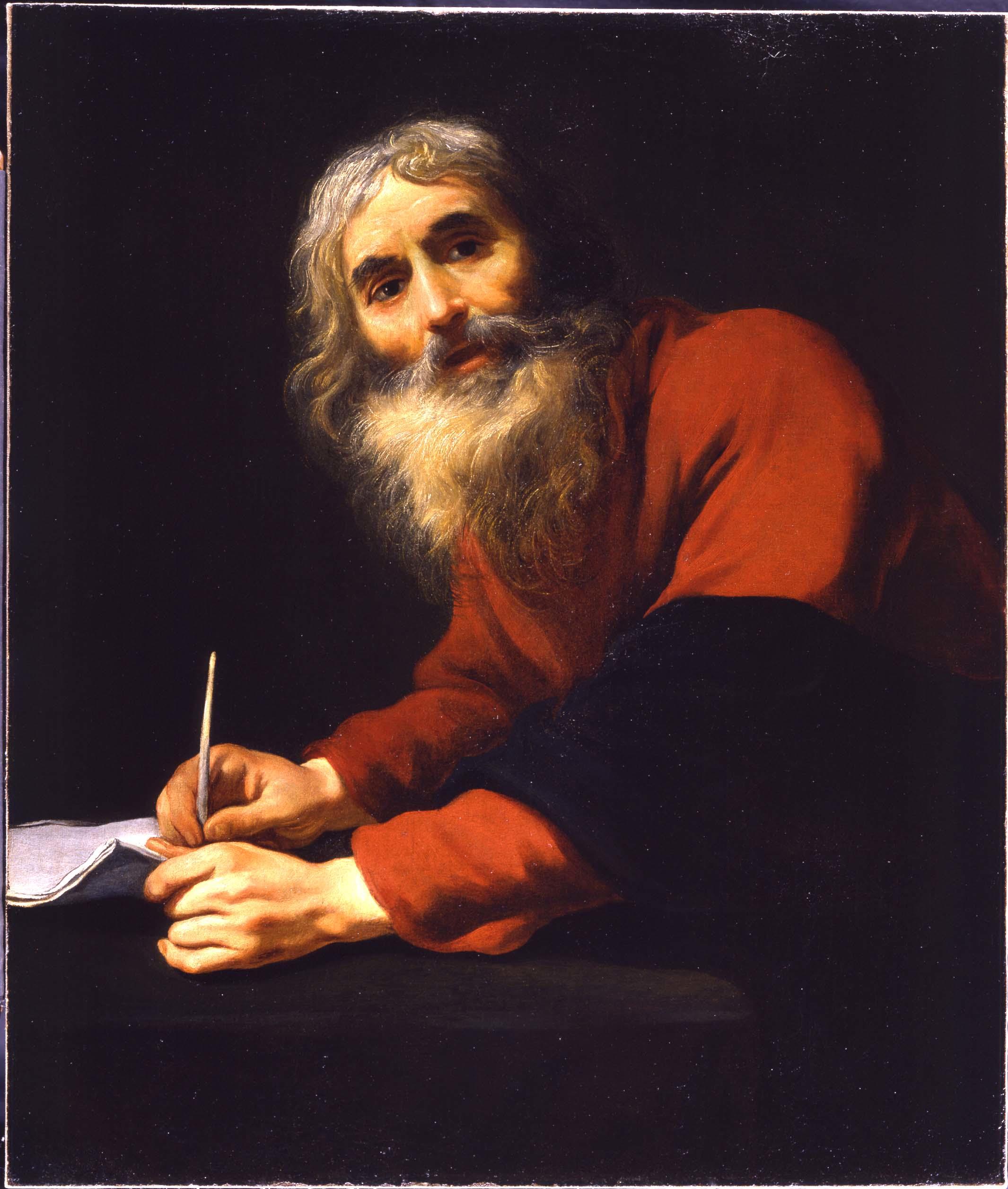
Saint Luke
Oil on canvas
93.5 x 78.4 cm (36 3/4 x 30 7/8 in.)
Provenance
Christie’s London, 7 December 2006, Lot 64
Acquired by Luigi Koelliker in 2006 (in this sale)
Description
Images of saints, apostles, fathers of the church and evangelists represented in groups or individually were always very close to the heart of Claude Vignon. The artist frequently recurred to such themes, throughout his long career. Sometimes he was satisfied, even after an interval of several years, to vary the same motif, posing evident problems to anyone trying chronologically to order his oeuvre. In the case of the present St. Luke, a work considered lost until a few years ago, and thought to be preserved only at second hand in the engraved version (fig1), this difficulty does not exist: its appearance, its very personal interpretation, its multiple points of reference, also chronological, make it clearly distinguishable and datable (at least broadly) within Vignon’s corpus. Undoubtedly created after Vignon’s return to France, and yet still imbued with Caravaggio’s tenebrismo, this painting has affinities with other paintings of Vignon, inspired by a similar style, theme and mode, that belong, they too, to the artist’s Parisian career. We may think for example of the St. Paul in the church of Saint Sévrin in Paris (fig2) or the Moses with the Tables of the Law, in the museum in Stolkholm, both painted during the 1620s. Yet the impressive accumulation of objects, the still lifes that so much characterised these compositions and transformed them into magnificent theatrical sets, are lacking in the St. Luke. Here the expression of the artist is more austere and essential; it is freed from the urge to monumentalise; it is concentrated on the figure of the apostle itself, rendered with a few essential features, and placed in the exiguous cell-like space. The saint’s restless contours, the curls of his beard and hair, the torsion of his neck, his parted lips, his penetrating and at the same time self-engrossed gaze, speak eloquently of a palpitating, and yet difficult to pin down sense of life, and a vital but at the same time funereal hymn in transience, by now fully baroque in manner. Such a presentation of the saint, seen in close up, and characterised by its intimacy, and the style in which it is painted, alternating smooth and compact zones with others rippled or more exuberant in pictorial effect (e.g. the saint’s hair and beard), seem to take hold in Vignon’s art especially from the 1630s on: we may cite, as an example of the former aspect the Hermit Pierre David, familiar thanks to an engraving by Jérôme David, and, of the latter aspect the Presentation of Christ to the Temple in the chapel of the hospital of Vernon, dated 1635. And it is within, and no later than, the 1630s that our St. Luke should be placed, just like the corresponding engraving probably attributed to young Gilles Rousselet.
The artwork described above is subject to changes in availability and price without prior notice.
Where applicable ARR will be added.
The artwork described above is subject to changes in availability and price without prior notice.
Where applicable ARR will be added.