


Bartolomeo Manfredi
b. 1582, Ostiano, Italy
d. 1622, Rome, Italy
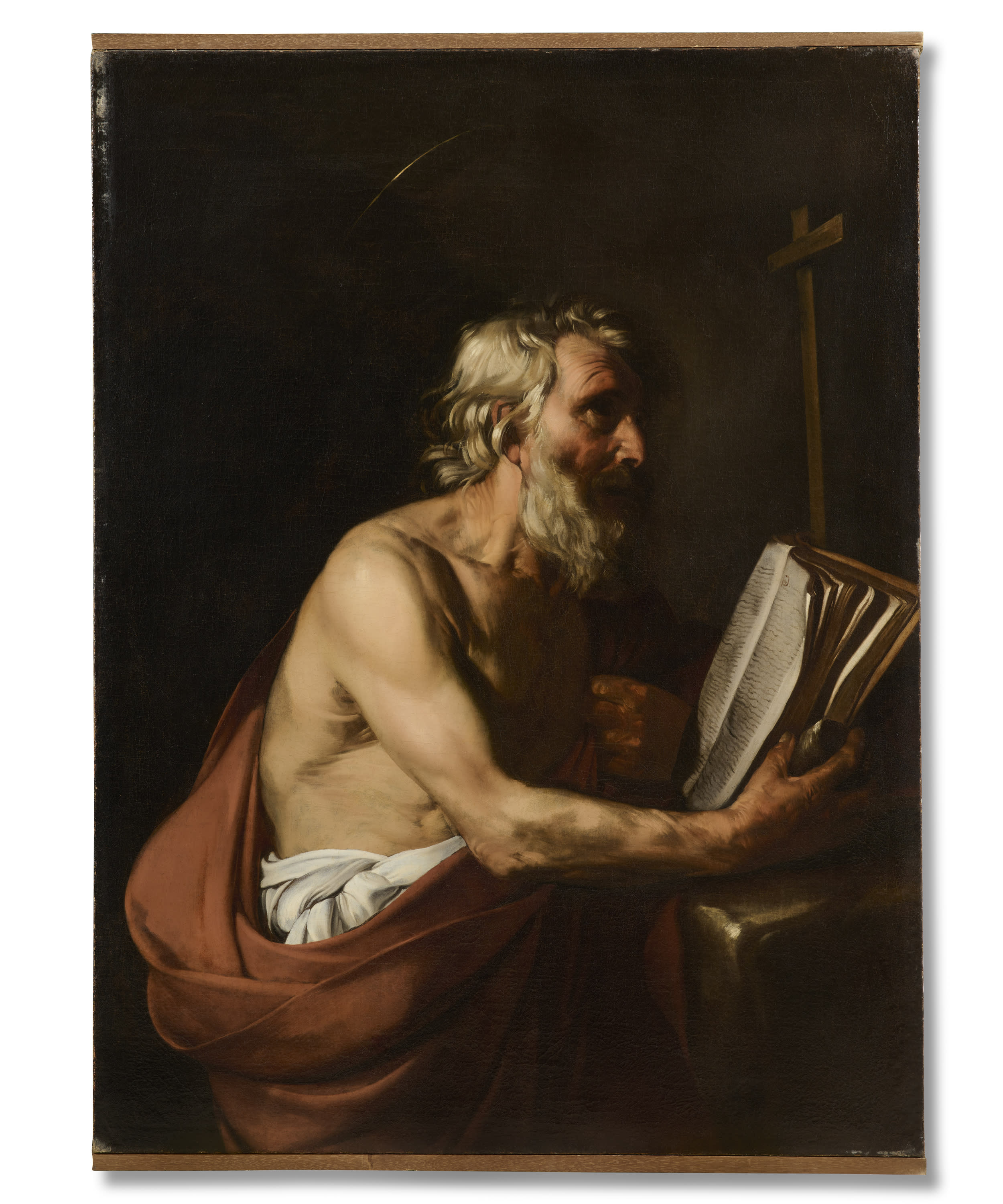
Saint Jerome
c. 1617–18
Oil on canvas
131 x 98 cm (51 5/8 x 38 5/8 in.)
With frame: 169 x 132 x 10 cm (66 1/2 x 52 x 4 in.)
Provenance
Koelliker collection, Milan.
Literature
G. Papi, ed., Il genio degli anonimi. Maestri caravaggeschi a Roma e a Napoli, exhibition catalogue, Palazzo Reale, Milan, 2005–6, pp. 105–19.
G. Papi, 'Postille ai dipinti in mostra al "Genio degli anonimi"', in L. Spezzaferro, ed., Caravaggio e l’Europa, l’artista, la storia, la tecnica e la sua eredità; atti del convegno internazionale di studi, Milano 3 e 4 febbraio 2006, Milan, 2009, pp. 224–29.
G. Papi, ed., La “schola” di Caravaggio. Dipinti dalla Collezione Koelliker, exhibition catalogue, Palazzo Chigi, Ariccia, 2006–7, pp. 42–45, as 'Bartolomeo Manfredi'.
G. Papi, Bartolomeo Manfredi, Soncino 2013, p. 115 tavola LVII, pp. 174 – 175, n. 38.
M. C. Terzaghi in In Pursuit of Caravaggio, exhibition catalogue, Robilant+Voena, London, 2016, pp. 44–45.
G. Papi, 'Un nuovo dipinto di Bartolomeo Manfredi', in Entro l'aria bruna d'una camera rinchiusa: scritti su Caravaggio e l'ambiente caravaggesco, Naples, 2016, pp. 167–68.
Description
Bartolomeo Manfredi was Caravaggio’s closest follower, who drew upon the revolutionary master’s naturalism and dramatic use of chiaroscuro in reinterpretations of his most popular subjects and in the rendering of themes Manfredi invented entirely by himself. Trained in Milan, Cremona and Brescia, Manfredi arrived in Rome around 1605 and studied with Cristoforo Roncalli. In his earliest works, Manfredi married the sharply defined forms and bright colours of late Roman Mannerism as practiced by Roncalli with the drama and tenebrism of Caravaggio. During his mature period, Manfredi evolved his signature frieze-like compositions with half-length figures, adopting themes beyond Caravaggio’s repertoire, especially tavern scenes. Though he executed very few public works, Manfredi was nevertheless highly successful, and many of the most important collectors in Rome and Tuscany, including Vincenzo Giustiniani and Ferdinando I de’ Medici, owned his works. Manfredi supplied a market hungry for Caravaggesque paintings, while his own innovations, especially in terms of the development of low-life genre subjects, inspired a new generation of artists coming to Rome from the North, such as Nicolas Régnier and Nicolas Tournier.
Indeed, it became apparent that the red of the saint’s mantle, the structured, defined and low creases of both the mantle and the white shirt knotted below, and the distinctive rendering of the saint’s hair pointed to the painting being an important and surprising addition to the oeuvre of Bartolomeo Manfredi. This attribution was confirmed when the work was displayed in the exhibition La “schola” del Caravaggio, held at the Palazzo Chigi in Ariccia in 2006. The combined emotional and physical vigour of the image are in fact rather rare in Manfredi’s oeuvre—the artist typically favoured smaller, even emaciated figures with short limbs, rendered with a less vehement hand.
The saint, represented in two-thirds profile, has an unusual monumentality that is reminiscent of similar figures (apostles, church fathers, exegetes of the Holy Scriptures, saints and hermits) by Ribera. The profound influence of Ribera on Manfredi here is also apparent in the abundance of drapery, in the strong and confident brushwork evident in the execution of the hand and in the elongated and vigorous brushstrokes of hair and beard. Manfredi has blended these Ribera-esque elements with his own sensibility, evident in the articulation of the just sweating skin, the fervent gaze of Saint Jerome and the clearly defined white linen.
The Saint Jerome has significant compositional similarities with a painting of the same subject by Manfredi of a similar date of 1617–18 (G. Papi, “Un nuovo dipinto di Bartolomeo Manfredi”, in Entro l'aria bruna d'una camera rinchiusa. Scritti su Caravaggio e l'ambiente caravaggesco, Naples, 2016, pp. 167–68). When the two works are placed side by side, it is clear that they present two different moments in a sequence. The saint in the present work is shown in act of penance, denoted by the stone held in his right hand and used to beat his chest. In the related painting, the book has been lowered on the lectern and the saint prepares to write on a sheet. The two saints are identical, down to the details of their garments.
There is another non-autograph version of this painting of good quality, in the collection of the Palazzo del Quirinale in Rome, which was formerly in the Collegio Romano (from 1773, when the goods of the Compagnia di Gesù were confiscated). This version, measuring 140 x 115 cm, has a substantial bibliography. The painting was attributed from the eighteenth century onwards as a work by Caravaggio and Ribera. Giuliano Briganti in 1962 recalled the nineteenth-century guides’ attribution of the painting to Ribera, but he did not express an opinion on the matter, instead referring to the Saint Jerome simply as being “Caravaggesque”.