

Carlo Dolci
b. 1616
d. 1686
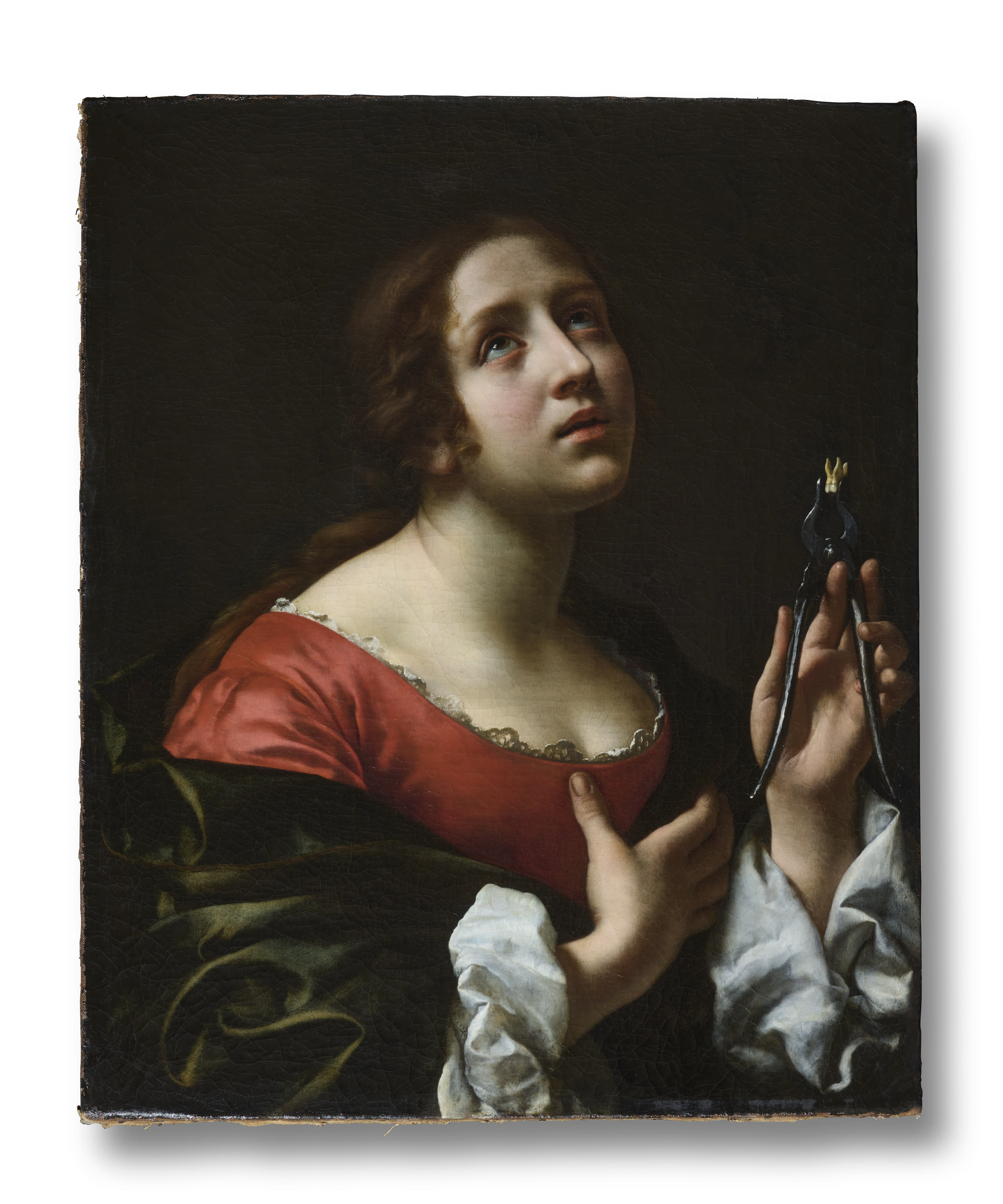
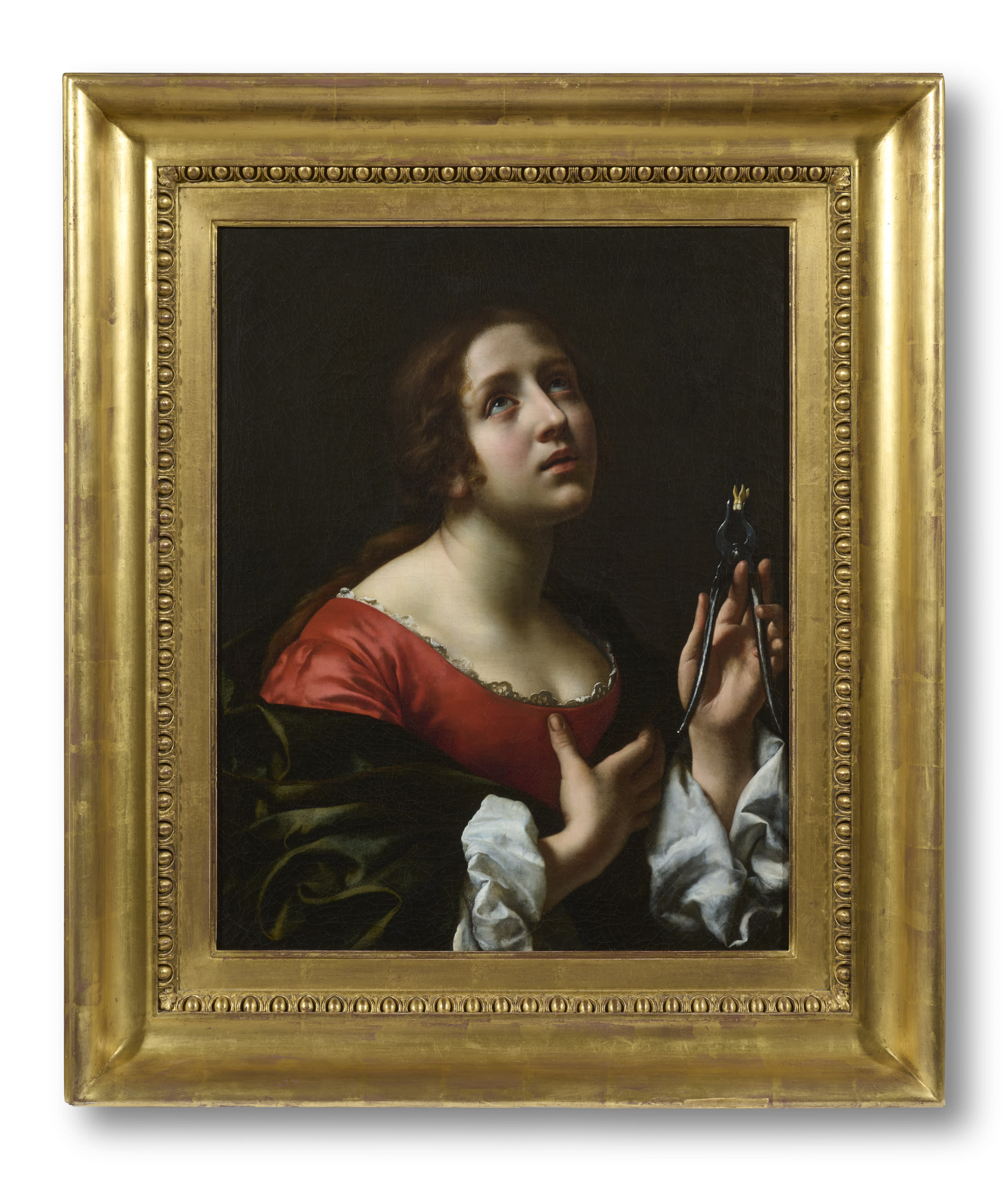
Saint Apollonia
c. 1660s–70s
Oil on canvas
63.9 x 53.9 cm (25 1/8 x 21 1/4 in.)
With frame: 105 x 92 x 21 cm (41 3/8 x 36 1/4 x 8 1/4 in.)
Provenance
Robert Clive (‘Clive of India’), 1st Baron Clive of Plassey (1725–1774), Oakley Park, Shropshire; by inheritance to the first son, Edward Clive, 1st Earl of Powis and 2nd Baron Clive (1754–1839), Oakley Park, Shropshire; by inheritance to his son the Honourable Robert Henry Clive (1789–1854), Oakley Park, Shropshire, who married Harriet Windsor, Baroness Windsor, daughter of Other Windsor, 5th Earl of Plymouth, Baroness Windsor; by inheritance to his son the Honourable Robert Windsor-Clive (1824–1859), Oakley Park, Shropshire; by inheritance to his son Robert George Windsor-Clive, 1st Earl of Plymouth (1857–1923), Oakley Park, Shropshire; then by descent in the family; Sotheby’s, London, 7 December 2001, lot 65; Koelliker collection, Milan.
Literature
Francis Leach, ed., The Country Seats of Shropshire, Shrewsbury 1891, p. 212, [“St. Apollonia, by Carlo Dolce”].
Giuseppe Cantelli, Repertorio della pittura Fiorentina del Seicento, Fiesole 1983, p. 72.
Marco Chiarini, ed., Bellezze di Firenze. Disegni fiorentini del Seicento e del Settecento dal Museo di Belle Arti di Lille, exh. cat. Palazzo Pitti, Florence 1991, p. 68, cat. 29.
Francesca Baldassari, Carlo Dolci, Turin 1995, pp. 115–16, fig. 85.
Francesca Baldassari in Mina Gregori, ed., Pittura fiorentina XVII secolo. Collezione Koelliker, Turin, pp. 16–17, 44.
Robilant+Voena, Italian Paintings from the 17th to the 18th Centuries, catalogue of the exhibition at Sperone Westwater, New York, 2011, p. 38.
Eve Straussman-Pflanzer and Francesca Baldassari, The Medici’s Painter: Carlo Dolci and Seventeenth-Century Florence, exh. cat. Davis Museum, Wellesley College, Wellesley, Massachusetts, 2017, p. 125.
Description
Carlo Dolci represented the saint in at least three autograph versions of differing formats though with similar measurements to this subject. Other versions may be found in the Galleria Corsini in Rome, though on a hexagonal canvas, and an oval canvas belonging to a private Florentine collection. In all three, the saint is depicted bust-length and dressed elegantly, clasping her breast with her right hand and holding in her left hand the pliers with which her teeth were removed. Any other allusion to the brutality of her torture is avoided by Dolci, who instead prefers to concentrate on the beauty of the saint, whose face is depicted in porcelain tones and illuminated by a heavenly light returning her gaze.
The sublime technique of the artist is evident in every fold of the white lace that adorns her red gown, in the reflections of light on the instrument of her torture, the palm of her hand, and the soft lines of her face, her eyes gazing upwards as if to invoke faith and dispel fear as she becomes a martyr. The image, intense in its treatment of emotional values, reveals stylistic characteristics of Dolci’s more mature period, of the 1660s and 1670s. Stylistic affinities with definitively dated works such as the Charity at the Cariprato at Prato (1659–65) and the Saint Barbara (1667) in a private collection confirm this dating. The positioning of the hands of the saint was studied by Dolci in a drawing kept in the Musée des Beaux-Arts in Lille (Pl. 205, red chalk on white paper, 281 x 189 mm).
The artwork described above is subject to changes in availability and price without prior notice.
Where applicable ARR will be added.