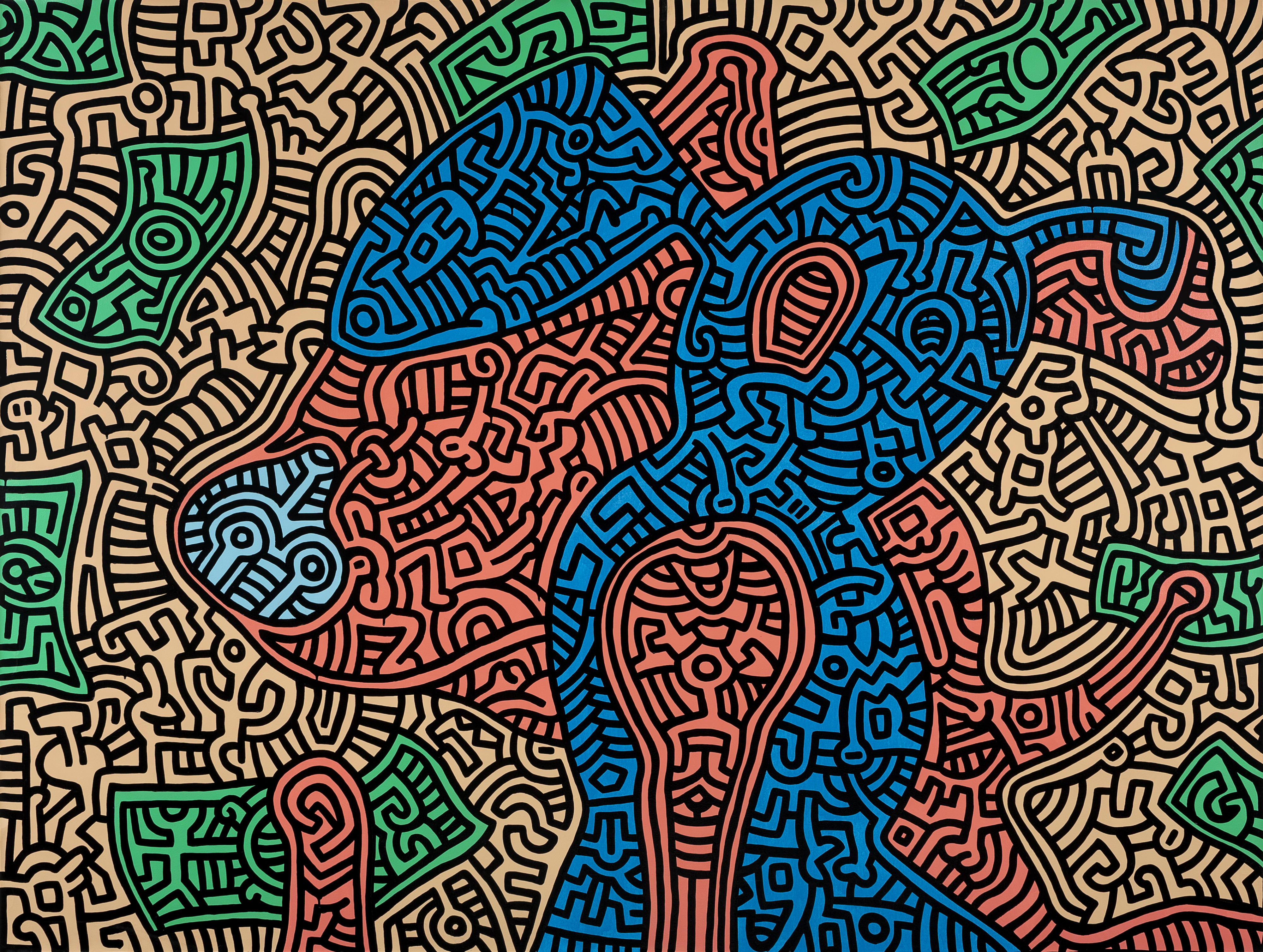




Keith Haring
b. 1958, Reading, PA
d. 1990, New York, NY
Piglet Goes Shopping
1989
Acrylic on canvas
182.9 x 243.8 cm (72 x 96 in.)
Provenance
with Gallery Cotthen, Knokke-Zoute, 1999;
Where acquired by the present owner.
Description
The American artist Keith Haring skyrocketed to fame in 1980s New York, embodying the energy and dynamism of the city. He belonged to the lively circle of young musicians and artists who frequented the East Village, including Kenny Scharf and Jean-Michel Basquiat, and from 1982 was represented by the prominent dealer Tony Shafrazi. Haring’s boldly iconic style is instantly recognizable: abstracted human and animal forms are rendered in stark black outlines, bright colours evoke a vivacious Pop mood and linear patterns emanating from his figures suggest an often effervescent sense of movement. Haring drew inspiration from myriad sources, including Jean Dubuffet’s art brut, the writings of the semiotician Umberto Eco, the graffiti of the New York subways and sidewalks, Pop art’s ambitions to bring popular culture into a critique of fine art, the commitment to public art on the part of Christo and Jeanne-Claude as well as African and Aboriginal forms. Haring also approached art as a liberating form of social activism, exploring themes around capitalist exploitation, drug abuse and the threat of nuclear holocaust; after contracting AIDS in 1988, his activism became focused on the lethal epidemic. Haring died of an AIDS-related illness less than two years later. Though primarily a painter, Haring worked in a wide range of different media, including chalk and sumi ink drawing, installation, performance, video art, sculpture, collage, among many others.
This work is accompanied by a certificate of authenticity from the Keith Haring estate.
The artwork described above is subject to changes in availability and price without prior notice. Where applicable ARR will be added.