
Mario Schifano
b. 1934, Khoms, Libya
d. 1998, Rome, Italy
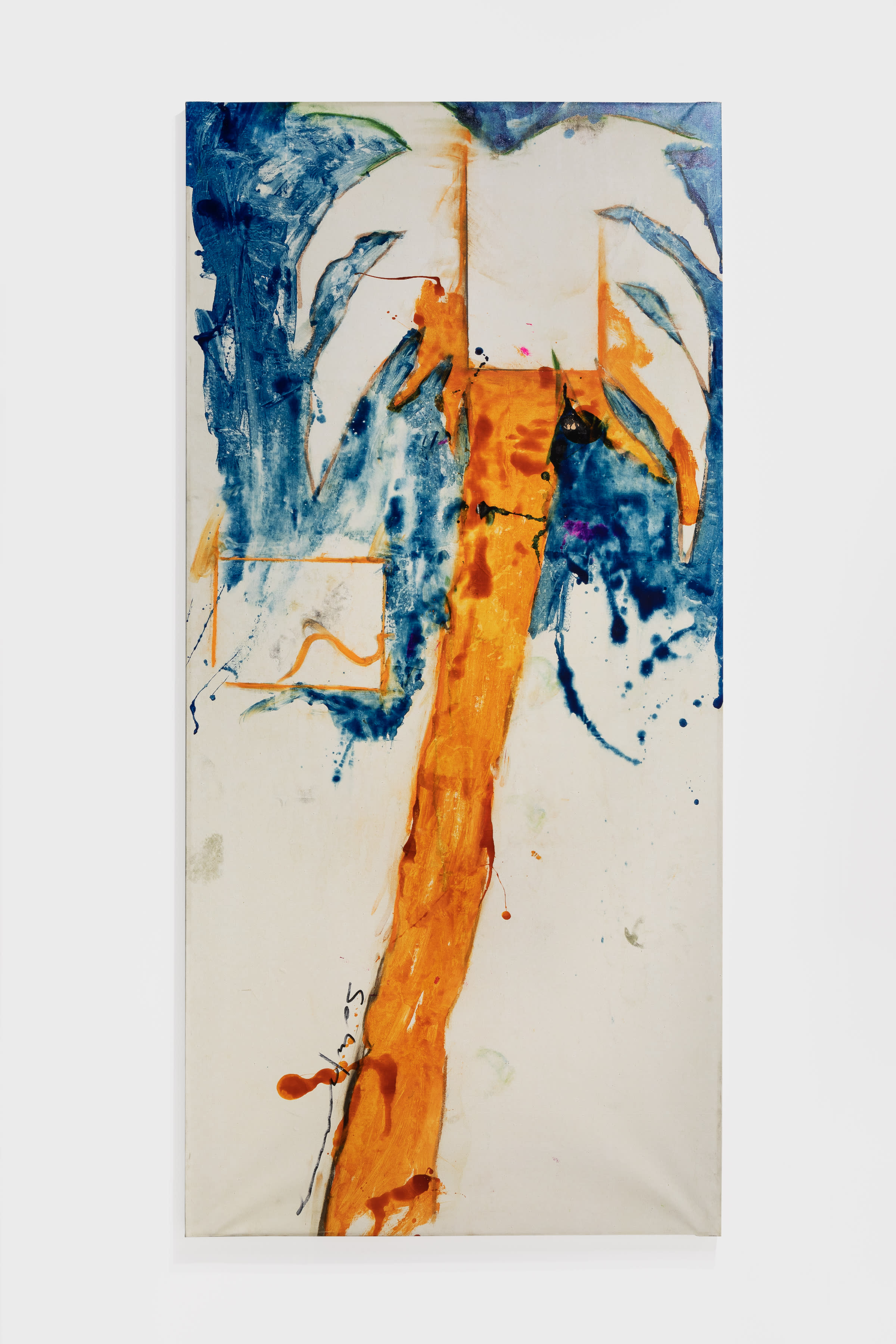
Palma (Palm)
1973
Enamel and acrylic on canvas
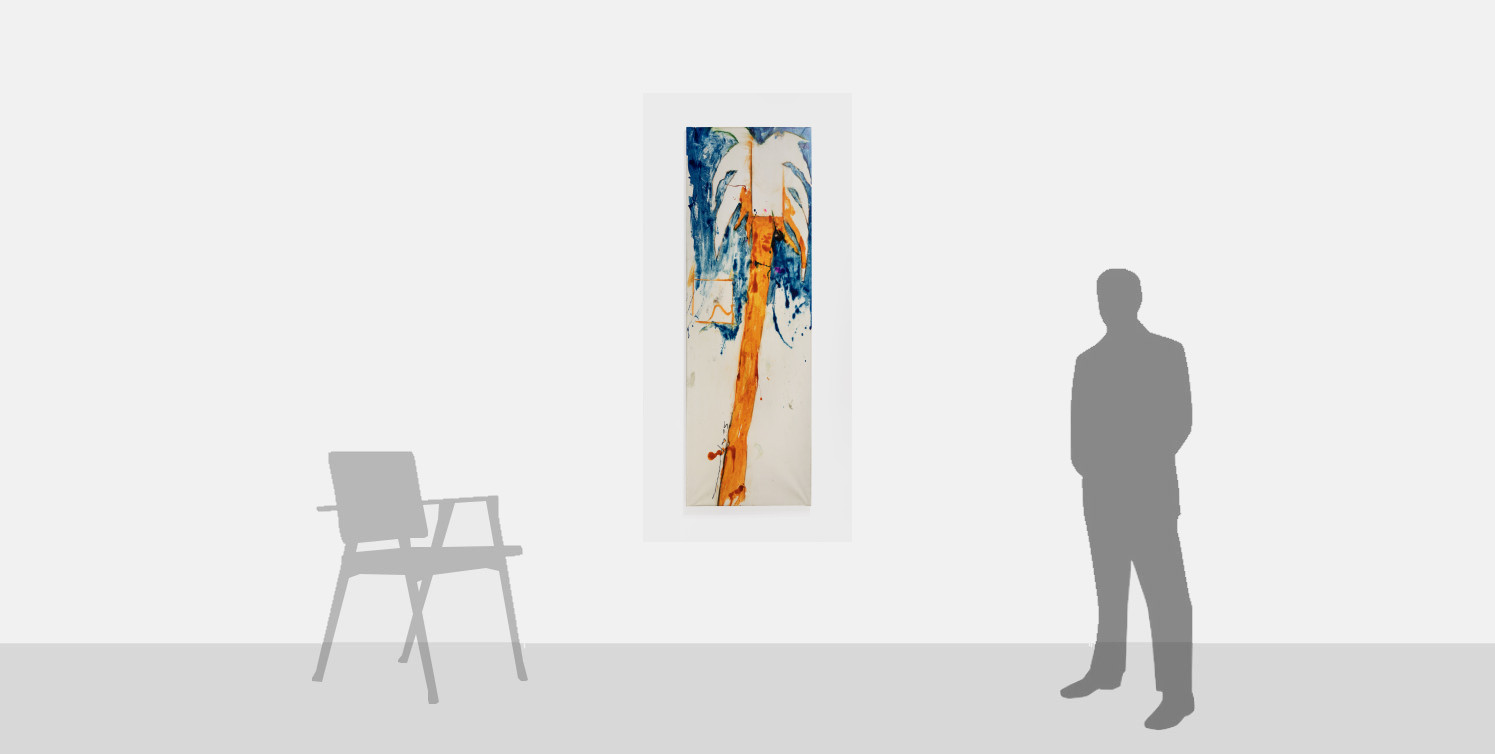
200 x 93 cm (78 3/4 x 36 5/8 in.)
Provenance
Description
Often referred to as “Italy’s Andy Warhol,” Mario Schifano was born in 1934 in Libya, an Italian colony at the time, and moved with his family to Rome after the Second World War. Although never formally trained as an artist, by 1960 Schifano had begun to create the works with which he made his name: a series known as Monocromi, in which each canvas consisted of an energetic field of a single colour. Painted using household enamel paint, Schifano’s monochromes are characterised by drips, rough brushwork and visible canvas – qualities which recur throughout his oeuvre.
Benefitting from the economic aid brought by the Marshall Plan, Rome in the early 1960s had become a city of conspicuous consumption, entering the age of la dolce vita. In this fast-evolving cityscape, Schifano’s reputation grew swiftly. He joined a group of artists known as the Piazza del Popolo school, whose work responded to the changing streets around them, above all to the abundance of advertising posters. Reacting both to consumer culture and the history of Italian art, Schifano created a uniquely Italian mode of Pop art. His work incorporating the Coca Cola and Esso logos anticipates Andy Warhol’s use of commercial symbols. Rather than depicting logos in their entirety, his isolation of select details and rough use of paint sets his work apart from the slick and mechanical nature of much American Pop art.
Schifano brought a rock’n’roll spirit to the art world, and not only because he started his own group, The Stars of Mario Schifano. He drove around Rome in a Rolls Royce and had countless girlfriends, the best-known being the model and actress Anita Pallenberg, who was later involved with both Brian Jones and Keith Richards of the Rolling Stones. Richards and Mick Jagger gave cameo performances in a film Schifano directed, Umano non Umano (1968), and he was even the inspiration for a Rolling Stones song, Monkey Man, on the album Let It Bleed.
Schifano was infamous for the parties he threw at his lavish Roman apartment. One exasperated neighbour, the professor Mario Praz, described him as “a complete savage” who had “shady people come and go,” creating “constant noise” and “riding around the apartment on bicycles.” In the mid 1960s Praz found peace when Schifano moved for the better part of a year to New York, where he shared an apartment with the poet Frank O’Hara and kept company with Warhol and Jasper Johns. Schifano was one of very few Europeans to exhibit alongside Warhol and Roy Lichtenstein in The New Realists, a landmark Pop art exhibition at Sidney Janis Gallery in Manhattan in 1963.
In 1966 and over the course of the next three years, Schifano became obsessed with the motifs of the palm tree and the starry sky, repeatedly rendering them using cut outs and spray paint. Rooted in memories of his childhood in Libya, these totemic images, revisited and reinterpreted through an expressive and intense use of colour and form, became archetypes of memory in technicolour. The present work uses vivid tones of orange and blue, applied loosely and varying in intensity. Typical of Schifano’s work, large areas of the canvas have been left bare, serving as a constant reminder of the paintings’ materiality and process,
Schifano died in Rome in 1998, after decades struggling with depression and substance abuse, leaving an eclectic and highly compelling body of work.
The artwork described above is subject to changes in availability and price without prior notice. Where applicable ARR will be added.