

Gaetano Gandolfi
b. 1734, San Giovanni in Persiceto, Italy
d. 1802, Bologna, Italy
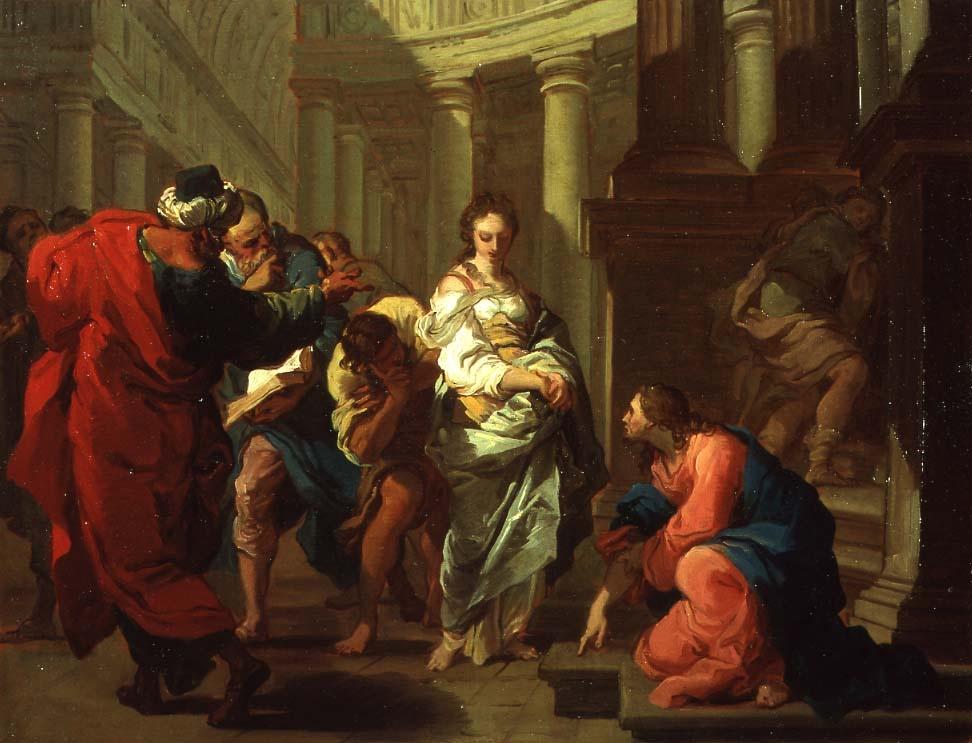
Pair: Christ and the Adulterers & Saint Paul Preaches in Athens
c. 1784
Oil on canvas
40 x 61.5 cm (15 3/4 x 24 1/4 in.)
Provenance
Trenta collection, Bologna
Literature
F. Trenta, Galleria di Filippo Trenta Nobile Ascolano Uditore Generale della Legazione di Bologna per la S. Sede Apostolica Uditore Generale ossia Catalogo delle Pitture disposte secondo il nome de’ proprii Professori, (1784), ms. della Biblioteca Comunale di Fermo, nos. 8 and 34.
F. Trenta, Manoscritto relativo al quadro dell’Adultera per mano del celebre Professore Signor Gaetano Gandolfi e al quadro del Dio Ignoto o sia S. Paolo predicante in Atene per mano del medesimo celebre Professore, ms. dell’Archivio Trenta di Bologna; Indice delle pitture più ragguardevoli di Monsignor Filippo Trenta. Foligno, 1791, p. 4.
L. Mannocchi, Guida pratica dei monumenti e delle opere d’arte…di Ascoli Piceno. Grottammare, 1900, p. 101.
F. Manaresi, Guida Storica e Artistica della città di Fermo. Fermo, 1945, p. 172.
L. Dania, La pittura a Fermo e nel suo circondario. Fermo, 1967, pp. 21–23.
R. Roli, Pittura bolognese 1650–1800. Dal Cignali ai Gandolfi. Bologna, 1977, p. 264.
C. Giudici, in I Gandolfi: Ubaldo, Gaetano, Mauro: disegni e dipinti, exh. cat. Fondazione Cini, Venice, and Palazzo Pepoli, Bologna, 1987, p. 62.
L. Battista, 'Filippo Trenta: un collezionista dimenticato', in Accademia Clementina: Atti e memorie, 1988, pp. 63–64.
D. Biagi Maino, Gaetano Gandolfi, Turin, 1995, pp. 389–90.
Description
In 1784 Monsignor Filippo Trenta, at that time the Uditore Generale di Rota (Auditor General of the Rota) in Bologna, commissioned from Gaetano Gandolfi two large canvases depicting Christ and the Adulteress and Saint Paul Preaching in Athens. In 1779 he had already commissioned to from the artist a large canvas depicting the Death of Socrates; in later years, after his appointment as bishop of Foligno, the prelate would return to Gaetano to execute the altarpiece for his new bishopric.
The contract between the churchman and the artist, drawn up on 4 April 1784, provides for a fee of 460 scudi for the two canvases and the related sketches. Completion of the work takes three years, not least owing to continued interference on the part of Monsignor Trenta, who obliged the Bolognese painter to submit to a very detailed iconographic program that went so far as to specify even the smallest details such as the little dog that appears in the Sermon of Saint Paul, which must be “a white and beautiful poodle.”
In both works great attention to detail is paid to the architectural backgrounds: in Christ and the Adulteress Gandolfi invented a complex architectural structure, based on models Flaminio Minozzi, to represent the Temple of Solomon, while in Saint Paul's Sermon the Areopagus of Athens is crowded with altars and statues of ancient divinities in response to Monsignor Trenta’s detailed requests for “the Forum, or be it Piazza Grande of Athens...in the middle...Statue of Pallas with the owl at her feet, in the other spaces of the square minor statues of Jupiter, Apollo and Hercules arranged in well-proportioned distance.”
The two final canvases, today both in a private collection in Rome, have been judged somewhat wanting by scholars, who have been particularly critical of the clumsily resolved figures with their showy theatrical poses and gestures. By contrast, the present two sketches demonstrate a much greater vivacity, especially in terms of their looser handling and more fluid draughtsmanship. In them, Gandolfi succeeded in preserving those traits of inventive ease and soft modelling for which his style is revered, which then in the large-format paintings the pedantic instructions of Monsignor Trenta seem to have hardened into a far less appealing result.
The artworks described above are subject to changes in availability and price without prior notice.