


Bernardo Strozzi
b. 1581, Genoa
d. 1644, Venice
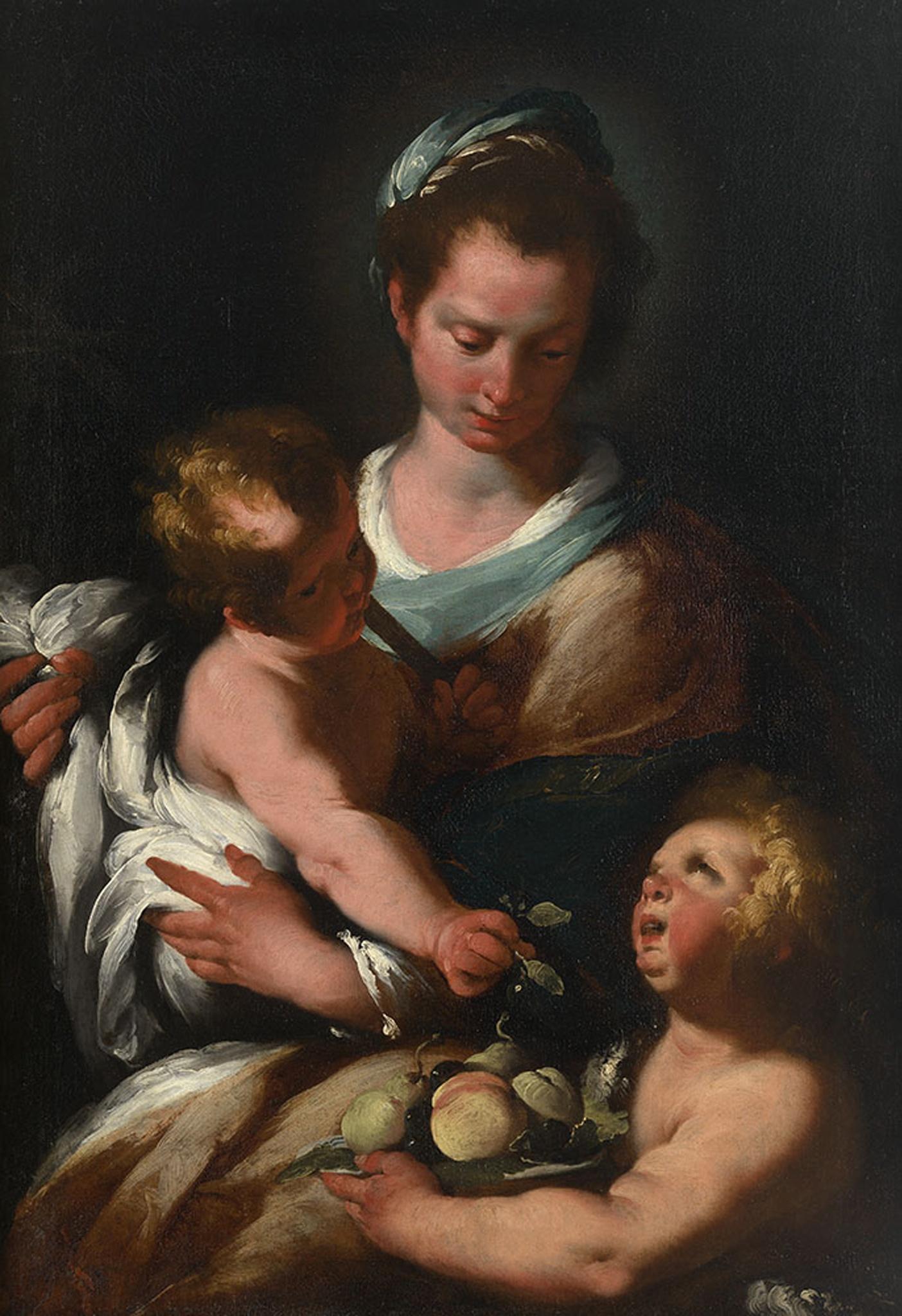
Madonna and Child with Saint John the Baptist
c. 1625
Oil on canvas
116 x 81 cm (45 5/8 x 31 7/8 in.)
Provenance
Private collection, France.
Literature
Camillo Manzitti and Alessandro Morandotti, Milano-Genova andata/ritorno, percorsi della pittura tra Manierismo e Barocco, exh. cat. Robilant+Voena, Milan, 2012, pp. 30–31.
Camillo Manzitti, Bernardo Strozzi, Turin, 2013, no. 157.
Anna Orlando and Daniele Sanguineti, Bernardo Strozzi: 1582–1644: la conquista del colore, exh. cat. Palazzo Nicolosio Lomellino, Genoa, 2019–20, pp. 200–1, no. 7.
Description
Born in Genoa, Bernardo Strozzi studied painting briefly before entering the Capuchin monastery of San Barnaba in 1598, which earned him the nickname Il Cappuccino. Strozzi received permission to leave the monastery in 1610 to care for his ailing mother and unmarried sister, during which time he continued to paint. He never returned to the Capuchin order, instead relocating to Venice in 1630 where he became known as Il prete Genovese. There, he must have headed a large workshop, as the many versions of some of his works suggest. During the first two decades of the seventeenth century, Strozzi’s painting became increasingly free, his brushwork broader. Paintings such as the famous Saint Catherine of the Wadsworth Atheneum of Hartford, painted ca. 1615, with the sweetly elegant female figure bathed in clear light, are exemplary of Strozzi’s early maturity. Although his style was initially indebted to the models of late Tuscan mannerism and painters like Pietro Sorri (his first teacher) Ventura Salimbeni and Aurelio Lomi, both active in Genoa, his mature style was highly personal, combining the models of his early years with the influence of Rubens and Procaccini, especially in terms of their vivid and bright colours.
The present work likely dates to the intermediary period during which he cared for his mother, as did other variations on the theme found in the present painting, a dazzling example of Strozzi’s strong chiaroscuro and vibrant colour palette, and of the painterly rendering of the voluminous folds of white drapery and ruddy complexions of his figures which are hallmarks of his style. While the Bible does not in fact describe a meeting between the young Jesus and his cousin Saint John the Baptist, the legend that the two met as infants during the Holy Family’s flight into Egypt became popular in the early modern period. Representing the two children interacting with naturalistic playfulness, under the watchful and tender gaze of the loving Virgin Mary, Strozzi underscored the humanity of the divine subjects. At the same time, the viewer is reminded of the eventual tragedy of Christ’s sacrifice, of which his mother had foreknowledge: Mary’s downcast eyes and ambiguous expression convey her simultaneous joy and sorrow, while the beautifully painted, brilliantly white drapery in which she cradles her child poignantly alludes to his future burial shroud. John the Baptist proffers a basket of fruit, emblematic of the fruit of Mary’s womb, i.e. Christ, of the fruits, or gifts, of the Holy Spirit, and of Original Sin, which Christ will redeem through the sacrifice if his death. Strozzi’s dramatic use of light and shadow heightens the emotional efficacy of the image.
The present painting is a significant addition to Bernardo Strozzi’s catalogue. As suggested by Camillo Manzitti in his catalogue raisonné of Strozzi’s paintings, the painting can be related to another version of the same composition now in the Museo Poldi Pezzoli in Milan. Yet there is a gap of between ten and fifteen years between the two works. The Poldi Pezzoli is variously dated to around 1610 (Luisa Mortari, Strozzi, Rome, 1996, pp. 94–95) or 1616/1618 (see Giuliana Algeri in the catalogue of the 1995 exhibition Bernardo Strozzi. Genova 1581/82–Venezia 1644, Palazzo Ducale, Genoa, pp. 124–25). Manzitti, meanwhile, dates the present painting to around 1625. Despite their compositional similarities, the palettes of the two paintings are quite different: the Milan painting is rendered in dark tones, dominated by browns and reds, with deep shadows demonstrating the influence of painters like Cerano and Procaccini, while the present painting instead presents an explosion of bright, far lighter colour that reaches its climax with the splendid pale blue mantle and head-dress of the Virgin. Similar tones may also be found in other paintings of the same period such as the Incredulity of Saint Thomas in the Museo de Arte, Ponce, or the Allegory of Charity in the Virginia Museum of Fine Arts, Richmond, usually dated 1622 to 1625.