Tino Stefanoni
b. 1937
d. 2017
Le Matite (Pencils)
1974
Mixed media on canvas
200 x 150 cm (78 3/4 x 59 1/8 in.)
Provenance
Private collection, Milan.
Literature
Valerio Dehò (curated by), Tino Stefanoni. L'enigma dell'ovvio, Milan, 2013, p. 20.
Description
Born in Lecco in 1937, Tino Stefanoni studied architecture at the Politecnico in Milan, beginning his career between 1967 and 1969, alongside the formation of the Arte Povera movement. As a result of his friendships with a number of important Italian artists of the time, he and his brother Dante opened an art gallery in 1964 with an exhibition dedicated to Lucio Fontana. Over the next few years his own artistic style evolved and in 1968 he held his first solo exhibition at the Apollinaire Gallery in Milan.
Although his work, from the beginning, was always grounded in the realm of the conceptual, Tino Stefanoni was still a painter, capable of combining the pleasure of the medium with the theoretical challenge of language. It would be unthinkable for an artist of his generation not to combine the innate aesthetic components of painting to something decidedly more intellectual in approach, not simply intellectualism, but rather lighter and hyper-theoretical. This was an attitude consistent with the artistic climate of Milan at the time, through the rise of abstraction, but also with the work of Munari and Manzoni.
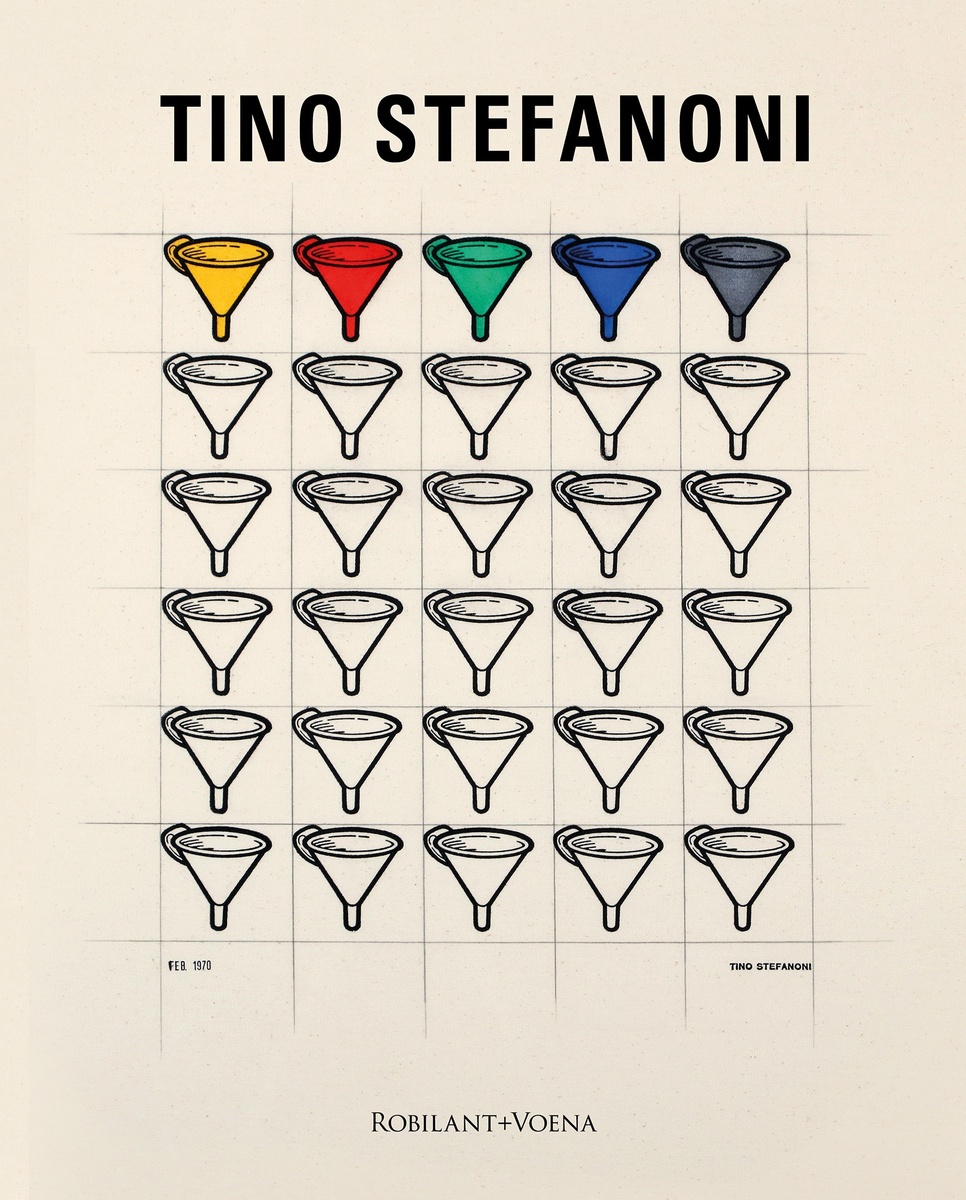
However, in reaction to the surplus of theories, Stefanoni’s works offered a sense of lightness, with nuances of wit, puns, word games and semantic shifts. These characteristics can be recognized in his works from the early 1970s, such as Segnali stradali and Rilievi sagomati, which were exhibited at the Venice Biennale in 1970. Similarly to the present painting, both these works depict everyday objects painted on raw canvas, laid out in serial order. Without losing the humorous nature and aesthetic appeal in his works, as a result of his intellectual partiality we can consider Stefanoni a key artist in the transition between established modernist practice and the new post-modern sensibility that has spread throughout the West.
Even in his mature works, in which he starts to include colour, or in an example from his Sinopie series (Fig.1), the artist never loses the conceptual nature of his research. If anything, it developed into a poetics that takes shape in the form of a minimalism renovated in style and content. Stefanoni, a failed architect, presents architecture in such a way, demonstrating unfinished monochrome sections, suspended between real and fantastic figuration, and with a mastery of style that allows exquisite use of colour. In this way one could say that Stefanoni is truly a theoretician of flat painting, with vibrations of light that are both analogous and complementary.
The artwork described above is subject to changes in availability and price without prior notice.
Where applicable ARR will be added.
Although his work, from the beginning, was always grounded in the realm of the conceptual, Tino Stefanoni was still a painter, capable of combining the pleasure of the medium with the theoretical challenge of language. It would be unthinkable for an artist of his generation not to combine the innate aesthetic components of painting to something decidedly more intellectual in approach, not simply intellectualism, but rather lighter and hyper-theoretical. This was an attitude consistent with the artistic climate of Milan at the time, through the rise of abstraction, but also with the work of Munari and Manzoni.
However, in reaction to the surplus of theories, Stefanoni’s works offered a sense of lightness, with nuances of wit, puns, word games and semantic shifts. These characteristics can be recognized in his works from the early 1970s, such as Segnali stradali and Rilievi sagomati, which were exhibited at the Venice Biennale in 1970. Similarly to the present painting, both these works depict everyday objects painted on raw canvas, laid out in serial order. Without losing the humorous nature and aesthetic appeal in his works, as a result of his intellectual partiality we can consider Stefanoni a key artist in the transition between established modernist practice and the new post-modern sensibility that has spread throughout the West.
Even in his mature works, in which he starts to include colour, or in an example from his Sinopie series (Fig.1), the artist never loses the conceptual nature of his research. If anything, it developed into a poetics that takes shape in the form of a minimalism renovated in style and content. Stefanoni, a failed architect, presents architecture in such a way, demonstrating unfinished monochrome sections, suspended between real and fantastic figuration, and with a mastery of style that allows exquisite use of colour. In this way one could say that Stefanoni is truly a theoretician of flat painting, with vibrations of light that are both analogous and complementary.
The artwork described above is subject to changes in availability and price without prior notice.
Where applicable ARR will be added.