
Vincenzo Agnetti
b. 1926, Milan
d. 1981, Milan
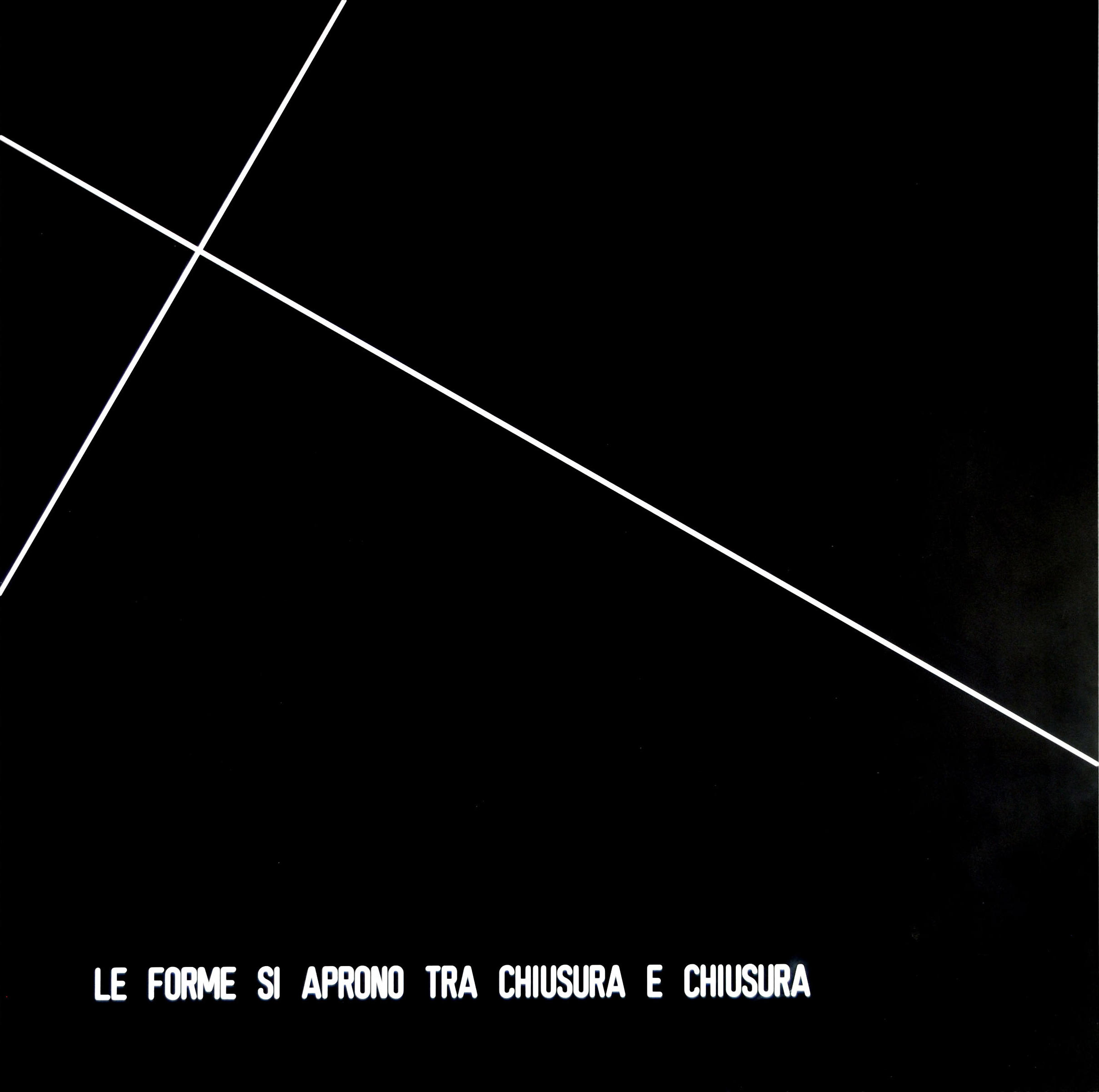
Le Forme Si Aprono Tra Chiusura e Chiusura (Forms Open Between Closure and Closure)
1971
White nitro paint on incised black bakelite
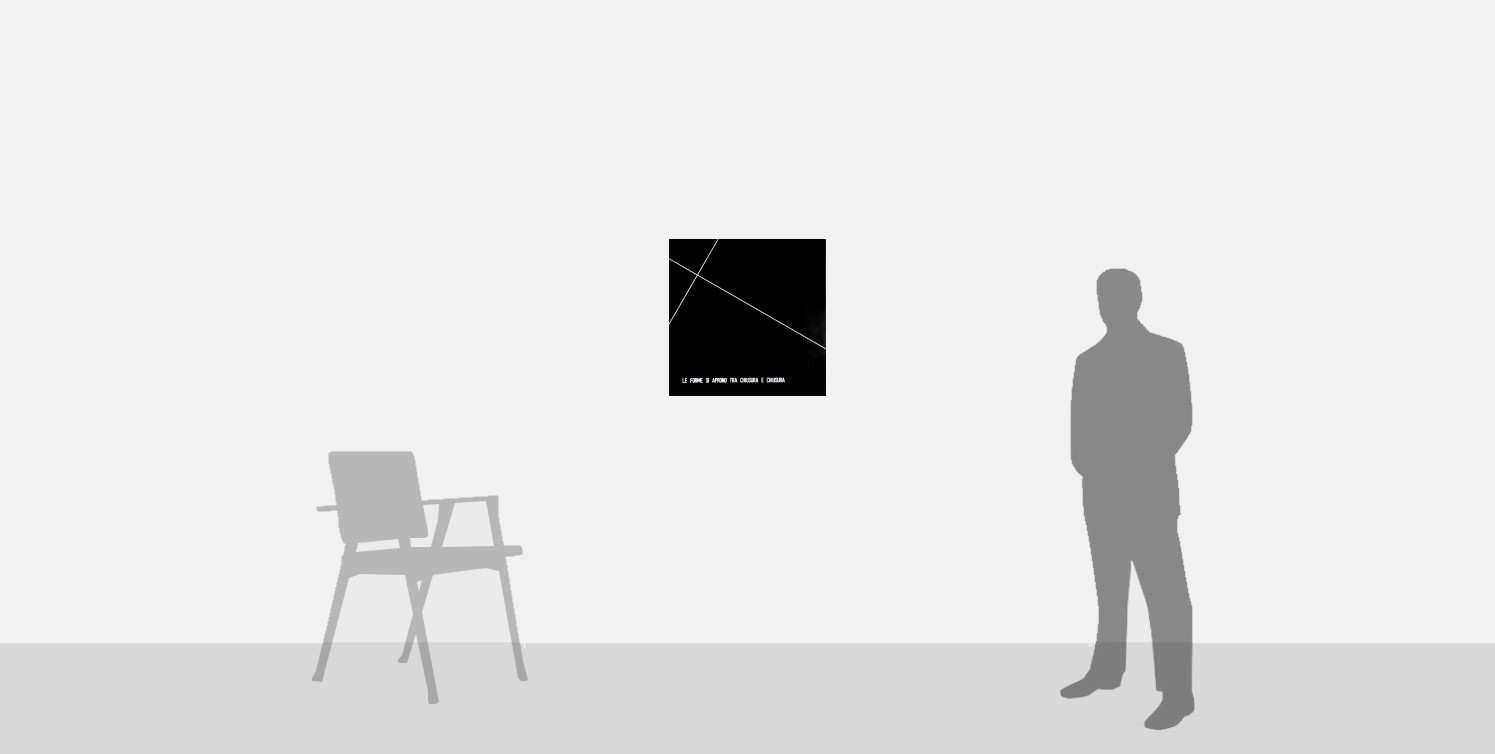
70 x 70 cm (27 1/2 x 27 1/2 in.)
Provenance
Private collection.
Description
“My works act as a signal for propagating what I have accumulated, by which I mean my theoretical and critical research. I write about things from which I call forth my paintings, which, in their turn, provide me with ideas for further research and writing…”—Vincenzo Agnetti
“Contradictions, paradoxes, tautologies help to cause language to short-circuit, to stop it from working, so that we may question ourselves about it.” —Vincenzo Agnetti
Fundamental to Vincenzo Agnetti’s art is his examination of the complex, shifting nature of language, its evolution and ambiguity when placed in different combinations and contexts, and the permeable, ever-changing, endless series of potential meanings which lay behind the words he used. The Milanese conceptualist artist began his career as a poet before becoming associated with Piero Manzoni and the Azimuth group. His involvement with the Italian avant-garde was interrupted by a voyage to South America in 1962, where he would remain for five years, living in Argentina with his family. While he maintained a correspondence with his colleagues in Italy during this time, Agnetti adopted a principle which he called “Art-no,” by which he refused to make art, instead immersing himself in tedious, repetitive, manual labour, believing it would generate within him a greater awareness of the true freedom of being an artist. At the same time, he channelled his creative energy into the obsessive creation of thousands of pages of writing, which he assembled in notebooks and called Assenza (Absence).
Describing this project, Agnetti wrote: “Two thousand pages that bring together thoughts, ideas and plans developed between one chance event and the next in South America, Scandinavia, Arabia…These objects are reminders. And yet I will never read these pages again. The texts are so precipitous and relentless that revising and editing them would take me another six years. It’s better simply to review these notebooks from a closer angle. Simply as notebooks: partitive and abstract participation. A solitary reference: a ‘here they are’ and a ‘now they’re gone’…” (Marco Meneguzzo, exh. cat., Agnetti, a hundred years from now, exh. cat., Palazzo Reale, Milan, 2017, p. 255).
Returning to Milan, Agnetti’s art reached a dramatic turning point which would determine its trajectory of the rest of his career. He began to integrate his literary experiences, his interest in theatre, and his critical writings into his visual art, using fragmented texts and tautological axioms to create enigmatic artworks which challenged established, accepted systems of language. From his early sculpture Principia, to his revolutionary reprogramming of an Olivetti calculator for La Macchina Drogata, his work investigated into the rules and logic of language, revealing the mutable, highly subjective circumstances which determines our understanding of words, phrases and statements. This continued with the publication of his novel, Obsoleto (1968), which made radical use of textual syntax, punctuation, narrative, content and form to create a highly experimental text that reads like a stream of consciousness, continually interrupting itself. Perhaps most importantly though, the artist developed his so-called Assiomi (Axioms) in which diagrams, graphs, symbols, and circular, looping, often contradictory statements, were engraved into black Bakelite panels. “From a theoretical assumption I construct a discussion of two or more written pages,” the artist explained, “Then, through logical decantation, I use an axiom to sum up the entire content that emerged” (quoted in Milan 2017, p. 15). In many cases the Assiomi achieve the appearance of tautologies, looping back on themselves to complicate our reading of the original statement, creating phrases that seem to make sense, yet, when examined further, fall apart and become tied up in a complex layering of potential meaning.
The present work belongs to the Assiomi series and is inscribed with the phrase “Le forme si aprono tra chiusura e chiusura” meaning “The shapes open between closing and closing.” The text itself is wonderfully poetic, folding in on itself like an origami crane, dissolving with uncertainty when examined closely, introducing contradictions, paradoxes, and loops to complicate our understanding of the text, and challenging our perceptions of the unshakeable, immutable nature of language.
Unlike contemporaries who were also exploring language at this time, Agnetti always used his own words, statements, and poetry in his works, rather than borrowing from others. A voracious reader of philosophical treatises and literature, he likewise saw writing as an essential element of his own creative expression, representing the developments of his intricate thought process as he grappled with the complex concepts and problems of his age, and distilled them into profound statements and poems. As Marco Meneguzzo noted, “Agnetti’s activity was paradigmatic because his use of words, and of statements using them, shows an interpretative richness and an evocative freedom that go far beyond the absolute determinacy, purposely impersonal, of the conceptual statements [of his contemporaries]…he aimed at establishing a new and radical syntax, not only in the field of art languages, but in that of languages tout court.” (Milan 2017, p. 31). For Agnetti, the hesitation, uncertainty, and insecurity inherent in the comprehension of his texts was key to developing an autonomous, critical way of looking at the world. By interrupting challenging and perplexing a straightforward reading of the words, he allows us to query our understanding of the text, observe our perceptions, and question the rules and logic of the systems we follow.
The artwork described above is subject to changes in availability and price without prior notice. Where applicable ARR will be added.
“Contradictions, paradoxes, tautologies help to cause language to short-circuit, to stop it from working, so that we may question ourselves about it.” —Vincenzo Agnetti
Fundamental to Vincenzo Agnetti’s art is his examination of the complex, shifting nature of language, its evolution and ambiguity when placed in different combinations and contexts, and the permeable, ever-changing, endless series of potential meanings which lay behind the words he used. The Milanese conceptualist artist began his career as a poet before becoming associated with Piero Manzoni and the Azimuth group. His involvement with the Italian avant-garde was interrupted by a voyage to South America in 1962, where he would remain for five years, living in Argentina with his family. While he maintained a correspondence with his colleagues in Italy during this time, Agnetti adopted a principle which he called “Art-no,” by which he refused to make art, instead immersing himself in tedious, repetitive, manual labour, believing it would generate within him a greater awareness of the true freedom of being an artist. At the same time, he channelled his creative energy into the obsessive creation of thousands of pages of writing, which he assembled in notebooks and called Assenza (Absence).
Describing this project, Agnetti wrote: “Two thousand pages that bring together thoughts, ideas and plans developed between one chance event and the next in South America, Scandinavia, Arabia…These objects are reminders. And yet I will never read these pages again. The texts are so precipitous and relentless that revising and editing them would take me another six years. It’s better simply to review these notebooks from a closer angle. Simply as notebooks: partitive and abstract participation. A solitary reference: a ‘here they are’ and a ‘now they’re gone’…” (Marco Meneguzzo, exh. cat., Agnetti, a hundred years from now, exh. cat., Palazzo Reale, Milan, 2017, p. 255).
Returning to Milan, Agnetti’s art reached a dramatic turning point which would determine its trajectory of the rest of his career. He began to integrate his literary experiences, his interest in theatre, and his critical writings into his visual art, using fragmented texts and tautological axioms to create enigmatic artworks which challenged established, accepted systems of language. From his early sculpture Principia, to his revolutionary reprogramming of an Olivetti calculator for La Macchina Drogata, his work investigated into the rules and logic of language, revealing the mutable, highly subjective circumstances which determines our understanding of words, phrases and statements. This continued with the publication of his novel, Obsoleto (1968), which made radical use of textual syntax, punctuation, narrative, content and form to create a highly experimental text that reads like a stream of consciousness, continually interrupting itself. Perhaps most importantly though, the artist developed his so-called Assiomi (Axioms) in which diagrams, graphs, symbols, and circular, looping, often contradictory statements, were engraved into black Bakelite panels. “From a theoretical assumption I construct a discussion of two or more written pages,” the artist explained, “Then, through logical decantation, I use an axiom to sum up the entire content that emerged” (quoted in Milan 2017, p. 15). In many cases the Assiomi achieve the appearance of tautologies, looping back on themselves to complicate our reading of the original statement, creating phrases that seem to make sense, yet, when examined further, fall apart and become tied up in a complex layering of potential meaning.
The present work belongs to the Assiomi series and is inscribed with the phrase “Le forme si aprono tra chiusura e chiusura” meaning “The shapes open between closing and closing.” The text itself is wonderfully poetic, folding in on itself like an origami crane, dissolving with uncertainty when examined closely, introducing contradictions, paradoxes, and loops to complicate our understanding of the text, and challenging our perceptions of the unshakeable, immutable nature of language.
Unlike contemporaries who were also exploring language at this time, Agnetti always used his own words, statements, and poetry in his works, rather than borrowing from others. A voracious reader of philosophical treatises and literature, he likewise saw writing as an essential element of his own creative expression, representing the developments of his intricate thought process as he grappled with the complex concepts and problems of his age, and distilled them into profound statements and poems. As Marco Meneguzzo noted, “Agnetti’s activity was paradigmatic because his use of words, and of statements using them, shows an interpretative richness and an evocative freedom that go far beyond the absolute determinacy, purposely impersonal, of the conceptual statements [of his contemporaries]…he aimed at establishing a new and radical syntax, not only in the field of art languages, but in that of languages tout court.” (Milan 2017, p. 31). For Agnetti, the hesitation, uncertainty, and insecurity inherent in the comprehension of his texts was key to developing an autonomous, critical way of looking at the world. By interrupting challenging and perplexing a straightforward reading of the words, he allows us to query our understanding of the text, observe our perceptions, and question the rules and logic of the systems we follow.
The artwork described above is subject to changes in availability and price without prior notice. Where applicable ARR will be added.