


Paolo Scheggi
b. 1940, Settignano, Italy
d. 1971, Rome, Italy
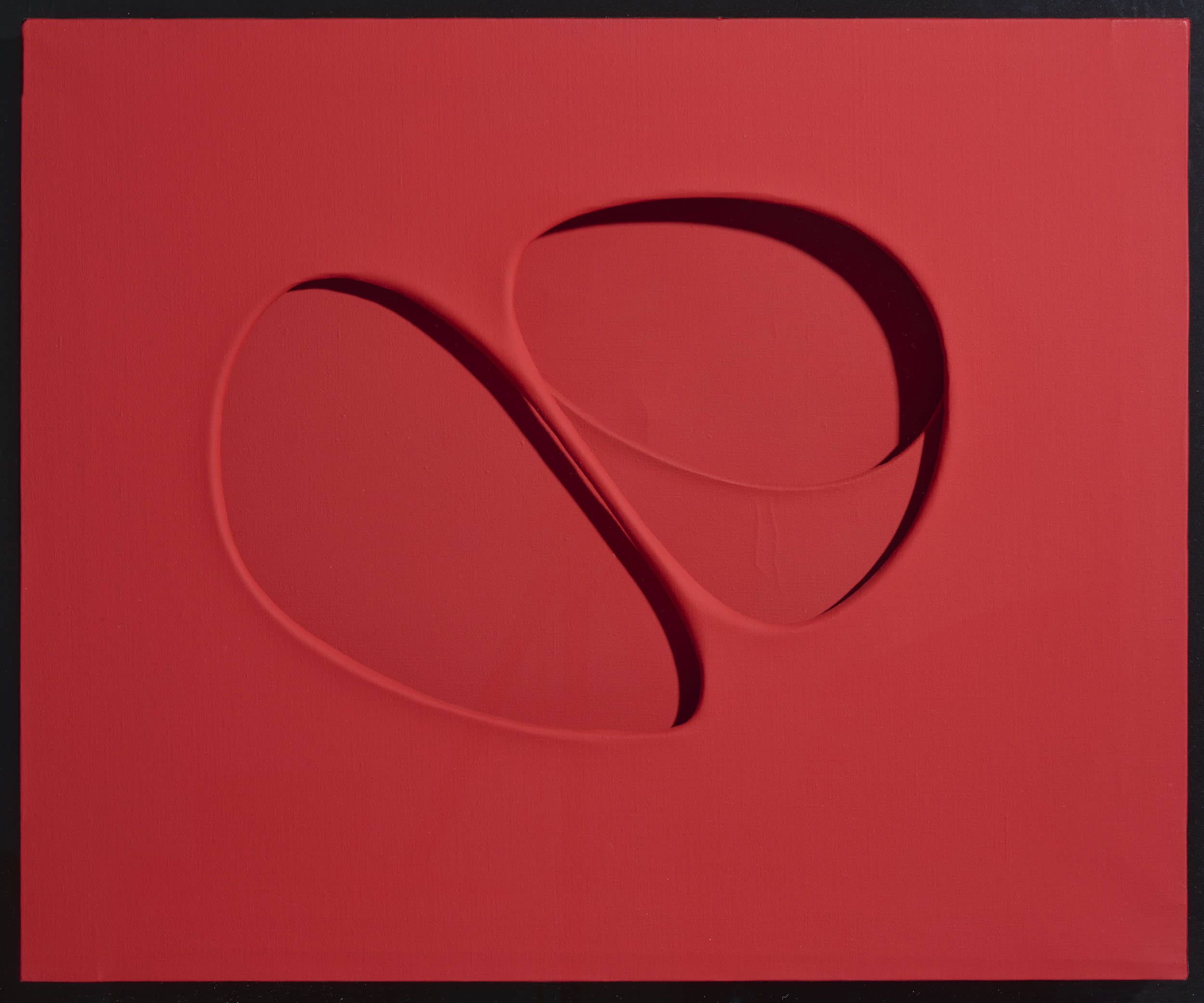
Intersuperficie Curva dal Rosso (Curved Intersurface from Red)
1962
Vinylic tempera on three superimposed canvases
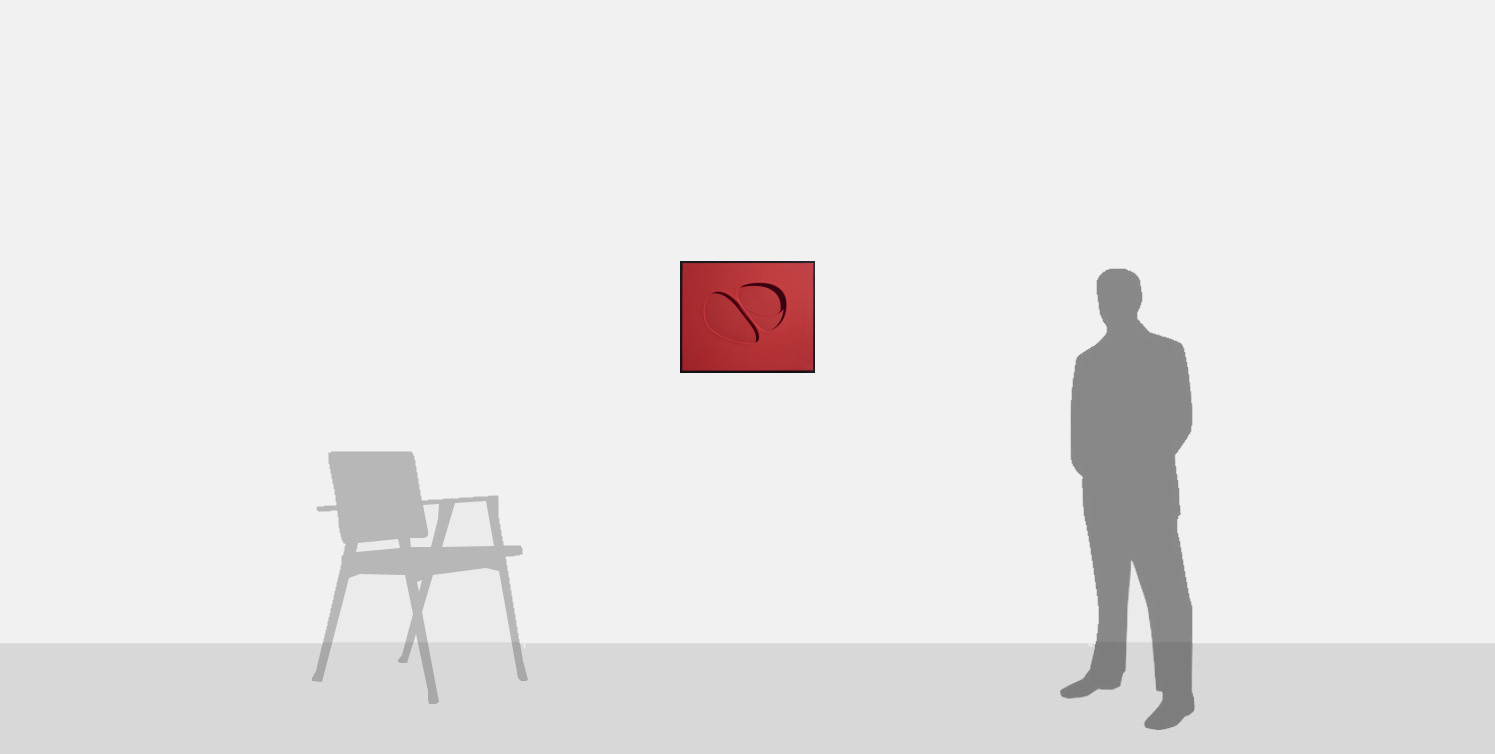
50 x 60 x 6.5 cm (19 3/4 x 23 5/8 x 2 1/2 in.)
Provenance
Private collection.
Literature
L. M. Barbero & G. Dorfles, Scheggi. La breve e intensa stagione di Paolo Scheggi, Parma, 2003, p. 123, PS021.
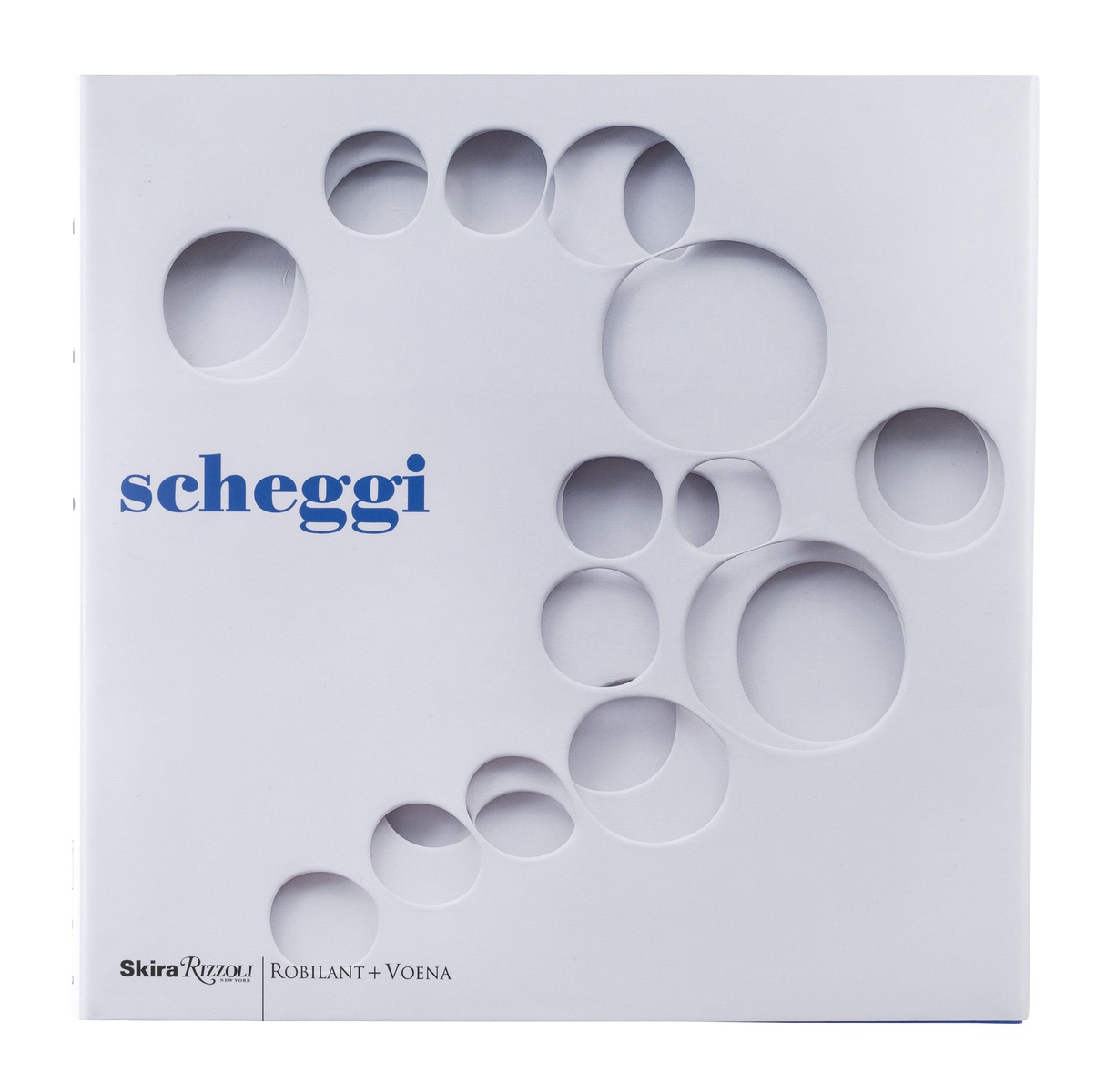
F. Pola, Italian Neo-Renaissance, Bonalumi, Scheggi, exh. cat. Robilant+Voena, New York, 2015, pp. 44, 60, fig. 13.
L. M. Barbero, Paolo Scheggi. Catalogue Raisonné, Milan, 2016, p. 221, no. 62 T 9.
Description
Scheggi’s dazzling work developed in postwar Milan, an effervescent and international artistic context. The milieu in which he worked was enriched by the crucial presence of Lucio Fontana, and by the experimental artists of a new Italian generation, especially those around the Azimuth/Azimut gallery and magazine (such as Piero Manzoni, Enrico Castellani, Agostino Bonalumi and Dadamaino), and those connected to the “Arte programmata” (such as Gianni Colombo). Scheggi’s work shares a like-minded desire to move beyond traditional painting into a new creative and perceptual dimension: objective, physical and spatial.
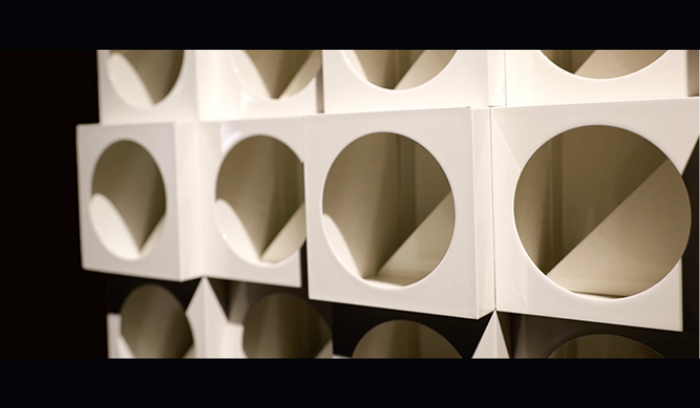
In 1962, after various three-dimensional mixed media experimentations, Scheggi developed his Intersuperfici (Intersurfaces), also called Zone riflesse (Reflected Zones): monochrome, three-dimensional works, which were created by fitting three canvases on top of each other. The works are characterised by their elliptical or circular apertures that create physically and optically complex spaces, aimed at investigating the dynamics of perception. In this spatial vision, Scheggi's work is also characterised by a wide interdisciplinary approach, intertwining his pictorial investigation with architecture, fashion, poetry, performance and philosophy.
Scheggi’s earlier pieces, like the present one, explore organically shaped apertures of various sizes rather than the staunchly modular forms that characterise his later work, marking a significant evolution in his practice and a maturation of his language. The artist described his own process thus, highlighting the inseparable link between his work and a total vision of perception understood as an instrument of knowledge: 'Theoretical process: the objects are square and derived from operations on the square. The space is divided by means of rotations of logarithmic spirals, logarithmic parabolas, modular and continual relations. The inscribed forms have elementary structures' ('Proposte sul cerchio. Dieci intersuperfici curve bianche', in Intersurfaces courbes–compositeurs spatiaux–un projets d’intégration plastiques, exh. cat. Galerie Smith, Brussels, November 4–21, 1964).
The artwork described above is subject to changes in availability and price without prior notice. Where applicable ARR will be added.
In 1962, after various three-dimensional mixed media experimentations, Scheggi developed his Intersuperfici (Intersurfaces), also called Zone riflesse (Reflected Zones): monochrome, three-dimensional works, which were created by fitting three canvases on top of each other. The works are characterised by their elliptical or circular apertures that create physically and optically complex spaces, aimed at investigating the dynamics of perception. In this spatial vision, Scheggi's work is also characterised by a wide interdisciplinary approach, intertwining his pictorial investigation with architecture, fashion, poetry, performance and philosophy.
Scheggi’s earlier pieces, like the present one, explore organically shaped apertures of various sizes rather than the staunchly modular forms that characterise his later work, marking a significant evolution in his practice and a maturation of his language. The artist described his own process thus, highlighting the inseparable link between his work and a total vision of perception understood as an instrument of knowledge: 'Theoretical process: the objects are square and derived from operations on the square. The space is divided by means of rotations of logarithmic spirals, logarithmic parabolas, modular and continual relations. The inscribed forms have elementary structures' ('Proposte sul cerchio. Dieci intersuperfici curve bianche', in Intersurfaces courbes–compositeurs spatiaux–un projets d’intégration plastiques, exh. cat. Galerie Smith, Brussels, November 4–21, 1964).
The artwork described above is subject to changes in availability and price without prior notice. Where applicable ARR will be added.