

Paolo Scheggi
b. 1940, Settignano, Italy
d. 1971, Rome, Italy
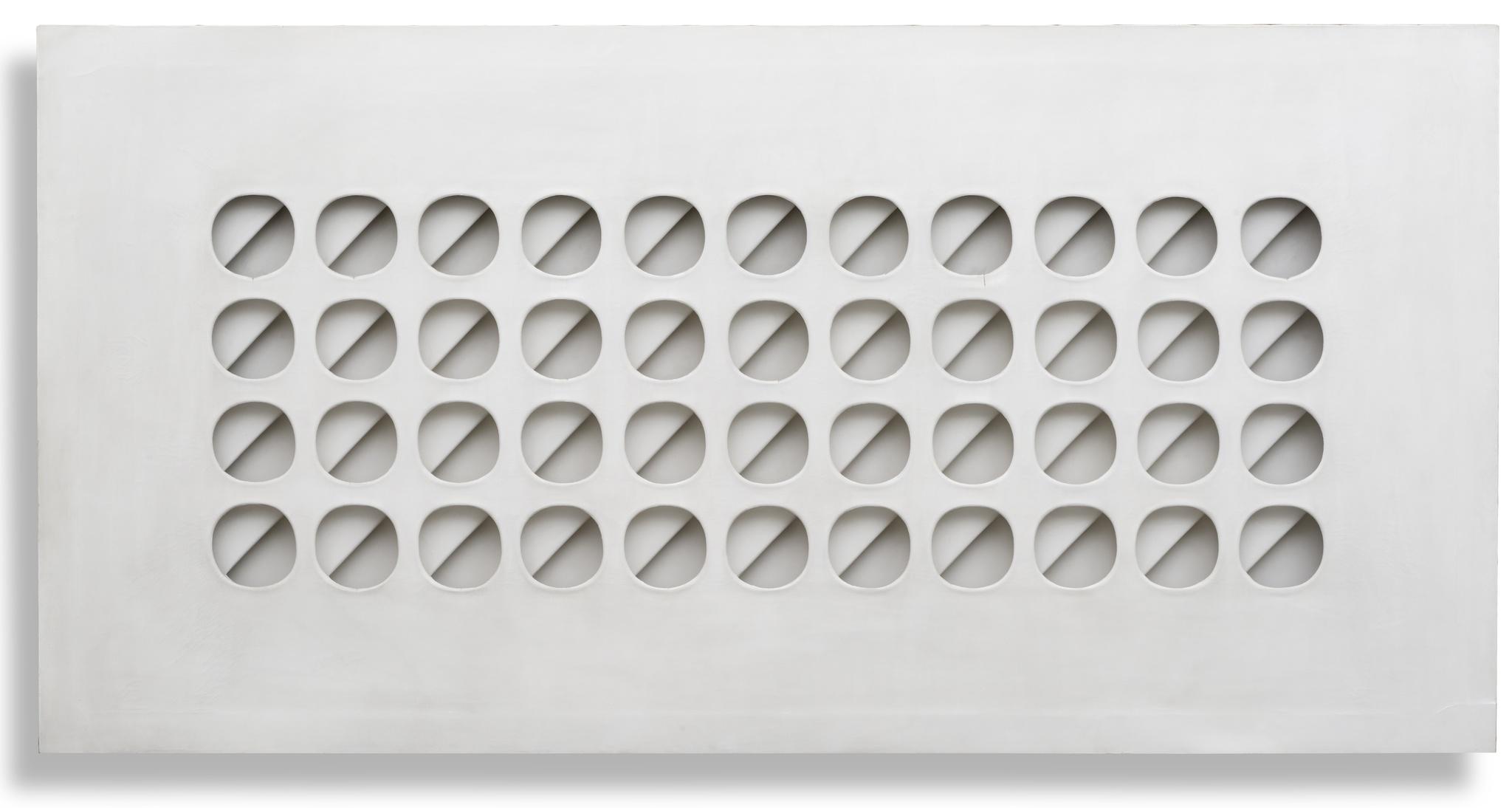
Intersuperficie Curva Bianca (White Curved Intersurface)
1966
Acrylic on three superimposed canvases
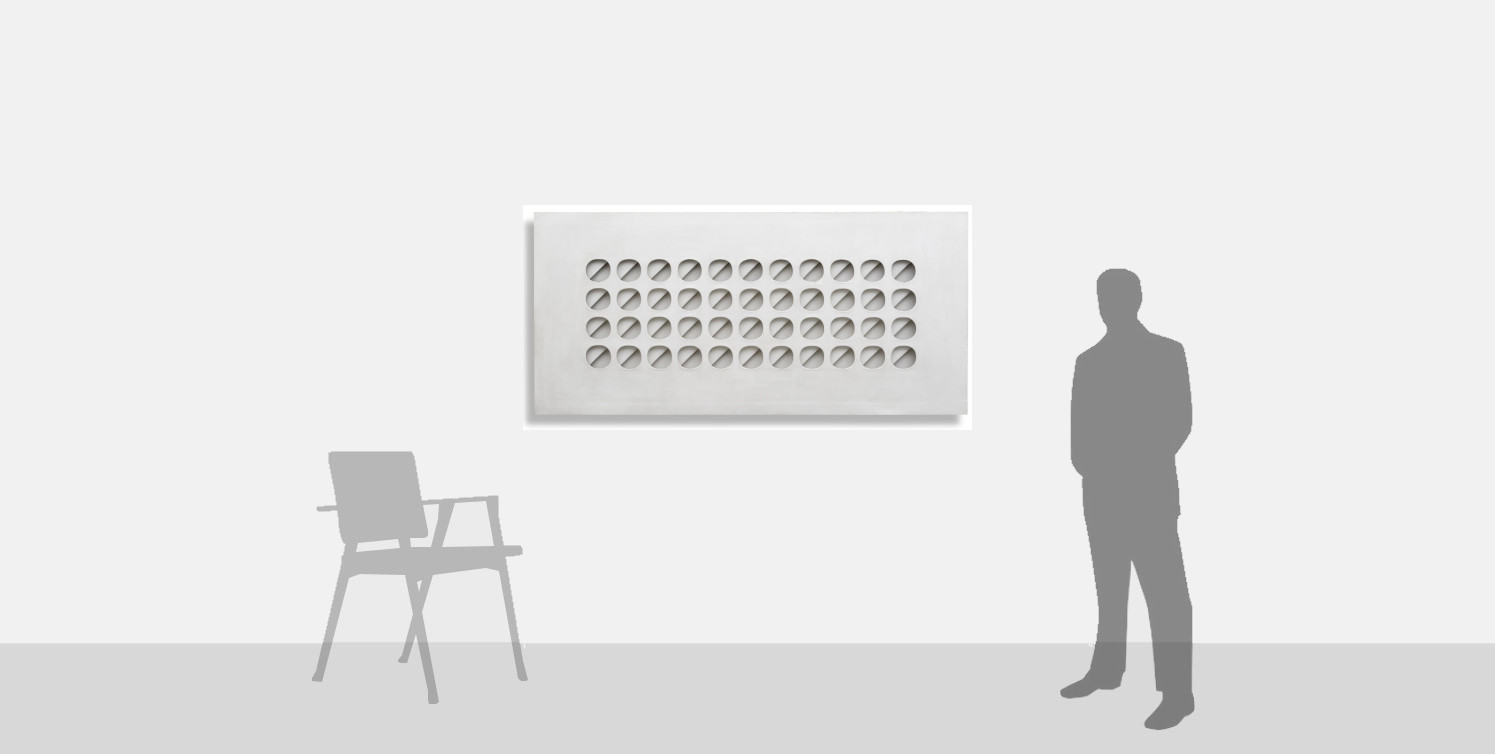
100 x 200 x 7 cm (39 3/8 x 78 3/4 x 2 3/4 in.)
Provenance
Gift of the Artist, 1969 (see fig. 4);
Private Collection, Italy
Literature
L. M. Barbero and G. Dorfles, Scheggi. La breve e intensa stagione di Paolo Scheggi, exh. cat. Galleria d'Arte Niccoli, Parma, 2002–3, p. 179, no. PS082.
L. M. Barbero, Paolo Scheggi Catalogue raissoné, Milan, 2016, p. 33, illustrated fig. 66 T 67.
Description
Pushing the boundaries of traditional painting on canvas
into new dimensions, the neo-avant-garde artist Paolo Scheggi was a key protagonist
of the Italian Spatialist movement. Born in Settignano near Florence in 1940,
Scheggi studied in London and then moved to Milan in 1961. He quickly joined
the vibrant young group of artists who, inspired by the work of Lucio Fontana,
were reshaping the traditions that had underpinned so much of Italian painting
over the previous centuries. Over the course of the next decade, Scheggi
engaged with an array of disciplines, from architecture, fashion, and poetry to
urban and theatrical performance. Yet his enduring artistic legacy depends upon
his pioneering investigations into the relationship between the surface and
depth of the visual field. In 1962, Scheggi developed his signature and now
famous Intersuperfici—monochromatic
surfaces, from canvas to coloured cardboard, Plexiglas, and aluminium, each
perforated with biomorphic or geometric openings and layered one on top of the
other.
Despite the brevity of his career, Scheggi gained significant international
recognition. In 1965, Scheggi had his first international exhibition, and
within a short time was involved in projects and shows in a number of countries.
He was invited to exhibit at the 1966 Venice Biennale, where he shared a room
with Agostino Bonalumi and showed a selection of his Intersuperfici.
Though his work had much in common with his Italian contemporaries, it also
paralleled trends practiced by the Zero Group artists in Düsseldorf, and by the
exponents of Op and Kinetic Art.
Dating from 1965, a key moment in the artist’s career, Intersuperficie Curva dal Rosso is a dramatic
work on a grand scale. Here, Scheggi has moved beyond the curved forms that previously
characterised his work, employing instead what would become his signature geometric
pattern of circular holes, creating a sense of spatial regularity. The repeated
curves of the round openings, contrasted with the sharpness of the diagonal
pattern created by the second canvas, emphasise the sculptural space Scheggi
sought to create within his paintings. The wide border surrounding the grid of
apertures acts as a visual pause, giving the work a notable balance between the
dynamism of the openings and the stillness of the framing canvas. Executed in a
vivid red, the painting is a masterwork of balance, tension and materiality,
exemplary of Scheggi’s small oeuvre.
The art historian Eugenio Battisti, along with the critic Germano Celant, was
very enthusiastic about Scheggi’s work. Battisti went on to acquire another Intersuperficie Curva dal Rosso,
which he presented as a gift to the Galleria d’Arte Moderna of Turin – a
work with a similar conception to the present painting.
Scheggi died very young, at the age of only thirty. Nevertheless, his
superimposed surfaces not only captivated audiences in 1960s Milan and further
afield, but with them he staked a claim upon the aesthetic ground zero to which
artists of his generation aspired.
The artwork described above is subject to changes in availability and price without prior notice.
Where applicable ARR will be added.