


Paolo Scheggi
b. 1940, Settignano, Italy
d. 1971, Rome, Italy
Inter-Ena-Cubo
1969
Enamelled aluminium
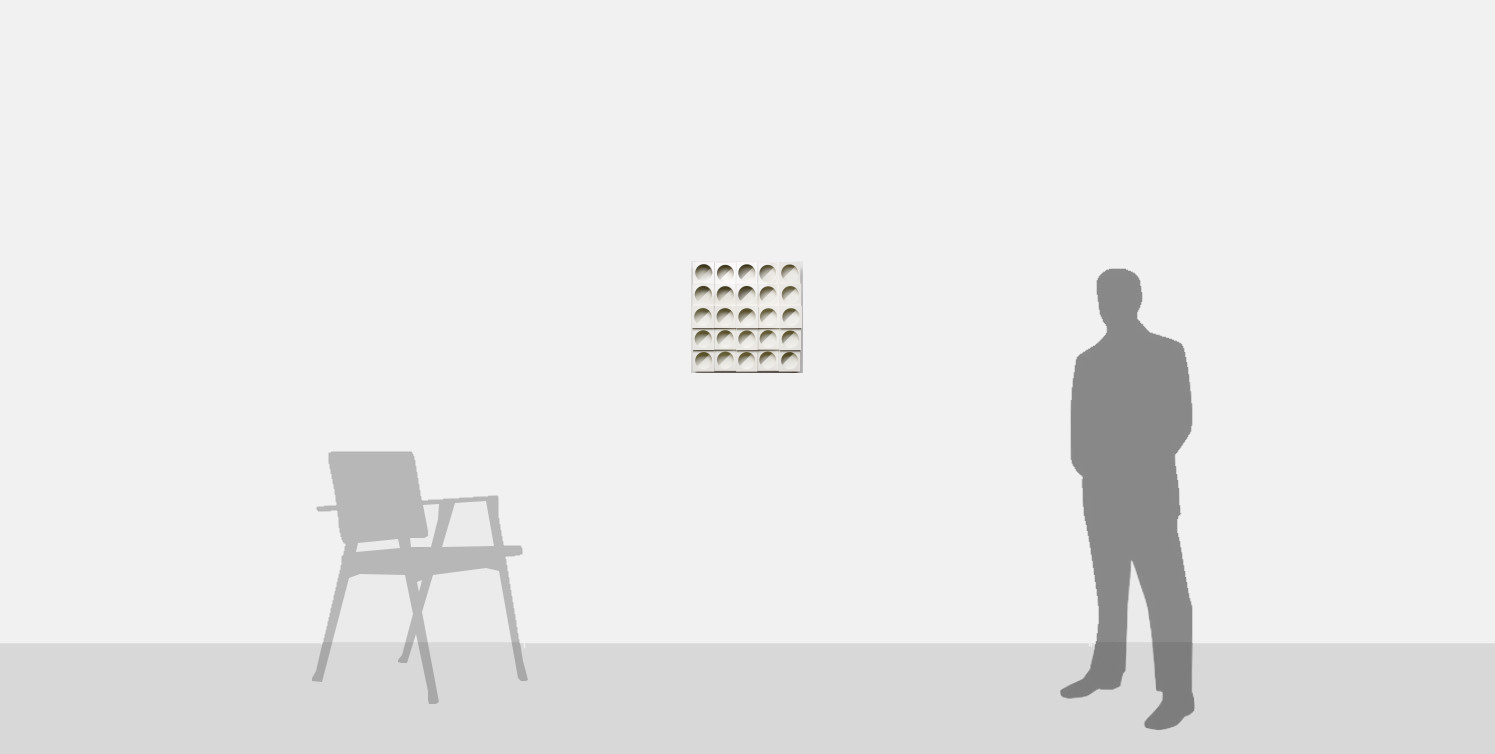
50 x 50 x 12 cm (19 3/4 x 19 3/4 x 4 3/4 in.)
Provenance
Private Collection.
Literature
L. M. Barbero and G. Dorfles, Scheggi. La breve e intensa stagione di Paolo Scheggi, Parma, 2002, p. 212.
F. Pola, Paolo Scheggi: the Humanistic Measurement of Space, exh. cat. Robilant+Voena, London, 2014, pp. 160, 161, 186.
L. M. Barbero, Paolo Scheggi: catalogue raisonné, Milan, 2016, p. 307.
Description
Paolo
Scheggi belonged to the neo-avant-garde of the 1960s, becoming was one of the key
protagonists of Spatialism. Born in Settignano near Florence in 1940, Scheggi
died at the age of only thirty in Rome in 1971. Over the course of a 'long' decade (1958–1971), he engaged with a
range of disciplines, from the visual arts to architecture, fashion, poetry, and
urban and theatrical performance. His investigations into the relationship
between the surface and the depth of the visual field built upon the example of
Lucio Fontana, who represented something of a spiritual father for the young
artist. In 1962, Scheggi developed his signature Intersuperfici (Intersurfaces), also called Zone riflesse
(Reflected Zones): monochrome, three-dimensional works formed of overlapping
layers of canvas pierced by biomorphic or geometric openings. His Inter-ena-cubi,
of which the present work is an excellent example, explored similar structural
forms, but used different and diverse materials, including coloured cardboard,
Plexiglas and aluminium.
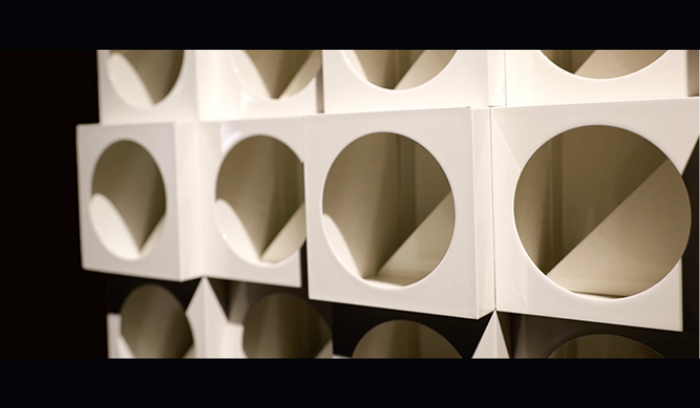
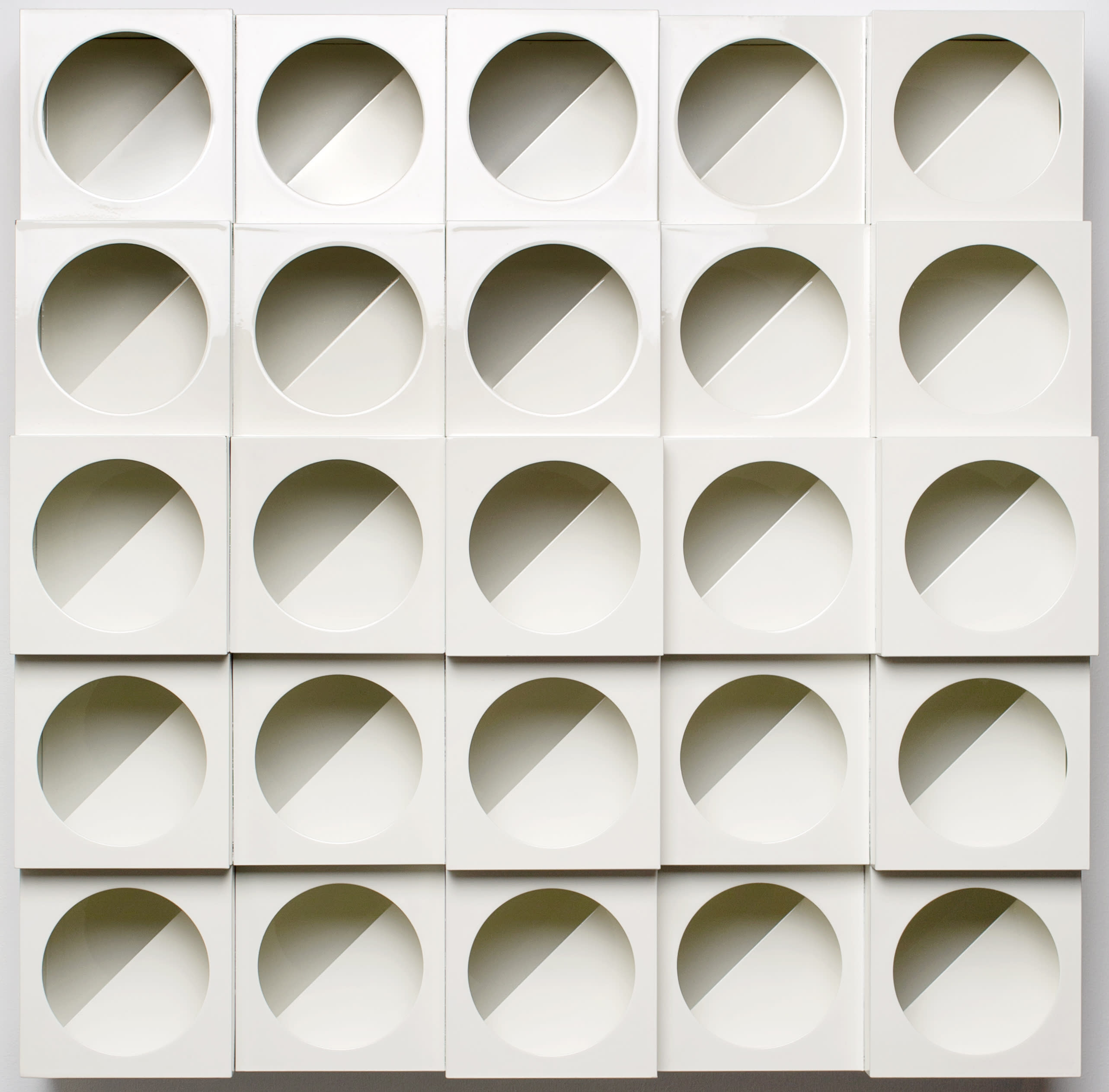
The present work, made in 1969, is composed of fifteen boxes of varying height
arranged in a perfect grid, each perforated at the top with a circle and inset with
a triangular element creating a diagonal line bisecting the inner compartment.
A complex calligraphy of partial eclipses and luminous reliefs writes itself
across the strict geometry of the enclosures and apertures. With its
sculptural, near-architectural surface, the work demonstrates intellectual and
aesthetic rigour, but at the same time, this calculated approach is playfully
disrupted by the way in which the exposed layers jostle together in an engaging
counterpoint of light and shadow, depth and contour. Within each circular
field, the three-dimensional echoes of shapes and planes construct a concrete,
structural interplay of perspective.
In the 1960s, Scheggi increasingly gained international recognition. Having
moved to Milan from his home in Tuscany, he quickly became part of a thriving
young group of artists who, inspired by Fontana, were reshaping the traditions
that had underpinned so much of Italian painting over the previous centuries.
In 1965, Scheggi had his first international show and within a short time was involved
in projects and exhibitions in a number of countries. Described by Fontana as 'a man of his time', Scheggi's work found much in common not only with his
Italian contemporaries, but with the parallel trends practised by the Zero
Group of artists in Düsseldorf, and by the exponents of Op and Kinetic Art.
Writing in 1966, the art critic Gillo Dorfles articulated his admiration for
the 'pittura oggetto' (picture-object), a term he applied to the work of
artists like Scheggi: 'On the one hand, painting tends to invade the field of
industrial design, to aim at absolute programming and processes permitting
replication in series of identical items. On the other, a deep-seated desire
exists—and will certainly exists for a long time to come—to preserve for visual
art, as at least a sector of it, the unique and precious character that can be
conferred by manual touch alone. It is the latter that informs the work of a
number of young artists active in Milan and distinguished for some years now by
their precise striving for compositional finesse and purity' ('"Object
Painting" in Milan', 1966, reproduced in Elementi
Spaziali, exh. cat., Galleria Tega, Milan, 2011, p. 62).
With his perforated, three-dimensional structures, inviting light and shade into their very depths, Scheggi staked a claim upon the aesthetic ground zero so resolutely cultivated by the artists of his generation.