
Jacques-Émile Blanche
b. 1861, Paris, France
d. 1942, Offranville-en-Caux, Normandy
Georges de Porto-Riche (1849–1930)
1889
Oil on canvas
100 x 65 cm (39 3/8 x 25 5/8 in.)
With frame: 114.5 x 80 cm ( 45 x 31 1/2 in.)
Provenance
From 1889, Auguste Rodin (1840–1917);
André Gide (1869–1961), Paris;
(his sale, Me Lieury, Cuverville-en-Caux, 12 October 1963);
André Bercowitz, Paris, acquired at the above sale.
Literature
J. Roberts, Jacques-Émile Blanche, Montreuil, 2012, p. 83.
K. Chrisman-Campbell in C. Miner, ed., The Elegant Man, from Van Dyck to Boldini, exh. cat. Palazzo Kiton, Milan, 2018, pp. 58–59.
J. Roberts and M. Molines, Jacques-Emile Blanche: Catalogue Raisonné, Montreuil, 2019, RM 1290.
Description
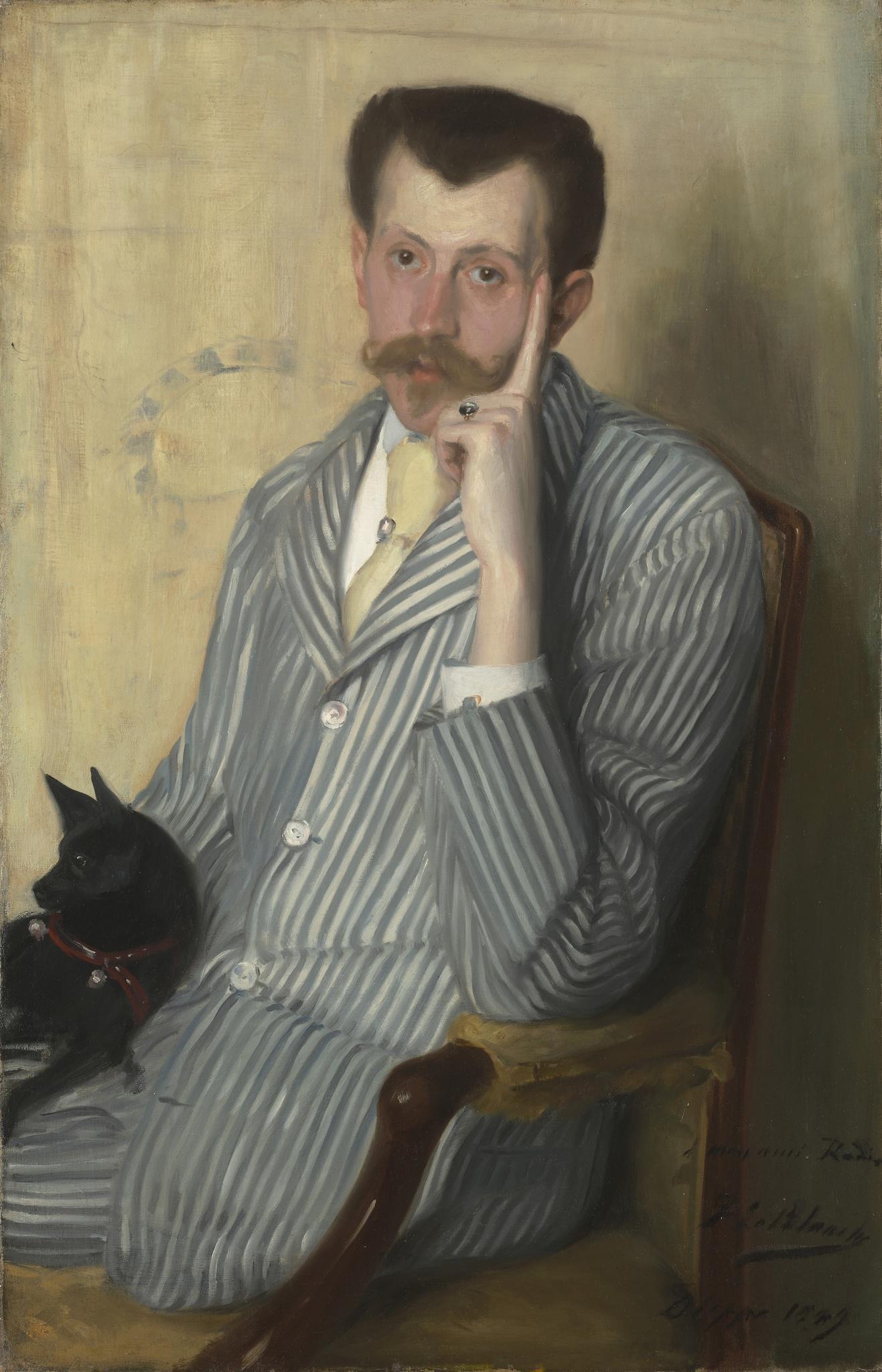
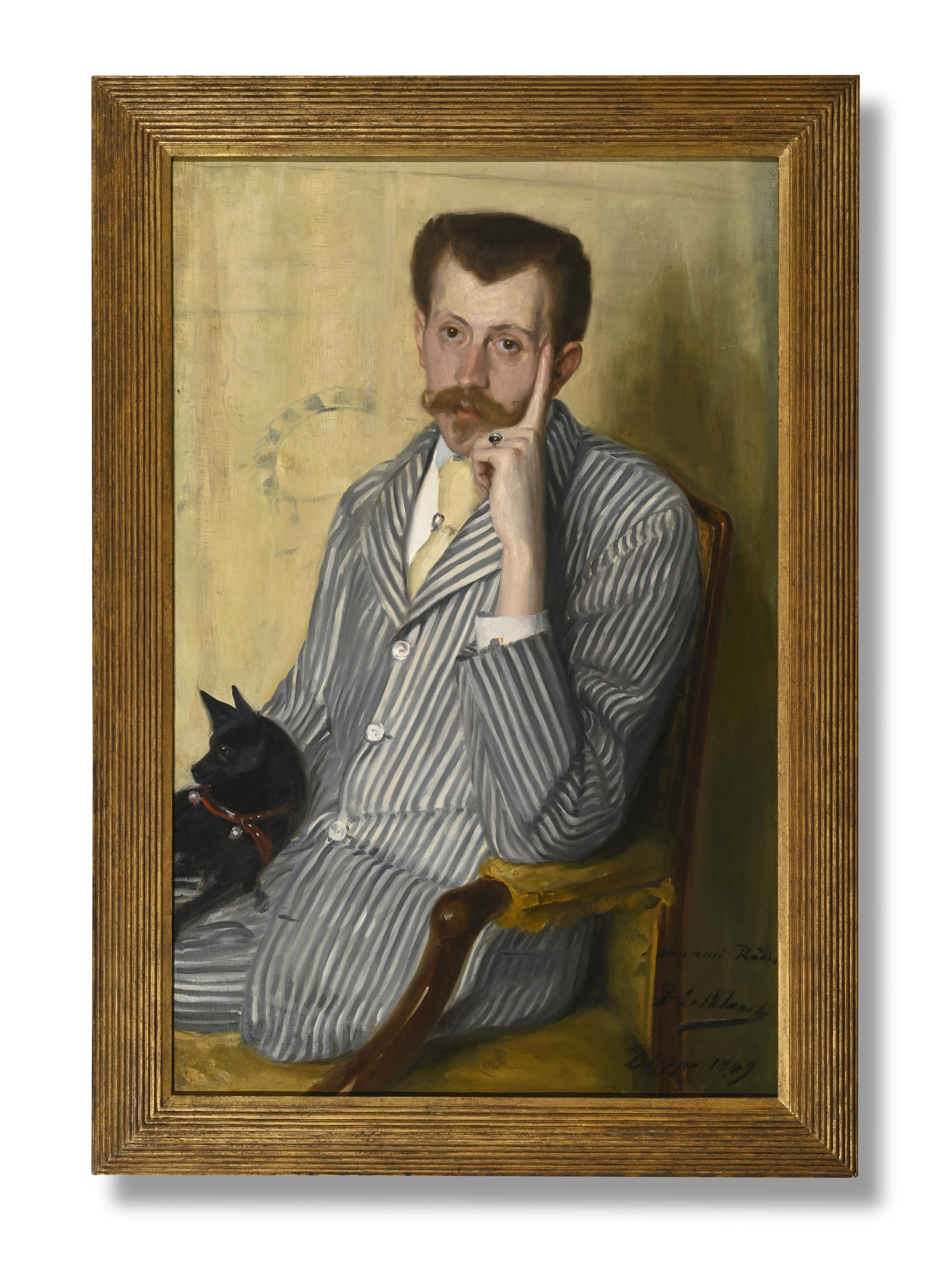
This compelling portrait by the French painter Jacques-Émile Blanche was presented as a gift to his fellow artist Auguste Rodin, whom he greatly admired. A depiction of the writer Georges de Porto-Riche (1849–1930), the portrait captures a sense of the artist’s fascinating social circle, as well as offering an acute observation of the sitter’s personality.
Though Blanche was, apart from a few lessons from the artists Henri Gervex and Ferdinand Humbert, largely self-taught, his loose brushwork and often muted colours have prompted comparisons with the work of Édouard Manet and Edgar Degas. In great demand for his portraits both in France and in England, Blanche also painted atmospheric landscapes which show the influence of the Impressionists in their energetic, spontaneous brushwork and more vivid colouring.
Blanche was at the heart of an extraordinary social circle, and his list of sitters reads as a summary of the period’s foremost thinkers and artists. His friends and social acquaintances ranged from the avant-garde artists and writers to wealthy and fashionable members of the haute bourgeoisie, and he moved with ease from one group to the other. A writer himself, one of Blanche’s closest friends was Marcel Proust, who helped edit several of his publications. He also knew Henry James and is mentioned in Gertrude Stein’s The Autobiography of Alice B. Toklas. Among the painter’s most famous works are portraits of Marcel Proust (private collection, Paris), the poet Pierre Louÿs, the Thaulow family (Musée d'Orsay, Paris), and the illustrator and author Aubrey Beardsley (National Portrait Gallery, London). Other sitters included the painter Mary Cassatt, the author James Joyce, the Pre-Raphaelite model Julia Stephen, the artist Edgar Degas, the composer Claude Debussy, the author Stéphane Mallarmé, the pianist Léontine Bordes-Pène, the authoress Colette, the novelist Thomas Hardy, the painter John Singer Sargent and Tamara Karsavina, who Blanche painted in the role of Stravinsky's Firebird.
Blanche’s father was a noted psychiatrist, and many of his patients, drawn from the upper echelons of society and artistic circles, went on to sit for portraits by his talented son. Summers were spent at the family home in the resort town of Dieppe on the Normandy coast, where Blanche painted the present portrait of Porto-Riche in 1889. Blanche also made a dramatic and highly skilled portrait in pastel of Porto-Riche around the same time, which can be found in an album of his paintings, published by Blanche himself (volume 1, folio 48).
Porto-Riche was a dramatist and novelist who became known for his shrewd psychological studies of conflicts between the sexes. Porto-Riche first came to public notice when La Chance de Françoise became the first of his plays to be produced at the Théâtre-Libre in Paris in 1888. Sensual love, studied in portraits of troubled marriages, is the subject of his best plays, Amoureuse (1891), Le Passé (1897) and Le Vieil Homme (1911), all of which examine the timeless triangle of wife, husband and lover. The so-called théâtre d’amour pioneered by Porto-Riche was highly influential and much imitated years to come, and he was elected to the Académie Française in 1923.
In Blanche’s portrait, the sitter is casually dressed in a two-piece lounge suit. His yellow necktie is anchored by an elegant stickpin which, along with his ring and cufflinks, complements the silver bells on his little dog’s collar. The lightweight suit with its pattern of nautical stripes would have been the perfect stylish leisure attire during summers in Dieppe. The painting captures a moment of introspection, perhaps even melancholy, with great intimacy. In a nonchalant pose, his head resting on his left hand, the writer looks out with a slightly unfocused gaze, as if lost in thought. The soft grey of his suit, and the muted yellows of his tie, the upholstered chair and roughly depicted wall, make for a calm and harmonious composition.
In 1904, Blanche painted the sculptor Auguste Rodin, showing him towering above his desk, his powerful hands resting on a book. Blanche held Rodin in great esteem and the latter was generous with his advice and support. An inscription on the present portrait reveals that it was a gift to Rodin, and it was later owned by the writer, André Gide, another of Blanche’s close friends.
Please note that the price and availability of the above work may change without prior notice.