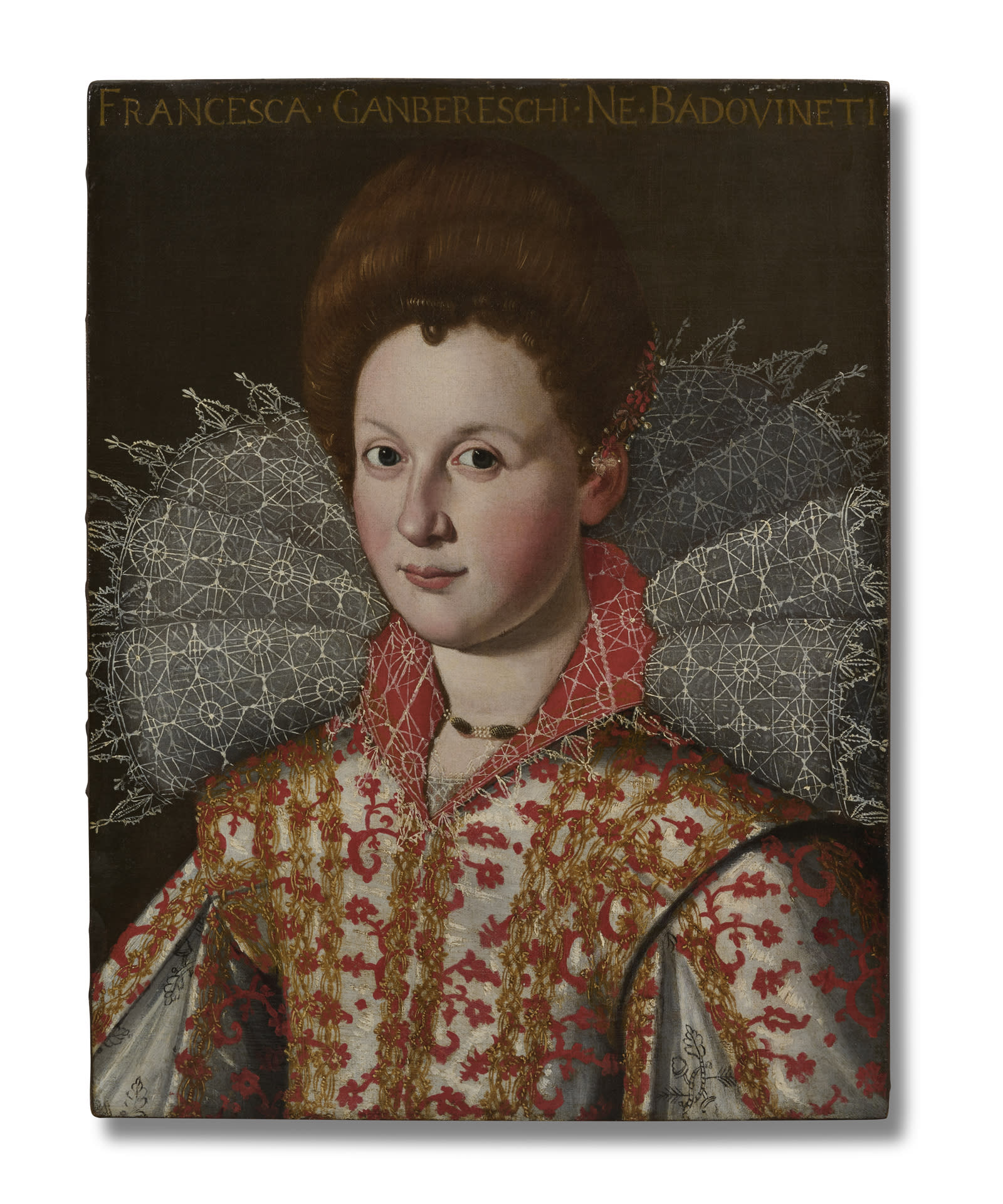




Santi di Tito
b. 1536, Sansepolcro, Italy
d. 1603, Florence, Italy
Francesca Gambereschi Baldovinetti
c. 1599–1603
Oil on canvas
59 x 45 cm (23 1/4 x 17 3/4 in.)
Provenance
Private Collection
Description
The Portrait of Francesca Gambereschi Baldovinetti belonged the Bellezze di Artimino, the collection of portraits of celebrated Florentine, Roman and Neapolitan ladies commissioned by Ferdinando de’ Medici for his villa at Artimino. The inventory of Artimino taken in 1609 following Ferdinando’s death records sixty-five portraits (with forty-two Florentine, seventeen Roman and six Neapolitan sitters). Fifty-seven of these are now in the collections of the Galleria degli Uffizi in Florence; together with the present work, other surviving members of the series include the Portrait of Isabella Buonguglielmi Montauti in the Musée de la Chartreuse, Douai and the Portrait of Ottavia Capponi Minerbetti and the Portrait of a Lady in the Musée de beaux-arts, Chambéry. The series comprises bust-length works (all of which are 58 x 45 cm), as well as contemporary copies of a number of those portraits in a three-quarter length format (69 x 45 cm). The present portrait is one of the original bust-length examples, generally considered to be superior in quality as well as the prototypes for the latter, larger canvases. The paintings we produced by a number of masters, and the present work has been convincingly ascribed on stylistic ground to Santi di Tito; compelling comparisons may be drawn between the present work and others by him, such as the portrait of Ferdinando’s wife, Christine of Lorraine, in the Palazzo Pubblico in Siena. Moreover, payments by Ferdinando to Santi di Tito prior to the painter’s death in 1603 have been linked to the Bellezze.1
Not a great deal is known of the sitter, Francesca Gambereschi Baldovinetti, save that she was married into an old and respected Florentine patrician family. Her marble-smooth skin and detailed costume, as well as the cool reserve with which she is shown gazing out of the painting, are all essential aspects of Florentine portraiture from the middle to the end of the sixteenth century, a style pioneered especially by Agnolo Bronzino, but carried forward in the work of his many followers, including Santi di Tito. Although Santi is best known as a painter of altarpieces and frescoes, a number of portraits survive, many of them showing members of the Medici family and other denizens of the Florentine elite. Perhaps the most striking element of the present portrait is the costume, especially the elaborate collar framing the sitter’s face, created from fine lace and heavily starched to achieve the desired height.
Though anticipating famous series like Sir Peter Lely’s Windsor Beauties of the 1660s, depicting the most alluring and powerful women at the court of Charles II, the Bellezze di Artimino series also reflects Ferdinando’s chivalric and libidinous impulses. Born powerful, rich and well-connected, Ferdinando de’ Medici (1549–1609) enjoyed two successful careers. A younger son of Tuscany’s most impressive early modern ruler, Cosimo I de’ Medici, Ferdinando was destined for the church, serving first a cardinal before succeeding his father second as Grand Duke of Tuscany. Having enjoyed relations with a series of mistresses throughout his clerical tenure, upon his marriage to Christine of Lorraine, which was celebrated with great pomp in Florence in 1589, he carefully assembled beautiful ladies for his wife’s retinue, with an eye towards making the court appear more noble and honourable. This idea also informed his later projects involving massed ladies: their well-documented rituals of promenading and riding in open carriages in the Florentine countryside, their depiction in the portraits for Artimino and in 1600, the fifty carriages of “gentildonne fiorentine e forestiere” (“Florentine and foreign gentlewomen”) accompanying Ferdinando’s niece Maria de’ Medici to her 1600 proxy wedding to Henry IV of France. This was not, however, unusual at the Medici court: for example, Ferdinando’s mother, Eleanor of Toledo, had been famous for surrounding herself with a coterie of beautiful young women. Thus, although Artimino was primarily Ferdinando’s domain, it is likely that his wife helped to select the gentildonne that would be displayed there, both in life and in portraiture, and indeed, documents relating to the series further suggest her involvement in its creation.2
1. The classic study on the series is Miles Chappell, “Le ‘Bellezze di Artimino’: una nota sull’attribuzione” Prospettiva 25 (1981), pp. 59–64.
2. Suzanne B. Butters, “Christine of Lorraine and cultural exchanges in the countryside: international customs in local settings” in Christina Strunck, ed., Medici Women as Cultural Mediators (1533–1743), Milan, 2011, pp. 111–47.
Please note that the availability and price of the work described above are subject to change without prior notice.