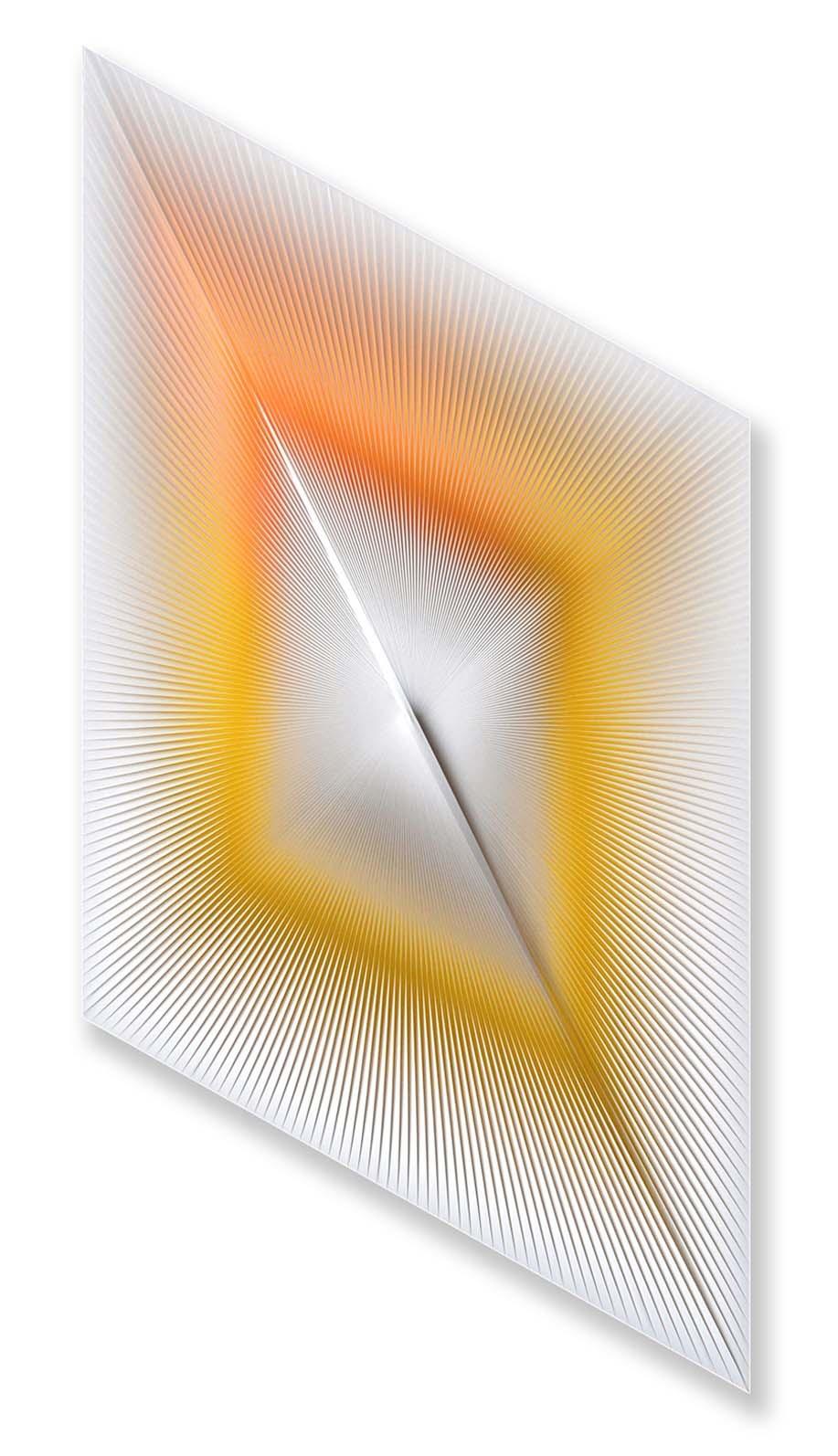


Alberto Biasi
b. 1937, Padua
Dinamica Ottico-Visiva (Optic-Visual Dynamic)
1961–71
PVC on panel
127 x 63 cm (50 x 24 3/4 in.)
Provenance
Galleria Niccoli, Parma.
Private collection.
Private collection.
Description
“I have always spoken of imagination of movement, more than just illusion…the shapes that appear to be moving in the majority of my works are in reality not in motion, even if the spectator imagines them to be. As Giulio Carlo Argan once said: I do gestalt art, the movement appears to be a visual phenomenon: each of my artwork is thought to sustain an energy that reveals the sublime capacity of the human eye and spirit to uncover them.”—Alberto Biasi
Born in Padua, Italy in 1937, Alberto Biasi has been widely recognized for his contributions to the development of kinetic art in Italy and abroad, both as a member of the Gruppo N and for his later works. A founder of the groundbreaking Gruppo N during the 1960s, Biasi was one of the first artists to experiment with the illusory possibilities that can be created through the mixture of traditional and non-traditional materials in works that straddle two- and three-dimensionality. Although the Gruppo N disbanded in 1967, Biasi continued to explore the concepts that first intrigued the group during this period over the course of his career. Explosions of vibrant color and astounding geometric precision, Biasi’s works explore optical effects through the use of everyday materials like PVC, mirrors, and light itself, inviting viewers to challenge their sense of their own perception: these stationary works of art seems to vibrate by the very act of viewing.
Biasi worked on two main series for decades. In the Torsioni, simple geometric forms are enlivened by a rhythmic procession of PVC strips, while in the Rilievi Ottico-Dinamici, to which the present work belongs, colorful explosions seem to vibrate through the grids of PVC that hover above painted designs. This sense of movement is key to the experience of Biasi’s work. Despite their relatively flat surfaces, these works are undeniably dynamic. Inspired both by his precursors, such as Futurism’s interest in movement, and the works of his contemporaries, Biasi’s work remains an intriguing development in the age-old quest to capture a realistic, and individualized, sense of movement. In Biasi’s case, the result is almost hypnotic.
A major figure in postwar Italian art, Biasi’s work has been exhibited in a number of important exhibitions at institutions worldwide, including the ground-breaking 1965 exhibition The Responsive Eye at New York’s Museum of Modern Art, and the 2014 exhibition AZIMUT/H: Continuity and Newness at the Peggy Guggenheim Collection in Venice. Other exhibitions include those at the Museo de Arte Contemporaneo, Buenos Aires, the Hermitage Museum Saint Petersburg, the Galleria Nazionale d’Arte Moderna, Rome, and the Hirshhorn Museum, Washington.
The artwork described above is subject to changes in availability and price without prior notice. Where applicable ARR will be added.
Born in Padua, Italy in 1937, Alberto Biasi has been widely recognized for his contributions to the development of kinetic art in Italy and abroad, both as a member of the Gruppo N and for his later works. A founder of the groundbreaking Gruppo N during the 1960s, Biasi was one of the first artists to experiment with the illusory possibilities that can be created through the mixture of traditional and non-traditional materials in works that straddle two- and three-dimensionality. Although the Gruppo N disbanded in 1967, Biasi continued to explore the concepts that first intrigued the group during this period over the course of his career. Explosions of vibrant color and astounding geometric precision, Biasi’s works explore optical effects through the use of everyday materials like PVC, mirrors, and light itself, inviting viewers to challenge their sense of their own perception: these stationary works of art seems to vibrate by the very act of viewing.
Biasi worked on two main series for decades. In the Torsioni, simple geometric forms are enlivened by a rhythmic procession of PVC strips, while in the Rilievi Ottico-Dinamici, to which the present work belongs, colorful explosions seem to vibrate through the grids of PVC that hover above painted designs. This sense of movement is key to the experience of Biasi’s work. Despite their relatively flat surfaces, these works are undeniably dynamic. Inspired both by his precursors, such as Futurism’s interest in movement, and the works of his contemporaries, Biasi’s work remains an intriguing development in the age-old quest to capture a realistic, and individualized, sense of movement. In Biasi’s case, the result is almost hypnotic.
A major figure in postwar Italian art, Biasi’s work has been exhibited in a number of important exhibitions at institutions worldwide, including the ground-breaking 1965 exhibition The Responsive Eye at New York’s Museum of Modern Art, and the 2014 exhibition AZIMUT/H: Continuity and Newness at the Peggy Guggenheim Collection in Venice. Other exhibitions include those at the Museo de Arte Contemporaneo, Buenos Aires, the Hermitage Museum Saint Petersburg, the Galleria Nazionale d’Arte Moderna, Rome, and the Hirshhorn Museum, Washington.
The artwork described above is subject to changes in availability and price without prior notice. Where applicable ARR will be added.