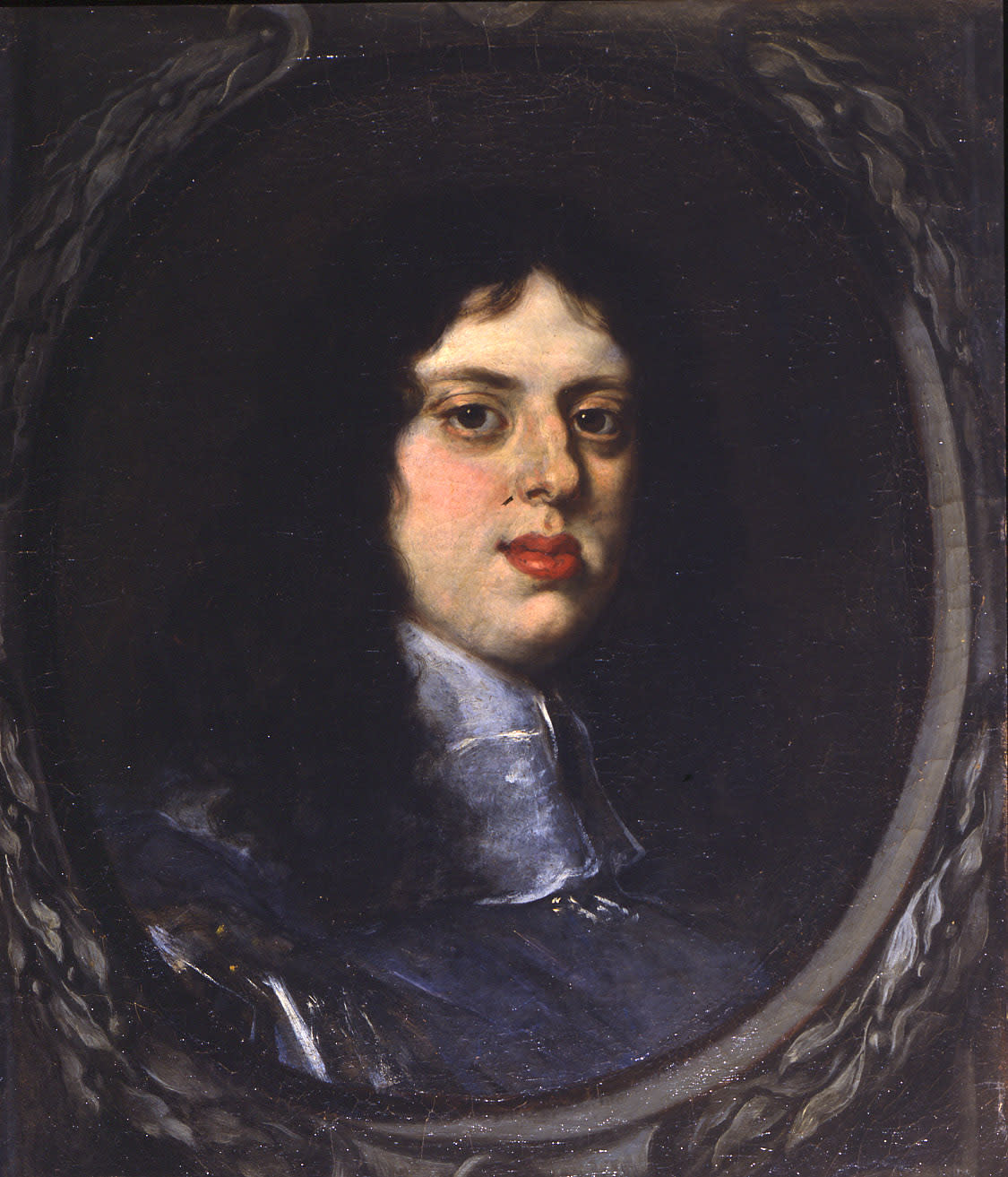

Baldassare Franceschini, called Il Volterrano
b. 1611
d. 1690
Cosimo III de’ Medici (1642–1723)
c. 1661
Oil on canvas
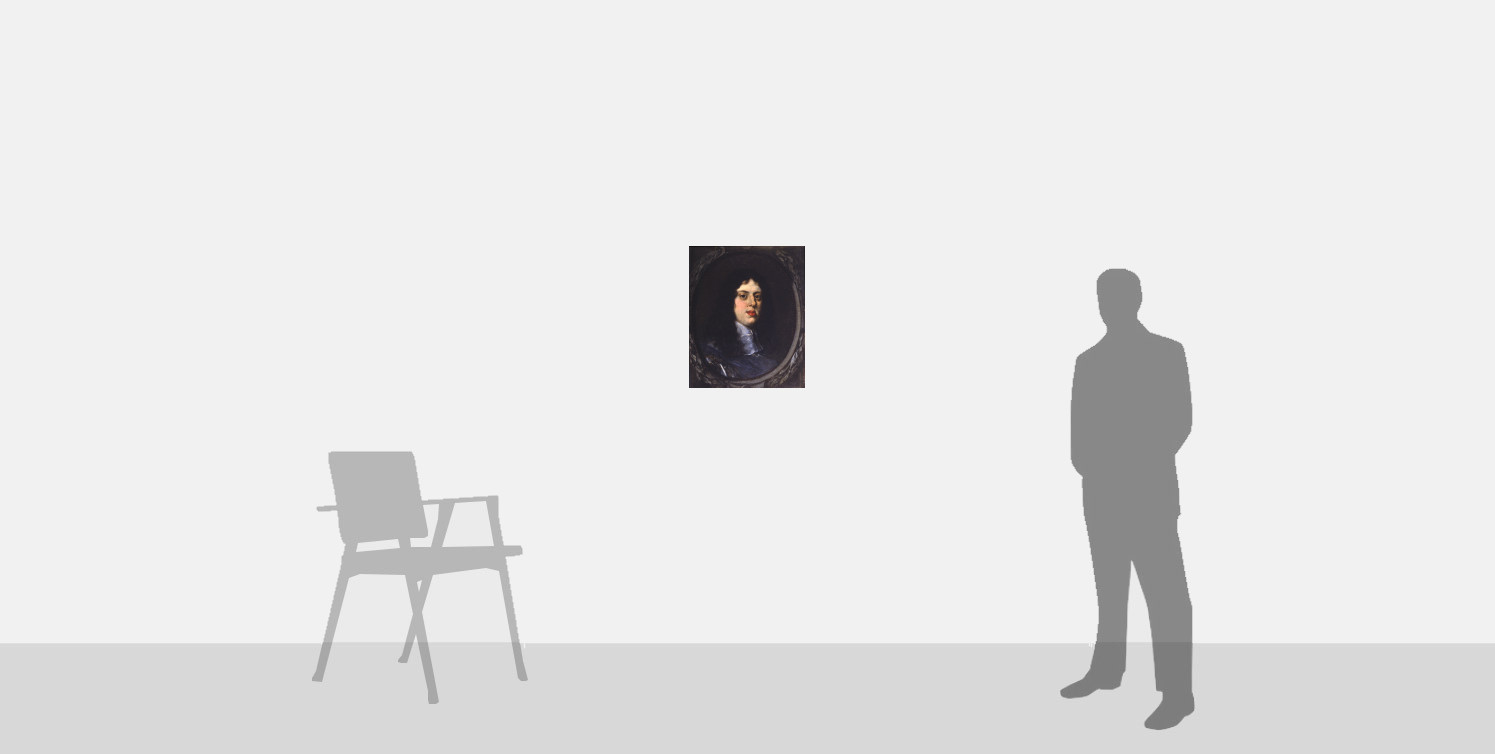
63 x 51.5 cm (24 3/4 x 20 1/4 in.)
Provenance
Possibly in 1715, Girolamo di Lorenzo Marsuppini (1648–1728), Florence,
Possibly by inheritance to his wife and in 1739, Maria Vittoria Zati Marsuppini (1693–1769), Florence,
From 2000, Koelliker collection, Milan.
Literature
(Possibly) Nota de’ quadri che sono esposti per la festa di S. Luca dagli Accademici del Disegno nella loro cappella, posta nel chiostro del Monastero de’ Padri della SS. Nonziata di Firenze per l’anno 1715, Florence, 1715. p. 14.
(Possibly) Nota de’ quadri e opere di scultura esposti per la festa di S. Luca dagli Accademici del Disegno nella loro cappella e nel chiostro secondo del Convento de’ PP. della SS. Nonziata di Firenze l’anno 1737, Florence, 1737, p. 13.
Description
The son of Ferdinando II de’ Medici and Vittoria della Rovere, Cosimo III de' Medici (1642–1723) ruled Tuscany for more than fifty years. Although his reign was a political and economic disaster, he was a great collector and patron of the arts, concerned to uphold the splendour of his court and the prestige of Medici patronage. The considerable breadth of his interests in learning and the arts was influenced by the example of his uncle, Cardinal Leopoldo de’ Medici, and by a brilliant entourage, which included his secretary Apollonio Bassetti and the Florentine dilettante architect Paolo Falconieri; the bibliophile Antonio Magliabechi was his librarian, and the archivist and biographer of artists Filippo Baldinucci worked at his court. His interests were also stimulated by his youthful travels; in 1656, at the age of fourteen, he visited Rome in the company of the artists Stefano della Bella and Livio Mehus. On 20 June 1661 his marriage to Marguerite-Louise d’Orléans was celebrated in Florence; the splendour of the accompanying festivities is preserved in Stefano della Bella’s etchings, Il mondo festeggiante. The marriage had been arranged by his father in the interests of an alliance with France, but the incompatibility of the couple was soon evident, and as a means of easing tensions Ferdinando sent Cosimo on further travels.
In 1664 he travelled in northern Italy; between October 1667 and May 1668 he travelled in Germany, where he met Queen Christina of Sweden in Hamburg, and in the Low Countries; from September 1668 to November 1669 he travelled in Spain, Portugal, France, the Netherlands, and England (where Samuel Pepys saw him in London and noted in his diary that he seemed “a very jolly and good comely man”). In England he acquired topographical paintings and sat for Samuel Cooper for his portrait in miniature (now Galleria degli Uffizi, Florence); in Leiden, he met Frans van Mieris. Cosimo acquired a lasting interest in northern European art and returned to Florence one of the most widely travelled princes in Europe. Through his agent, Francesco Terriesi, he ordered English books and paintings, including portraits by Sir Peter Lely (now Galleria Palatina, Palazzo Pitti, Florence) and a portrait of the Duchess of Portsmouth (Uffizi, Florence) by the miniaturist Richard Gibson. He subsequently commissioned many pictures from Van Mieris, including the Sleeping Courtesan (Uffizi, Florence), and in 1667 Van Mieris complied with Cosimo’s request for a self-portrait, which, together with those of Gerrit Dou and Gerard ter Borch, was added to the collection of artists’ self-portraits begun by Cardinal Leopoldo (all Uffizi, Florence).
Cosimo’s interest in the careers of Florentine artists is reflected by his establishment of the Accademia Fiorentina in the Palazzo Madama in Rome, where Florentine painters and sculptors trained under the direction of Ciro Ferri and Ercole Ferrata. This was crucial to the development of the Baroque in Florence, and the style of Cosimo’s court, which blends the grandeur and seriousness of the Roman Baroque with the Mannerist elegance of Florentine court art. Ciro Ferri was himself the most distinguished artist patronised by Cosimo and in 1675 began the renovation of the choir chapel in Santa Maria Maddalena dei Pazzi, Florence. Cosimo also commissioned from him fourteen tondi of the Stations of the Cross for the garden of the convent church of San Pietro d’Alcantra, near the Villa d’Ambrogiana, Montelupo (now Santi Quirico e Lucia all’Ambrogiana, Montelupo, and Victoria and Albert Museum, London). Cosimo sent both Giovanni Battista Foggini and Massimiliano Soldani to study in Rome; Foggini succeeded Pietro Tacca as court sculptor, and also directed the Galleria dei Lavori, creating those elegant works in hardstone with which the Stile Cosimo Terzo is particularly associated. Soldani, meanwhile, was trained for the mint, in Rome and Paris, and created outstanding medals, coins, and elegant small bronzes for the Medici court. The architect Alessandro Galilei, who served as Superintendent of Buildings, also enjoyed Cosimo’s patronage.
Among Florentine painters, Cosimo’s tastes ranged from Carlo Dolci, whose religious paintings presumably appealed to his extreme piety, and to the specialist in still-life painting Bartolommeo Bimbi. Bimbi’s paintings of specimens of flowers and fruits, painted to adorn the casino, La Topaia, at the Medici Villa di Castello, reflect the scientific interests that Cosimo shared with other members of his family, and which are also present in Bimbi’s portraits of natural curiosities, such as animals born with two heads. A similar taste for the bizarre attracted Cosimo to the eccentric works of the wax modeller Gaetano Zumbo.
As a collector Cosimo continued Cardinal Leopoldo’s work of systematizing the family collections, seeking to enlarge them wherever possible. The sculpture collection was reorganized, and in 1677 three classical statues, the Wrestlers, the Knife Sharpeners and the Venus de’ Medici were transferred to Florence from the Villa Medici in Rome. In 1681 Falconieri, acting as art agent, was urged to redouble his efforts to find more artists’ self-portraits, and a request to the painter Anton Domenico Gabbiani to inspect a picture by Veronese in Rome in 1718 shows that Cosimo’s desire to enrich the family collections continued into his declining years.
Cosimo was formally separated from his wife in 1674, and thereafter the public image of the increasingly corpulent Grand Duke was that of a deeply religious man whose piety became more pronounced. In Florence he introduced ever stricter legislation to impose his standards of morality on his subjects. In 1713 his son and heir Ferdinando de’ Medici died without issue, as a result of which it was foreseen that the male line of the Medici would terminate with his dissolute second son, Gian Gastone de’ Medici. Cosimo negotiated an agreement that the succession should pass to the House of Bourbon, though in the event it passed to the House of Lorraine.
The present portrait shows the young Cosimo, around the age of nineteen or twenty, dressed in armour, and was painted by Baldassare Franceschini, called Il Volterrano. Cosimo posed several times for Volterrano. A full-length portrait intended for Cosimo’s uncle, Cardinal Giancarlo de’ Medici, is noted both by Baldinucci and in a 1663 inventory of the cardinal’s collections in the Villa di Castello. Another portrait was exhibited in 1674 by the Accademici del Disegno of Florence at the exhibition held on the feast of San Luca in the cloister of the Santissima Annunziata. Yet another portrait with Cosimo depicted full-length in granducal robes on the dock at Livorno was recorded at the entrance to the Medici Guardaroba in March 1677 and is recorded again at the villa of Poggio Imperiale in 1780 (now Royal Castle, Warsaw).
The fictive stone laurel wreath framing the bust-length portrait of Cosimo finds an echo in the Medici portraits engraved by Adrian Haelwegh in the 1680s, as well as in the group published by Giuseppe Allegrini in 1761. A copy of the present portrait, from the Gagliardi collection, was auctioned by Jandolo & Tavazzi in Rome in 1908, with an attribution to Justus Sustermans (see clipping of the auction catalogue, Witt Library, London).
The inscription on the back of the present portrait places it in the collection of Maria Vittoria Zati Marsuppini (1693–1769) is abbreviated. Maria Vittoria, daughter of Gaetano Zati and Agnese Costanza Strozzi, was married in 1708 to Girolamo di Lorenzo Marsuppini (1648–1728). In his 1762 biography of Anton Domenico Gabbiani, Ignazio Hugford mentions a Flight into Egypt by Gabbiani which the dying Girolamo Marsuppini bequeathed to his wife, along with various other paintings, which she brought with her in 1729 when she married Filippo Cerretani. It is tempting to identify the present portrait with the “testa del Volterrano” loaned by Maria Vittoria to the Accademici del Disegno for their 1737 exhibition on the feast of San Luca in 1737, and indeed with one of the two heads by Volterrano loaned by her first husband to the 1715 exhibition.
Please note that the availability and price of the work described above are subject to change without prior notice.