Lucio Fontana
b. 1899, Rosario de Santa Fé
d. 1968, Comabbio
Concetto Spaziale (Spatial Concept)
1964–65
Glazed ceramic
37 x 28 x 25 cm (14 5/8 x 11 1/8 x 9 7/8 in.)
Provenance
Description
Lucio Fontana was one of the foremost artists of the twentieth century. While perhaps best known for his signature slashed canvases, his oeuvre is diverse and varied, and ceramic sculpture was a lifelong obsession. Fontana first presented his sculptures in the early 1930s at Galleria del Milione in Milan. These works hovered in between figuration and abstraction, but Fontana’s forceful modelling of his materials resulted in works which evoked a raw intimacy as well as the gestural nature of his artmaking. In 1939, Fontana returned to his native Argentina, where he remained until the end of World War II. Together with a group of acolytes, in 1946 he published the Manifiesto Blanco, which announced the birth of Spatialism, an entirely new philosophy of art. The following year Fontana returned to Italy, bringing with him the revolutionary energy of his Spatialist ideas. His first spatial sculpture was exhibited at the Venice Biennale in 1948.
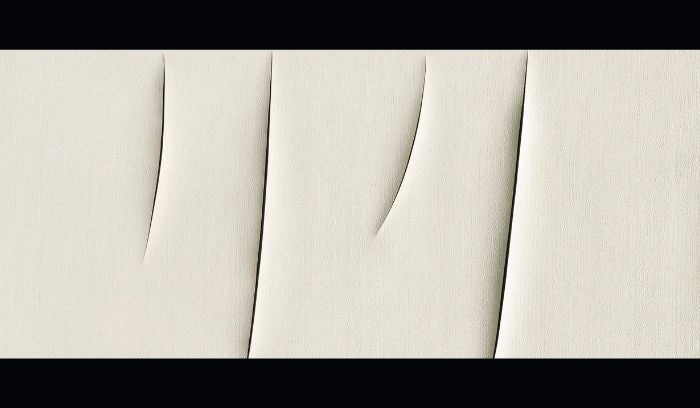
During the early 1950s, Fontana continued to sculpt in a semi-abstract, semi-figurative mode, exploring a wide range of subject matter, including religious themes. During the second part of the decade, however, his work in ceramic began to mirror that on canvas, which he had begun to mark with buchi (holes) and tagli(slashes). Departing from figuration in his sculptural practice as well, Fontana began to apply these gestures to elegantly simple cylindrical vases and various platters and plates.
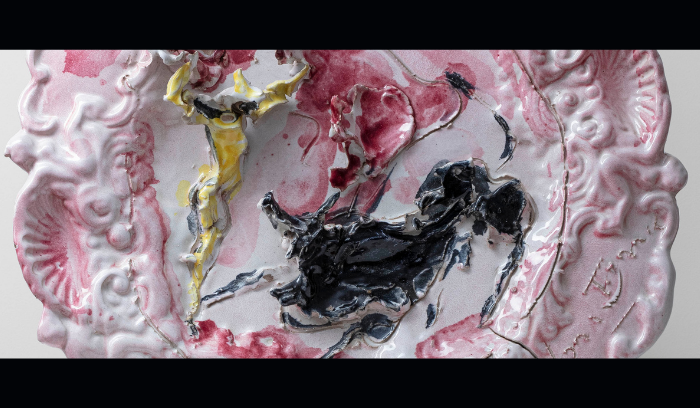
Between 1959 and 1960, Fontana created a new sculptural series entitled Nature. Moulded and shaped from terracotta into organic spheres bearing violent gouges and raw clefts, Fontana executed forty-four monumental Nature of which thirty-three were cast in bronze. In subsequent years, Fontana created more intimately scaled works like this one which resonate with the same constellation of ideas. With their spherical, planetary compositions, punctured like the surface of the moon, these sculptures evoke the mysterious and infinite dimensions of space. Smooth and shimmering with iridescent glazes reminiscent of the outer reaches of space, in the present work a crater appears and the material of the sphere itself seems to become a turmoil of magma— bursting the surface, the rupture leaves only darkness, nothingness, the beyond.
The artwork described above is subject to changes in availability and price without prior notice.
Where applicable ARR will be added.