Lucio Fontana
b. 1899, Rosario de Santa Fé
d. 1968, Comabbio
Concetto Spaziale (Spatial Concept)
1958
Incisions on paper laid on canvas
96 x 130 cm (37 3/4 x 51 1/8 in.)
Provenance
Literature
Description
“While working on one of my perforated canvases, I do not want to make a painting; I want to open up space, create a new dimension for art, tie in at the cosmos as it endlessly expands beyond the confining plane of the picture. With my innovation of the hole pierced through the canvas in repetitive formations, I have not attempted to decorate a surface, but, on the contrary, I have tried to break its dimensional limitations. Beyond the perforations a newly gained freedom of interpretation awaits us, but also, and just as inevitably, the end of art”.—Lucio Fontana, 1966
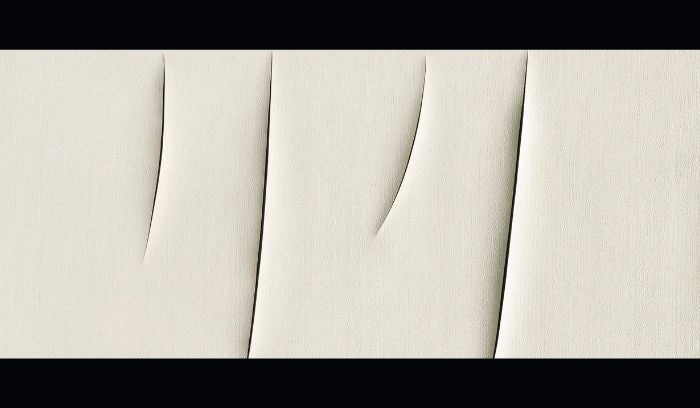
With its creamy white, papery surface penetrated by a host of brief but brutal incisions, Lucio Fontana’s Concetto Spaziale (1958) stands at a pivotal moment in the artist’s career. For some years before, Fontana had been working on a series he called Buchi, in which he punctured and perforated his canvases with patterns of holes, disrupting the two-dimensionality of the flat surface and exposing the limitless space beyond the picture plane. During the summer and fall of 1958, Fontana pioneered what would become his signature gesture—the slash—developing the eponymous series called the Tagli. Though eventually he would evolve his Tagli into boldly monochrome canvases marked by large and forceful vertical slashes chiefly done in pairs, trios, and quartets, in his earliest efforts he opted for larger numbers of small vertical, horizontal, and diagonal gashes arranged in constellations that almost seem to coalesce into or be in the process of diffusing away from coherent forms, as he had already done with his Buchi. The present work, pierced with small cuts in every direction, was executed during this fundamental period of transformation and experimentation as Fontana continued on his path to rupture both the concept and object of painting to create a fully spatialist art. Indeed, in both the Buchi and the Tagli, destruction and creation become one. Performed in decisive, theatrical, and irrevocable movements, the creative gesture instigating the slash forcefully breaks the traditional pictorial support and simultaneously opens up a new field of possibility in which invisible energetic forces collide in an inter-dimensional concetto spaziale (“spatial concept”), surrounded by an infinite void.
The present work is an unusual example of the artist’s use of carta telata, in which heavy paper was lined onto a fabric support subsequently mounted onto a stretcher. Fontana first deployed this technique in his very first Buchi, made in 1949, and between 1957 and 1960 he would add fifty further examples, including the present work, to his oeuvre. A one scholar has aptly observed “The most interesting and important examples of the carte date to 1958 and already point to towards the tagli begun months later: they display disconcertingly imprecise rents with torn edges. These edges reserve the energy of the hand’s physical movement much more visibly thank the—by comparison—aseptic cuts in canvas. In their peculiar mixture of direct and seemingly unpremeditated gestures, including automatic drawing, they resemble mental maps of agitation, excitation, exhilaration, and restlessness. The moment of force and aggression, notwithstanding Fontana’s subsequent denials of this impulse, is probably more palpable here than in any other work.” (See Pia Gottschaller, Lucio Fontana: The Artist’s Materials, Los Angeles, 2012, p. 32).