
Peter Wtewael
b. 1596, Utrecht, Netherlands
d. 1660, Utrecht, Netherlands
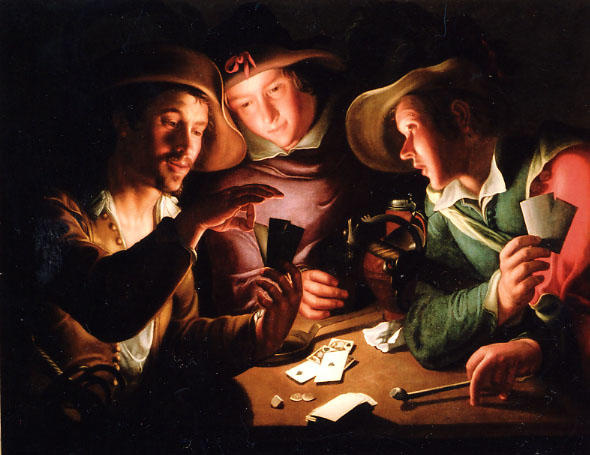
Card Players
1620s
Oil on canvas
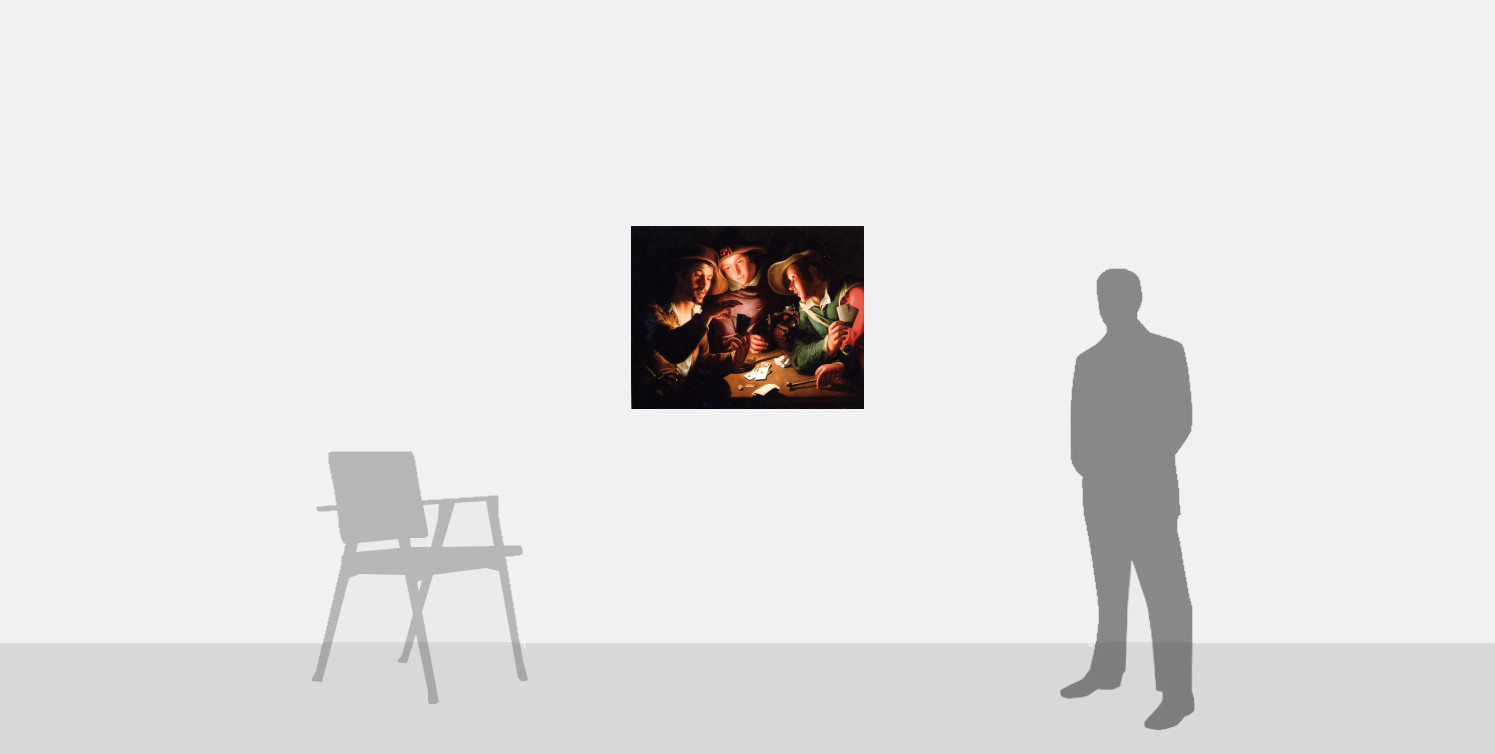
81.3 x 103.5 cm (32 1/8 x 40 3/4 in.)
With frame: 96 x 118 x 5 cm (37 3/4 x 46 1/2 x 2 in.)
Provenance
Galerie Pompadour, Cannes, 1950, as Gerrit van Honthorst,
Possibly Antonetta Wtewael and Johan Pater, the sister and brother-in-law of Peter Wtewael, in 1656,
Christie’s, Monaco, 7 December 1987, lot 11,
Koelliker collection, Milan.
Literature
Leonard J. Slatkes, 'Book Review: Benedict Nicolson, The International Caravaggesque Movement', Simiolus, 12, 1981–82, p. 178.
Christina J. A. Wansink, 'Some History and Genre Paintings by Willem van der Vliet', Hoogsteder-Naumann Mercury, 1987, p. 3.
Christina J. A. Wansink, 'Book Review: Anne W. Lowenthal, Joachim Wtewael and Dutch Mannerism', Oud Holland, 103, 1989, p. 176.
Description
Peter Wtewael was the eldest son of the Utrecht mannerist painter Joachim Wtewael, who was probably his first and only teacher. His relatively small oeuvre consists of five signed paintings and around twenty-five attributed works, and the dated paintings fall between 1623 and 1628. He apparently gave up painting around 1630, a fact that was lamented by Joachim von Sandrart in his Teutsche Academie, published in the 1670s: “One of his [Joachim Wtewael’s] sons practiced this profession also, and came along far in it, and would have achieved great learning in this art, if he had remained active in it.” Von Sandrart, who visited the Wtewael family studio in the 1620s and probably again on a short visit to Utrecht in 1637, informs us that Peter’s priorities came to focus instead upon the family flax business, in which they “made a fine fortune.” Later, the sometime artist also devoted his energies to municipal politics.
A version of the Card Players, then owned by the Trustees of the Arniston Estate, was catalogued by Benedict Nicolson in his monumental International Caravaggesque Movement of 1979 as “Circle of Trophime Bigot”. When Leonard Slatkes came to review Nicolson’s book a few years later, the present painting had resurfaced, and it was obvious that it was the primary version. As it carries the monogram “GH”, it appears that someone attempted to pass off the painting as the work of Gerrit van Honthorst at some point in the past. Slatkes correctly rejected the attribution to Bigot’s circle, but viewed the painting as the work of the little known Delft artist Willem van Vliet. Christina Wansink realized later that Van Vliet was not the author, and finally correctly attributed the Card Players to Peter Wtewael. Significantly, a “card player by P. Wttewael” (“Een kaerdtspeelder van P. Wttewael”) is recorded in a 1656 inventory of the possessions of Peter’s sister and brother-in-law, Antonetta Wtewael and Johan Pater. The painting compares best with Peter Wtewael’s signed Supper at Emmaus (Nasjonalgallerieet, Oslo), which shows similar half-length figures compressed into a narrowly confined space. In both works the figures are seated around a table, and an emphatic chiaroscuro is produced by illuminating candlelight, masked by a hand. Peter’s facial types and pudgy hands are indebted to his father’s style, while the use of artificial light is a modern Caravaggesque element, probably derived from Honthorst’s work. Indeed, beginning with his earliest dated composition, Christ Washing the Feet of the Apostles (Musée des Beaux-Arts, Arras), candles, torches, lanterns, and fires occur with marked frequency in Peter Wtewael’s small oeuvre. The artist was particularly fond of combining such artificial lighting with gesturing hands, as with the spread fingers in the Card Players, whose edges beautifully catch the light. Another feature indicative of Peter Wtewael’s authorship is the wonderful and distinctive use of colour in the present painting; the gentle mauve and the combination of bluish green with red and gold can be found in a number of his works.
Scenes with cards players were produced in the Netherlands as early as the sixteenth century, in works by artists such as Lucas van Leyden. Peter Wtewael’s painting, however, clearly follows the example set by Caravaggio’s Cardsharps (ca. 1594, Kimbell Art Museum, Fort Worth, Texas), in which three young men in fancy costumes are shown at half-length around a table. Card games were very popular in the Netherlands and were played in taverns and in the street but also in the homes of the upper-class and in court circles. However, Calvinist preachers and other moralists, criticized the pastime as a sinful pursuit, connecting it to sloth, greed, deceit, querulousness, and indecency. While in many scenes showing card players one of the parties is unaware that he is being cheated, Wtewael’s young men appear to be playing an honest game. Nevertheless, the figures, whose swords identify them as soldiers, are engaged in two decidedly sinful pursuits, drinking and smoking, and the latter in particular carried a connotation of vanitas in the seventeenth century. In the 1620s, when Wtewael painted this work, smoking was a relatively new phenomenon. While some emphasized the medical benefits of tobacco, smoking for pleasure was condemned and associated with drunkenness. Moreover, the fact that smoke quickly dissipates led some moralists to draw a comparison with the ephemeral nature of life; smoking was not known to kill you in the seventeenth century, but it was certainly nonetheless associated with death.
The artwork described above is subject to changes in availability and price without prior notice. Where applicable ARR will be added.
Traversi.
Additional Images
Gaspare Traversi