

Francesco Guardi
b. 1712, Venice, Italy
d. 1793, Venice, Italy
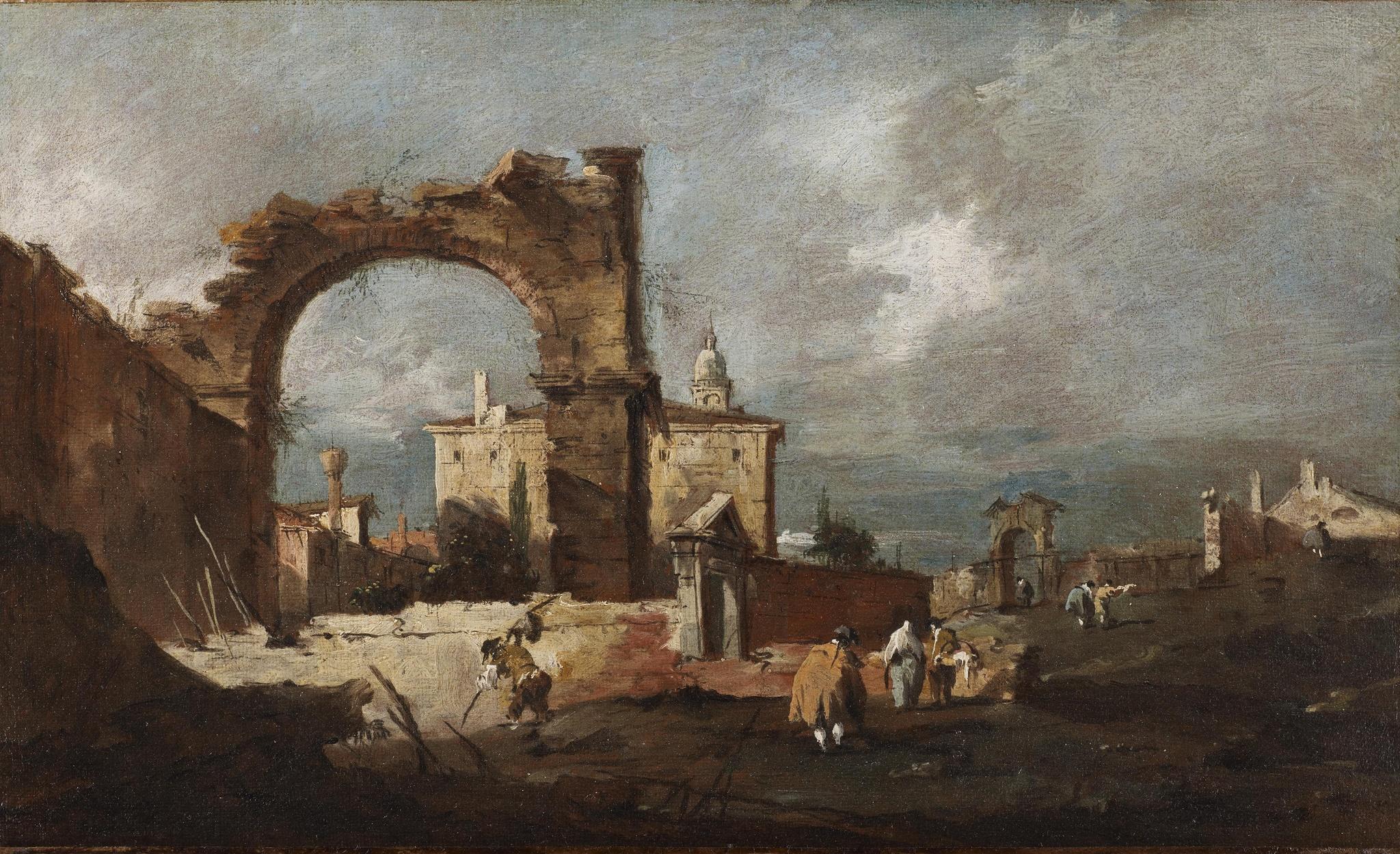
Capriccio with a Crumbling Arch and a Villa in the Background
c. 1770
Oil on canvas
30.5 x 50.5 cm (12 1/8 x 19 7/8 in.)
With frame: 45 x 66 x 6 cm (17 3/4 x 26 x 2 3/8 in.)
Provenance
with Knoedler Galleries, New York;
Chicago, Ernest Hamill collection (by at least 1937);
Chicago, Judith Hamill collection;
On loan to the Ackland Art Museum, North Carolina, 25th September 1977 – 24th September 1992;
Sotheby’s New York, 30th January 1997, lot 172.
Literature
J.L. Clarke Jr (ed.), Francesco Guardi, 1712-1793, exhibition catalogue, Springfield 1937, no. 10; R. Pallucchini, I disegni del Guardi al Museo Correr di Venezia, Venezia 1943, p. 56, n. 138; A. Morassi, Guardi. I dipinti, Venezia 1975, vol. I, pp. 280, 492, n. 987, vol. II, fig. 870; A. Morassi, Guardi: i dipinti, Venezia 1984, vol. I, pp. 280, 492, n. 987, vol. II, fig. 870.
Description
Together with its pendant, the Capriccio with bridges on a canal, the present painting was bought by Ernest Hamil, a Chicago collector, in the thirties of the last century, who lent the paintings to the Guardi exhibition held in Springfield in 1937.
Francesco Guardi painted different versions of this composition, all with slight variations: a first one, already published by Morassi, in the Galtrucco collection in Milan, and previously in the Crespi Morbio collection (fig. 1); a second one (fig. 2), not listed in the Morassi, has recently brought to our attention by Doctor Robert La France, director of the David Owsley Museum of Art, Ball State University, Muncie (Indiana), where the work has been kept since 1995.
The three canvases present vast uncultivated fields and different figures in the foreground; on the background on the right, nearby the remains of a wall by a large portal, is a rustic farmhouse. The Galtrucco version presents a small watercourse on the right, crossed by a little bridge, while darker tones characterize the Muncie version.
.
The preparatory drawing for this group of works (pen and watercolour on white paper, 190 x 262 mm, Fig. 2) is today kept in the Correr Museum in Venice; made with dark pen line drawing and black blurred shadings, this composition is under many aspects comparable to the capriccio in question.
Pallucchini chronologically places the work around the 1780’s; on the other hand, Morassi, based on the painting’s style characterized by intense chromatics and impetuous brushwork, believes the painting was made around 1760 and 1770, thus slightly anticipating the Pallucchini’s hypothesis. Conclusively, Pallucchini highlights how, he painting strongly recalls scenery elements of Canaletto’s etchings under the compositional aspect.
We would like to thank Doctor Robert La France for having pointed out the painting by Francesco Guardi of the David Owsley Museum of Art, Ball State University.