
Alighiero Boetti
b. 1940
d. 1994
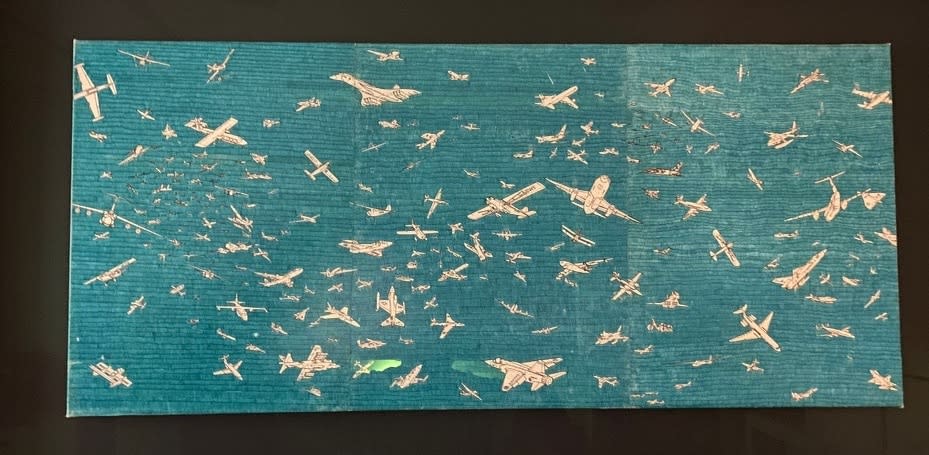
Aerei (Airplanes)
1983
Ballpoint pen on paper laid on canvas
36.5 x 82.5 cm (14 2/5 x 32 1/2 in.) (overall)
36.5 x 27. 5 cm (14 2/5 x 10 4/5 in.) (each)
Provenance
Private collection, Bologna;
(Il Ponte, Milan, 15 December 2020, lot 64);
Private collection.
Description
Boetti began his Biro series in the 1970s, using a ballpoint pen - a common, quotidian object - to fill entire sheets of paper with inked patterning. 'In his universe of meaning, ballpoint pens also served to dispel better the distinctive, unique, and inimitable act in the sea of collective and anonymous signs that is the basic intention of Boetti’s art, these works’ surfaces appear indented by commas, small white zones, each of which correspond to one of the letters of the alphabet, it is connecting comma and letter that the phrase the work conceals finally emerges. The simple mechanism of deconstructing language actually causes the rebirth of all languages, words, signs, painting and so on' (Giorgio Verzotti, Alighiero Boetti quasi tutto, exh. cat, GAM Bergamo, 2004, p. 67). Each Biro work contains panels executed by collaborators, often students, and most times a man and a woman. The Biro series might usefully be compared to the artist’s tapestries: the embroidery represents for an Afghan something similar to what the ballpoint pen constitutes for a Westerner, as both were media used by those communities uses to communicate and thus create expressions of collective memory.
The present work is moreover an example of the Aerei, ‘Airplanes’, series that Boetti began in 1977 in collaboration with the illustrator Guido Fuga. Here the ballpoint pen is used to delineate the air in which dozens of different airplanes fly, temporary and transient objects that may suddenly disappear beyond the frame, lost like Boetti in infinite possible journeys. The repetitive patterning of the Aerei embodies the beauty of the sense of limitless possibilities. The theme of time is also present, as the airplanes represent a meditation on the concept of movement and stillness through the human body and mind.